College’s Best-Kept Secret and How to Overcome It (I think)

Here are some reasons that I haven’t written in a while:

1) The next “favorite” on my list was favorite people, and when one really comes down to it, how does one write that entry? Could get a bit touchy, you know?

2) I’ve been working. Mopping floors and filing papers—quite enviable.

3) I’ve been writing. A little story for the new Mr. and Mrs. Upper along with the beginnings of something much longer.

4) I’ve been watching Good Mythical Morning.

5) I’ve been reading Suri’s Burn Book.

6) I’ve been slacklining. (Excuses are wearing thin at this point…)

7) Mainly, I just haven’t.

Before college the inhabitants of every corner of the earth converge to give you conflicting and vehement advice, but there’s one thing no one ever tells you. Unless you’re one of those mission driven people who gets an internship or works at a camp (and if you are, that’s fine, I still love you) then here’s college’s best kept secret: SUMMERS ARE WEIRD.

It goes like this. You come home and you think “Oh! I’m home! It’s summer!” and then you do nice home things and you go to work and you come home at the end of the day and you think “Oh! I’m home… Where is everyone? Oh. It’s summer.”

And that’s when it hits: you thought summer was going to be like partying inside of instagram, but it’s really more like sitting in your messy room looking at everyone else’s instagram, which you’re pretty sure (but not positive) that they’re all inside of partying without you.

So here’s some suggestions for my fellow weird-summer enthusiasts (or not so enthusiasts):

1) Read your summer books aloud: to your friend, to your cousin, to your teddy bear, to yourself.

2) Look up all those quotes whose origin you’ve never actually known, for that satisfying feeling of I-once-was-wrong-but-now-I’m-right.

3) Dry your laundry on the clothesline.

4) Go for a run in the heat, come home and say, “Welp, I did THAT.”

5) Turn halfway down the stairs into your regular hang-out spot.

6) Paint a room alone. Write secret messages in large letters then cover them up and giggle.

7) Try on old clothes and sit around in them for an embarrassingly long time.

8) Drive. Be loud in the car in whatever way you can think of.

9) Go to the farmers’ market on week days to make the venders feel loved.

10) Make lists. Surprisingly easy and surprisingly fun.

Do this and you will be left with a sore throat, extraneous knowledge, nice smelling clothes, a bunch of lists and no pictures or gas. Summer well spent.
Favorite Words

For years my favorite word has been quixotic. She’s a marvelous little heiress of a word. She didn’t have to make her own way in the world, work to build her own connotation. She’s named after Cervantes’ legendary windmill slayer, and the Oxford English Dictionary draws connections with the word vagabond. She sounds good too, like mint ice cream, and a loud, old-fashioned oath, and shuffly feet.

My other favorite words are stolen from others. In the play Wit the main character describes the first time she came across the word soporific in Beatrix Potter’s The Tale of the Flopsy Bunnies. (All the best words have stories, of course.) The little girl is fascinated to discover that “The bunnies in the picture are sleeping. They’re sleeping like you said, because of sop-or-fic. The illustration bore out the meaning of the word…just as he had explained it. At the time it seemed like magic.” And she moves from there onto John Donne.

There’s also the list from The Cozy Book. “Mumble, Scribble, Sandal, Muzzle, Alabama, Cuspidor and Orphan Annie, Pachysandra, Sarsparilla, Tusk and smug and fog, Galoshes, Ambidextrous, Henrietta, Amble, Dawdle, Wobble, Mosey, Listen, Cousin, (Close to cozy),Superstition, Baked Alaska, Dandelions, Hummingbirds, Busybody, Dillydally, Ali Baba—Cozy words.”

And just now flipping through the OED I found the word shriven. That’s one I haven’t known for long, but I love it. It sounds like it lives at the heart of everything truly good, and it does.

But I’ll tell you a secret. It easy to think of lovable words, but it is far easier to think of unlovable ones. Pull out your psychology textbook or your latest tax return or even your saved texts and you will find them: words which have had their livelihood confiscated. Words which are no longer permitted to mean anything to anybody, to be colored in some brave, bright or bilious way, but only to be a code, destined to be deciphered by the brain and summarily discarded. Most can be resurrected if one is willing to stop and eat them slowly, but some are quite dead and one must replace them with their first cousins. What follows is a post mortem.

UNNECESSARY (un-needful, not full of need, not desirous of action); FULL (abundant, fitting, “…it is fitting and right, its out constant duty at all times and in all places…”); TRANSCRIPT (across the written word, a ship skimming over ink to deliver the message, the meaning, the truth); LIKE (bearing a likeness to, as He bore our griefs and carried our sorrows, we are to bear likeness to Him); COMMON (as in the Book of Common Prayer, and Aaron Copland’s Fanfare for the Common Man, the commonalities which bind us); ORIGINALLY (beginning, birth, that from which we inevitably derive our meaning); DEMONSTRATION (manifest action, letting words live, living oneself); SECURE (do not think of safety, but why you desire safety, of what and for what?) GRADUALLY (gradient, sloping, speeding down a grassy hill not so gradually after all); CONFIRM (with assurance, understanding, a setting of records); PREVIOUS (before, progenitor, parent to the now); COMPLETE (“He said, ‘It is finished!’ And bowing His head He gave up His spirit.”)

It is the connotation which makes all the difference, you see. We need denotations to communicate, connotations to do everything else, to express.  A word without connotation has, as yet, no color. It has not lived. Bathroom for example, means simple body functions to most of us, but really it’s the sanctuary of the bathtub, the place of solitude and hour-long wonderings. (I planned this entry in the bath.) Also, my grandparents use the word costly instead of expensive, and I find it vaguely enchanting. What does expensive mean anyway? Out of thoughtfulness? I like taking words apart and putting them back together and seeing how much bigger they become. It’s filling, satisfying, right.

For real, thirst-quenching language here is a sonnet from my favorite word dismantler, stitcher, piler and occasional word-welder, Gerard Manley Hopkins:

As kingfishers catch fire, dragonflies draw flame;

As tumbled over rim in roundy wells

Stones ring; like each tucked string tells, each hung bell’s

Bow swung finds tongue to fling out broad its name;

Each mortal thing does one thing and the same:

Deals out that being indoors each one dwells;

Selves—goes itself; myself it speaks and spells,

Crying Whát I dó is me: for that I came.

I say móre: the just man justices;

Keeps gráce: thát keeps all his goings graces;

Acts in God’s eye what in God’s eye he is—

Chríst—for Christ plays in ten thousand places,

Lovely in limbs, and lovely in eyes not his

To the Father through the features of men’s faces.

Favorite Clothes

Sometimes people give me old clothes. I really like that. They tell me “This just looked like Alice,” which is flattering. Apparently I have a style. I am distinctive.

But then sometimes, I look closer at whatever they’ve given me and I wonder, “Really? That screamed my name to them from the back of their closet? Or did they just think ‘Oh. A dress. Alice wears dresses. She’ll take it.’”

Because I’m that girl. I’m a take-that-last-cookie-so-you-can-wash-the-container and take-that-dress-I’m-sure-I’ll-wear-it-tomorrow kid. I cannot resist good clothes. I avoid going to Goodwill when I’m broke because it makes me sad, and I never even look at stuff retail anymore because I get so indignant that I’m actually being charged for it.

So maybe what I end up with is a little eclectic. This is not to say, however, that I don’t have opinions. I have lots of them. Most of them are about things I love, but there are a couple strong negative ones, which I think I’m going to go ahead and share. This is the internet after all. It’s time I offended somebody.

Uggs are ugly. This should not need to be said. They are even uglier when stained with road salt. And ugliest when worn with basketball shorts, as I saw a man do in Long Beach a couple years ago.

Do not wear cargo shorts. Ever. Please don’t even ask about cargo pants. The only legitimate excuse I can come up with for such behavior is if you use all of those pockets on a regular basis, in which case, you look truly strange, but more power to you.

Maybe you think you don’t care about clothes. This entirely untrue. Even my little brother cares, evidenced by the fact that he stubbornly refuses to wear the wonderful bomber jacket my mom got him a couple years back. What you wear matters. I don’t really mind too much that he won’t wear it though, because that means I get to.

In other coat news, more men should wear pea coats. I know women are attempting to dominate that market now, as they do almost everything, but they were originally worn by sailors. So if you want them, which you should, take them back! Don’t be afraid.

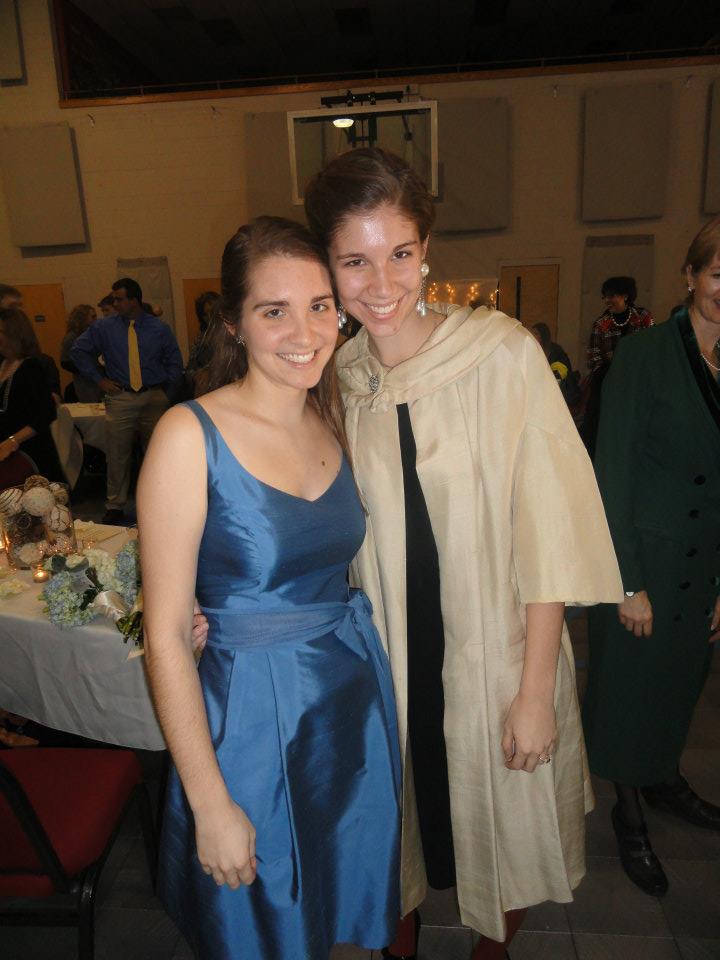
Then there’s the marvelous silk one from my Grandma’s closet which I’m only just now beginning to gain confidence about. I did wear it to a wedding, though.

Image

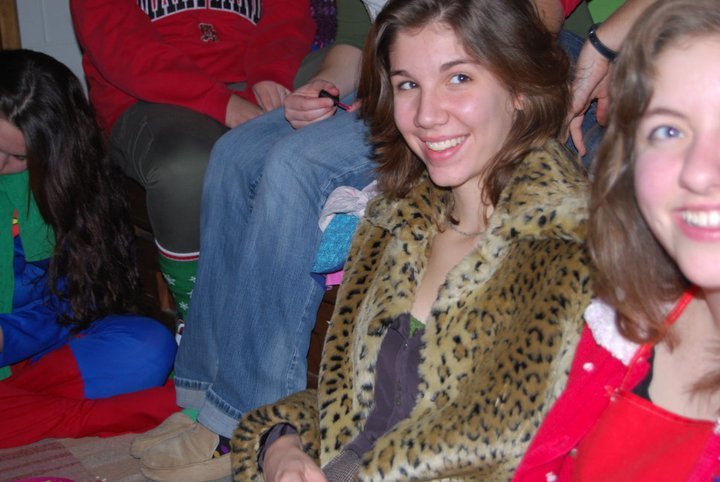
Final coat of note: my leopard fur (faux.) My Grandma and my cousin have matching ones, and I like to wear mine to entirely inappropriate occasions, like a low-key hall Christmas party.

Image

If a certain piece of clothing is my favorite, I will wear it nearly anywhere. This includes my polka-dot dress which I wore to pack up last year, and my eyelet lace graduation dress which I nearly ripped playing Frisbee a few weeks back. Oops.

Image

There’s also the brown leather and black suede skirts which I found with Hannah at Goodwill at different times. The suede particularly tends to show up in all sorts of odd places.

Image

And the hound’s-tooth jumper that used to be my aunt’s has run the gamut from Italy to Storytime.

Image

Then there are sweaters. Sweaterssweaterssweaters. Big, cozy, versatile sweaters. Here is a sampling of my favorites:

Black, courtesy of United Airlines, for not swimming:Image

Green, the one Emily Van Vranken loves, for wandering:Image

Orange, cashmere for fall, for crowded couches:

Image

Dad’s, for lazy days and flat cakes:

Image

And blue, my favorite, for pizza and everything else:

Image

I’m also a huge fan of anything with a waist. (I assume we all know what a waist looks like…) They are the key to success. So get thee some belts and high-waisted skirts and maybe even some high-waisted pants, and have at it!

Then there’s Family Pantry gear. Obviously. (Kevin is spending the summer with me, if anyone wants him.)

Image

I like clothes that remind me of people I love (i.e. everyone above). Maybe that’s really why I love hand-me-downs so much. They come with people and stories attached. They come loved and lovable. It is easy to forget that they’re factory made. I do care how they look, but maybe not quite as much as I like to pretend I care. Because sometimes I reserve the privilege to unapologetically wear something really hideous. Just because it sometimes makes a bad day better.

Image

Favorite Books

Just now I had the great pleasure of staring at my bookshelf for a couple minutes, deciding what to write to you about. I’ve had these shelves since Mary and I moved into this room when I was about five, and they sag a little with an assortment of classic literature, children’s books, and a growing number of writings on educational theory and policy. I skipped over ones I know you will have heard of. You know Laura Ingalls Wilder, C.S. Lewis, and Harper Lee, and if I have not already told you about I Like You and The Cozy Book, I’m sure I will someday, whether you want me to or not. Also, though I’m appreciative of all the ed books, I am not destined to crack any of those bindings with overuse. What I chose, perhaps unsurprisingly, was almost exclusively kid’s books.

There is something in childhood flights of adventure that is binding. It is the dyscatastrophe and the eucatastrophe, the moral imaginings of battle and redemption and grace. Not that most of these are adventure stories in the traditional sense, but they are written for people who are still small enough to see how grand this Story really is, who have not yet believed the falsehood of everlasting meaninglessness. Thus, when you read these stories, you have to read them like a child, like they matter, else you’re reading blind.

All of the below books fall into one of two categories. Either when I first read them I wouldn’t shut up about them, like I won’t shut up about the ASC in Staunton, VA, or, more simply, I cannot remember a time when their stories were not a part of my bones. They are listed roughly in the order that I first loved them.

The Melendy Books by Elizabeth Enright: (The Saturdays, The Four-Story Mistake, Then There Were Five, Spiderweb for Two) Mary and I sometimes reminisce about these as if Mona and Randy and Rush and Oliver and Mark were real live people we actually knew, as if we too used citronella to ward off mosquitoes, and had a Cuffy to boss us about. Their childhood was my childhood. Last fall, I read The Saturdays to Liesel, and was delighted to discover that it was the same wonderful book I remembered, only better.

The Story of the Treasure Seekers by E. Nesbit: She dedicates it “in memory of childhoods identical, but for the accidents of time and space.” I do sincerely hope that everyone’s childhood contained moments like this, when you went on some complex quest for honor (and adventure,) and anyone who told you it couldn’t be done was only “Albert-next-door,” and not to be heeded. Also, Oswald Bastable is my favorite narrator of all time.

Pinky Pye by Eleanor Estes: The bits of this book that I remember coming back to time and time again are the chapters that Pinky, the cat, supposedly writes herself on Mr. Pye’s typewriter while he naps. The entire story is also good for learning about how to properly enjoy a summer vacation, pygmy owls, and watching.

The Witches by Roald Dahl: You may know this one, but still, isn’t it marvelous? There’s an underground network of evil out to get you and only you, and you and only you can fight it. Grandmothers are wise; pretty women with candy are not to be trusted; one may sustain awkward battle wounds; Quentin Blake’s illustrations are quite perfect—good lessons all. (Also see The BFG.)

The Mennyms by Sylvia Waugh: (followed by Mennyms in the Wilderness, Mennyms Under Seige, and Mennyms Alone) Often when I describe this series to someone who hasn’t heard of it, (which is, it seems, everyone but myself) they get a look on their face as if I’ve smilingly advised them to eat raw meat. It’s about a family of life-sized rag dolls who live unobtrusively at 5 Brocklehurst Grove. The story’s solemn weirdness is just mundane and unselfconscious enough that the entire thing is utterly enchanting. Trust me on this one: Soobie alone is worth the read.

The Penderwicks by Jean Birdsall: When I first got this book for Christmas in 2005, I read it three times in row to myself, then aloud to my family who was stuck in the car with me. I couldn’t stop. It’s subtitled “A Summer Tale of Four Sisters, Two Rabbits, and a Very Interesting Boy.” All books should have subtitles like that. All of them.

The Ruby in the Smoke by Philip Pullman: I’ve never read The Golden Compass, and have no opinion to offer. This, however, is a marvelous little mystery about orphans and cursed jewels and opium dens. He writes chase scenes that actually interest me, and that’s quite a feat. (I am not, strictly speaking, a fast-paced action kind of girl. I like talk.) I have a specific memory of outlining the whole plot for Sarah Moon on Mrs. Liebmann’s board one day, when we should have been doing classwork.

The Thief Lord by Cornelia Funke: I like this book because of Venice, and I like this book because of Scipio, the thief lord himself. It starts as a story about friendship and growing up, then two-thirds of the way through, just when you’re quite comfortable, it begins to spit magic, forcing you to put in some effort and suspend disbelief you didn’t think needed suspending. But really, how could you be a child in Venice without a touch of the fantastic?

The Astonishing Life of Octavian Nothing, Traitor to the Nation: Volume I, The Pox Party by M.T. Anderson: You saw the title—what else can I say? “Historical fiction about the Revolutionary War” doesn’t begin to cover it. Somewhere between fact and fable, it wasn’t written, but lovingly created.

Caring for Words in a Culture of Lies by Marilyn Chandler McEntyre: This one is different. It’s not a children’s book. It’s not even a novel. A family friend and former teacher gave it to me as a graduation present two years ago, and though during its first reading I accidentally dropped it in the slimy spillway at my grandparents’ house, that doesn’t reflect how I feel about it in the slightest. I think everyone should read this book, particularly people who use words on a daily basis. It is about being good stewards of language, perpetually handing it with care and wisdom. In her chapter called “Read Well” she writes about why it matters “Our lives are lived in relationship to words, written and spoken, sacred and mundane. They are manna for the journey.” Golly, I love words…but that’s for another day.

Summer

I could tell you about this year, about my accomplishments and finishings, but I am tired. My dear sister graduated from college today, and in a few hours will be home for the summer, as I have been since Wednesday. And that is what I want to talk about: Summer.

Here is what I plan to do: clean my church every week, babysit a lot, go to a wedding, write a story or two, read some good books, wean myself off the internet, train for a 10k (God help me), throw an unbirthday party, write some letters, get vitamin D, cook a lot, finally write that review for the Quad, organize my books, spend time with people I love, and stay HOME.

Something else I plan to do is breathe a little life back into this blog. I’m going to start with what will probably be a five part series on those of my favorite things with which I think you ought to be acquainted. I’ll try to post at least once a week. They’re likely to be very list-y, so, you know, get excited.

I want to get together with lots of people this summer, and write lots of letters, so if either of those things sound appealing, please be in touch!

Brief Thoughts on Amendment One

I am doing something I’ve never done before and will hopefully never do again: reeling you in with political sensationalism.

For those of you who either are not North Carolinians, or who have been living under a rock, my home state just passed an amendment to its constitution stating that marriage is between one man and one woman.  However, I don’t really have much interest in talking about the amendment per se, but in people’s response to it. They talk as if the passage of this amendment will utterly desecrate or rejuvenate civilization as we know it.

I think that you ought to care. I think that you ought to seek truth and vote. I believe that the law, in its place, is a very good thing. What I take issue with is people first reading then believing then perpetuating the idea that the outcome of this vote changes everything. Do not simply fall back on thinking in abstractions. That way lies madness. Laws do not change things. People change things by everyday acts of goodness and evil, and those people are changed by spiritual forces. The law cannot stop that. Do not pin your faith to the law.

The law neither saves nor destroys. It does not save because it cannot, and it does not destroy because, biblically, we do that ourselves by smashing our heads against it. God, in His grace, saves us from our own self-destruction. That’s how it works. The law is only a supporting character in the story, so wait on the Lord, live faithfully, and don’t have a cow.

Rich Condition

A week and a half ago, during the drive back up to school I made this list of things I was thankful for.

Friends who periodically lose their voices

Birthday cake

The opportunity to read books and write papers

My sister’s slackline

My sister

Weddings

The south

Leaves on trees

Mille Bornes

My grandparents

Driving by myself

The promise of summer jobs

The perhaps of eventual teaching jobs

Storybooks

Heroes

Computer battery life

Sun

Pretty dresses

Mothers who sew things magically overnight like the tailor of Gloucester’s mice friends

Not wearing make-up

Growing up

Chairs that recline

Not going to the dentist

Mountains

Game night

The fact that there is a man named Roger Beverage running for Sherriff Somewhere in West Virginia

Small boys In Subway with bowl cuts

Scenic overlooks

The Family Pantry

Dinner

Double spring

The interim between then and now has contained some less than pleasant days, but let me tell you some nice things.

-Sarah and I are officially living on third floor West next year, with a bathroom all to ourselves. I will forever remember MEP with fondness, but can promise not to miss it in the slightest.

-I registered for classes last night, and (along with Pre-Calc and Baby Physics) am taking Creative Writing, Sacrament and Lit, and Fantasy Lit next semester. Wonderful, wonderful.

-Today I got up and dressed up for Friday for the first time in quite a while. Then, with the rest of my Educational Policy class, I went to Dr. Edwards’ lecture for the Vision and Values conference, instead of watching the movie he’d assigned us for our class hour. He sent us an email later which said “You all are very kind. Disobedient. But kind.”

-This afternoon Laura and I went on a walk down Pinchalong, and sat on the edge of a cornfield for about twenty minutes. The field was raised so right at eyelevel we could see the stubble of the stalks all crowded round with big bright dandelions, and behind them were barely-leafy trees and a grand blue sky. There was sun and wind and roosters from that one weird house crowing in the distance. We decided that it was almost like finding Nowhere.

-In a few minutes I have a date with Heidi and Maddie to discuss making a big old wonderful breakfast for the Family Pantry in a couple weeks. Then I’m going to children’s theatre, then to finally watch that movie with the girls from Ed Policy.

I can easily describe this year in one word: humbling. I can no longer seem be able to do anything the way I’d like, or be anything I think I ought to be able to be. I am incapable, broken. Sometimes I feel like those words must be written on my forehead. I know that this is God “breaking the back of foolish pride,” and it is good, but it has been long. Every time I think I must surely, surely have learned enough, something else I had been counting on breaks down, and I must run for cover to the Rock. I must keep returning to Him till I clearly see that all else really is sinking sand. The first verse of one of my favorite hymns ends in this way:

Perish every fond ambition,
All I’ve sought or hoped or known;
Yet how rich is my condition!
God and heaven are still my own.

That, I suppose, is the lesson of the year. My condition is rich. I have faithful friends whose goodness continues to bless me, I have truly wonderful parents who will love me no matter what, I have two wonderful homes (at the very least), I have clothes and books and papers and pencils which make me quite happy, and I’m getting a really good liberal arts education, for heaven’s sake! Yet I have all these things by the grace of God. They are His. And, by the grace of God, so am I.

Spring Comes, but Slow

Spring is here fast and well. Everything is budding and blooming. There are two trees on campus, one on the far side of Hoyt and one in J. Howard’s garden, that smell particularly like heaven. The magnolia with droopy pink blossoms outside our window is the most beautiful thing, though. We’ve had our window open and screens out for a week now—Liesel is in raptures. (While I was trying to take a nap today, confused bumblebees kept crashing into the glass and waking me up.) The jar of daffodils on my desk is regularly (and covertly) replenished. I do not own enough shorts or dresses or tank tops or sandals.  And the leaves! They are coming fast and lively, born tip-first out of knobbly twigs. As for my yearly measure, I can say with confidence that they will be here by my birthday. This is not a Pennsylvania March. This is not a North Carolina March. This is a March like nowhere on earth. It is the March I need.

There have been good days lately. Last night I went to the midnight showing of the Hunger Games (more for the company than for the show) and had a worthwhile, silly time. I’ve more than once played with Emily’s boys in the backyard. I interviewed my dear Grandpa for my Mod Civ paper.  I presented my poems for my Dorothy L. Sayers Class outside in the heat, and I’m adding a classics minor of sorts. There have been good days.

There are still sometimes bad days, though. Today has been one of them a bit. I came out to take a nap on the grass and woke up in a foul and frightened mood. I didn’t like the sun, I didn’t like the happy people enjoying it, I didn’t like the towel I was lying on. I went in and finally ended up in my friends Kelsey and Hannah’s room. I put my head down on Hannah’s lap and cried just a tiny bit as she rubbed my back and stroked my hair for nearly half an hour. I am thankful for undeserved and unconditional kindness.

Nature’s spring is coming sudden while mine “comes dropping slow.” But come it does, and come He does.

February

This blog entry started in a funny way. I saw this commercial, and it was weirdly affecting. It made me feel a little less lonely and a little more lonely, and a little more cold and a little more warm…it also made me realize that I’ve begun to massively overthink small bits of media.

In fact, it sent me to Wikipedia to look up the month of February. The root word is Latin: februum. It means purification. Ouch. Other historical names for it include the Finnish helmikuu, meaning “month of the pearl,” and two Old English terms, Kalemonath, after cabbage, and Solmonath, meaning “mud month.”

A couple weeks ago in Am Lit we read a Robert Frost poem called “Two Tramps in Mud Time.” We’ve had a mild winter here, so in some ways, it is already mud time. And though I love to quote Hopkins’ line about “dearest freshness deep down things,” I’m having a hard time seeing the life beneath. There are nights when the mudflats of my heart are interminable, refusing to even end at some horizon.

(I’m floundering safely in imagery. I can’t even express myself without borrowing a whole month to lean upon. Sometimes I just can’t find the words—I was reprimanded in class the other day for describing a love story as “nice.” Oh, how the little writer in me has fallen…)

I hope, I believe, that I simply can’t see the end of it because I’m underneath it right now. This bloated February is my ceiling.

Yeats, who is, perhaps, not the ideal poet to cling to in my distress, says that “Things fall apart; the center cannot hold”–truer word was never spoken, but for this: “The parched ground shall become a pool, and the thirsty land springs of water; in the habitation of jackals, where each lay, there shall be grass with reeds and rushes.” (Isaiah 35:7)

There are times when that is easy to believe, and then there are times when just the suggestion, applied to my heart, is incredible. Why is abundance so hard? Isaiah 55:1 calls “Ho! Everyone who thirsts, come to the waters; and you who have no money, come, buy and eat. Yes, come, buy wine and milk without money and without price.” Why is it so difficult to come?

Emily lent me a book the other day called One Thousand Gifts, of which some of you have probably heard. In the very first chapter the author remembers the nation of Israel, wandering in the desert. “For forty long years, God’s people daily eat manna—a substance whose name literally means ‘What is it?’ Hungry, they choose to gather up that which is baffling. They fill on that which has no meaning. More than 14,600 days they take their daily nourishment from that which they don’t comprehend. They find soul filling in the inexplicable. They eat the mystery.”

Yesterday, I went to church twice, and took communion twice. I ate the mystery in the morning, and again in the evening. It was wonderful. I filled my soul with “the inexplicable.” And I simply don’t understand. His death for my life. My life. And what is that, pray tell?

On Wednesday, I got a bit of news which forced me to let go of my last shred of self-assurance, my last sacred imaginative territory. Which was good. I was unexpectedly relieved. It’s gone. I’ve been holding onto it for years, and more suddenly than I’d expected, it’s simply no longer allowed me. Oh, but it’s frightening. I’m left alone with only me. February, my blank mudflat heart, and me, awash in freedom.

So here, a prayer for my muddy heart and for yours, is a devotion by Charles Spurgeon that my 12th grade English teacher once read to us: “Come in, O strong and deep love of Jesus, like the sea at the flood in spring tides, cover all my powers, drown all my sins, wash out all my cares, lift up my earth-bound soul, and float it right up to my Lord’s feet, and there let me lie, a poor broken shell, washed up by His love, having no virtue or value; and only venturing to whisper to Him that if He will put His ear to me, He will hear within my heart faint echoes of the vast waves of His own love which have brought me where it is my delight to lie, even at His feet forever.”

Letter to Self

Having a hard time, dreariness, melancholy, feeling down, heartsickness, depression. There. I said it. Depression. You don’t frighten me!

That is why I have not been writing much. The writers I study in my english classes always  produce great masterpieces from the depths of despair (or at least produce something…), but for me it is simply not so. Perhaps it means I am not a real writer, or perhaps it means that my depression itself is “differently abled.” All I know is, it has certainly manifested itself in less productive ways.

I have spent a huge portion of time watching TV on hulu and generally neglecting personal hygiene. Cool. It is easier to forget how inadequate I’m feeling if I make no attempt to be adequate in the first place. It is easier to run and hide than it is to deal. Easier to pretend that the melancholic little thing I have become has never existed, and that these imaginary characters’ small stories in this next show have the power to infuse me with life again. They do not.

Neither do I really have the power to help myself. I know that. But, meanwhile back at the ranch, I’ve written myself a letter about “waking up and trying.” Because, while writing does not come eagerly right about now, the satisfaction in saying precisely what I mean is a warm, welcome relief.

Self,

I know you are having a hard time remembering about things like swelling opera and sloping fields in sunny Tuscany and the “giggle when a tickle takes.” You’ve been having an even harder time remembering about amazing grace and everlasting arms and Jesus, lover of your soul.

So let’s start with an easy question.

WHAT IS TODAY LIKE? Not only the color, but the texture, the scent, the tang?

How is it different from yesterday?

How is it better?

What do you miss and why?

That too much? No, don’t stare in the mirror and cry–answer me this:

How do you feel about your socks? Are you wearing socks? You ought to, we both know how cold you let your feet get before putting something on them.

Perhaps you ought to take a hot bath and sing a song.

Is it sunny out?

How about wearing a skirt today?

If you put on a skirt I’ll let you look in the mirror. Then at least there’ll be something worth seeing.

Why don’t you read something aloud?

Do you remember the sound of a good sentence snapping into place like brand-new elastic?

I bet you remember the man who wrote this:

I am gall, I am heartburn. God’s most deep decree

Bitter would have me taste: my taste was me;

Remember how he also wrote this:

I walk, I lift up, I lift up heart, eyes

Down all that glory in the heavens to glean out Saviour;

How do you think he wrote both? I know we’re getting to the hard questions here, but stick with me. I’m going as slow as I can.

Do you remember in Persuasion when Anne receives Captain Wentworth’s letter which is “not soon to be recovered from,” and they walk along with “smiles reined in and spirits dancing in private rapture”?

Do you remember in the Great Divorce when the man let the spirit destroy his sin but instead of dying it turned into a magnificent stallion and carried him up the mountain?

Do you remember when Jesus had to tell Mary not to cling to him, because she was so overwhelmed to find her Lord alive, and would not let go?

What I’m really asking is do you remember joy and do you still think it’s worth waiting for?

Do you remember how “having done all, to stand”?

You must be just a little more than “patience on a monument.” Chin up, toots.

Affectionately,

Alice