Something Steady

I’m sitting in a room surrounded by half-unpacked suitcases. Sometimes, I feel as if that’s my constant state, even when I haven’t been travelling. Why is that?

Now that I’m back in Vancouver it feels like it’s properly the new year. The other day I wrote myself a list of things I wanted to accomplish and ways I wanted to grow in 2019. I wasn’t exactly digging deep–one of the entries was “get better at French-braiding”–but much more so than when I left Greensboro and moved here five months ago, I do feel like sitting down and taking stock.

Yesterday (was it only yesterday?) I subbed for the seventh grade humanities class at Caldwell. Around midday I realized that it was easier and more joyful than I had expected it to be. I don’t know why I was surprised by that, though. Especially in retrospect, I tend to focus on my weaknesses as a teacher, and I had them in spades, but I had strengths too. I was good at my job. And even if I never return to it, I’ve been marked by teaching, my heart scuffed all over with funny, seemingly-accidental marks that will not wear away. Those four years changed me. I grew.

I gained confidence, prudence, perspective, a greater ability to think on my feet, and a keen sense of my own limitations. But the greatest thing I learned was Love. I still know very little of it, but simply by necessity, because increasingly I realized there was no other way to view my students, I began to wade into the borderlands of that frighteningly bright place where you see the people around you as Christ sees them. Human faces there are drawn in bold lines, the image of God and the sin that mars it both clearly visible, and you know instinctively, without thoughts of either discouragement or heroism, that Love is the only power, the only recourse, the only cure. Plenty of times, certainly, I’ve tucked my tail between my legs and retreated back to the shadowlands of my own easy criticisms and lazy assumptions, but I had just enough lessons there that I can attest to this: that land is the only way through. As one of my grandma’s favorite little books was called: Love or Die.

I learned all of that without planning to. And now that I am in a new place and new season, what will I learn here? I find it very easy to ask that question with blissful, blind anticipation and then sit still, doing nothing, waiting for the answer to drop down out of the heavens into my lap. In fact, I do that far too often on this blog. And certainly, there are many things I can’t and am not meant to predict. God is sovereign and I am not. But at times the “I don’t like being in charge” part of my personality stretches to excess, and I fail to even take charge of myself.

When I first moved here one of the things I said quietly to myself (and probably wrote on some piece of paper somewhere) was that I wanted to grow in holiness, which often runs shallow in me. And that’s not exactly a minute task. So I am realizing that nearly half a year in perhaps it is time that I begin, that I stop floating and wandering and hoping I get somewhere, but start to walk in as straight of a line as I can manage, going somewhere on purpose. The Lord will be there all along the way. It’s not as if I’ll need to wait for him to catch up–he’s well ahead, Alice.

To that end I’m about halfway through a book about holiness. (Who knew I could be so practical?) And, as icing for my new goal-oriented self, I’ve set myself a very manageable little writing target for 2019: draft two full chapters of the new novel I’ve just started poking at. Oh, the terror and the joy!

So there. I’ve sat and I’ve taken stock and, by God’s grace, perhaps even made progress. Now to my gaping suitcases.
 

Restoration

2019 has begun quietly. (For me, at least–I can’t speak for you.)

I’ve been home for a while now and will be home a little while longer. Events worth noting have included lots of time spent at Caldwell (more than I intended, really), lots of time spent with friends from high school and before (more than I expected, really), a brief, exciting ambulance ride to the ER (I’m fine, totally fine), and a trip with my family to Staunton to see Shakespeare (because that’s what we do).

If you don’t know anything about this Staunton place (which probably just means you haven’t known me very long) it’s right in the heart of the Shenandoah Valley in Virginia, which might be the most beautiful place in the whole American South. It’s all close winding creeks and green grass and steep, steep hills woven over with blankets of quiet tree branches, surrounded by wave upon wave of blue mountain ridges. Even its dilapidated buildings with cracked shutters and mossy, caving roofs are soul-wrenchingly picturesque. During the Civil War they called it the breadbasket of the Confederacy because its fields were so fertile, and, perhaps, for me, more than any other place in the South it seems to be marked like Cain, to be aware of both its beauty and its sin, but unable to reconcile them. I think it is what my friend O’Connor called “Christ-haunted.” It is a place that makes me want to sit very still.

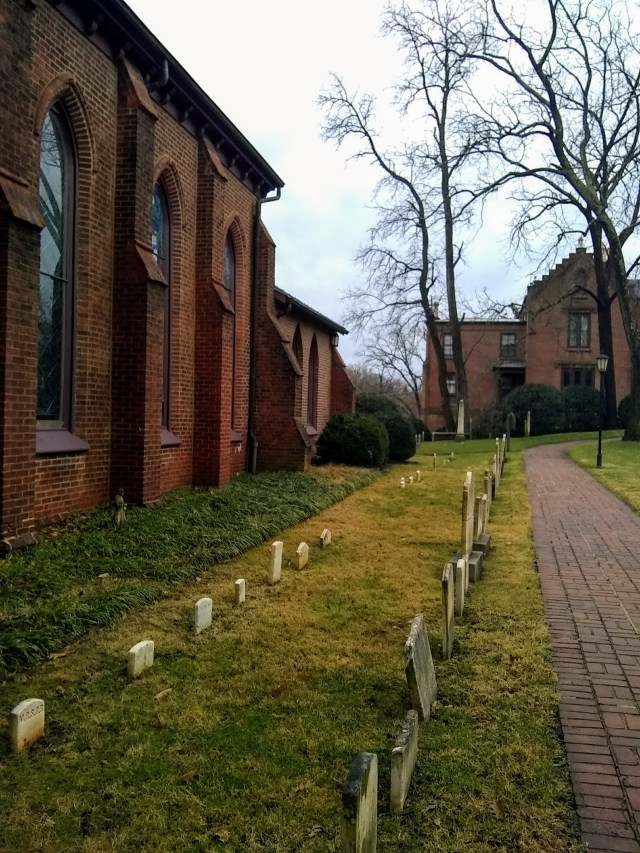
To that end, I spent a lot of time over Christmas and the days that followed, as we went up to those mountains and down into that green valley, thinking about restoration. It showed up in my poetry reading for Christmas day and then I thought of it again as we walked through and over the cemetery full of lilting nineteenth century gravestones by the big Episcopal church in Staunton. I wondered about those graves, how they lay so still and quiet and temporary. How the promise of Christmas is not brand-spanking-newness, something never-before-seen, but even more miraculous: God making skin-to-earth contact, causing the lame feet to run at last, the long-silent lips to speak, and the dead to sit up in their grave-clothes and breathe fresh air. He makes the first things new and whole again.

Then on Saturday night we went to see Winter’s Tale, which begins so grim. “A sad tale’s best for winter,” Mamillius says. Leontes bursts out in a fit of unwarranted jealousy so lethal that by the end of the third act his wife and son are dead, and his best friend and daughter are so far banished that they are presumed so. But then in the final scene of the play, which takes place sixteen years later, the statue of Hermione, penitent Leontes’ now long-dead queen, steps down off its pedestal and takes him by the hand, alive again. He turns to the audience, to the heavens, to anyone who will listen, and says with awe, “O, she’s warm!”

So this theme of restoration kept coming up this weekend, but I’m not sure if I have anything to say about it except that it is. It exists. It’s all true. “She’s warm.”

Happy New Year.

IMG_20181228_154850512

December Inventory

I have a little brown paper Moleskine journal that’s gone with me almost everywhere this semester. When I first got to Vancouver I titled it on the inside cover: “Bus Poems: From Between and For Between.” And a couple months later, I wrote a Chesterton quote on the front: “The greatest of poems is an inventory.”

I ended up only writing one poem about the bus, but from the most recent nearly-illegible scribblings in the notebook, I can at least give you an incomplete, three-part inventory of the last few days. Whether it will manage to perform like a poem for you, I don’t know, but living it has felt like meter and rhyme.

First, my semester at Regent ended in a great rushing swell of rain and essay exams, both of which I sort of enjoy. On Friday night I went to a celebratory Christmas potluck where there was lots of good food and more and more fond faces kept coming in through the door. I talked and laughed and drank wine and, as occasionally happens, transformed like a butterfly into something resembling an extrovert. One friend told me I looked so happy, another said she felt like I’d been at Regent forever, and then another looked at a wet spot where I’d been sitting and asked if I had peed a little, so that brought me back down to earth. (I hadn’t, to clarify.) When I left around ten o’clock so I could still catch the bus at a reasonable hour, for a moment or two I had a hard time finding my boots in the piles amassed around the coat rack. I stood still and took a deep breath, overwhelmed by all the shoes and the feet and the beating hearts and the laughing hands. Then I laced up my ancient, salt-stained Timberlands and walked warm into the cold.

Then, on Saturday evening, my plane touched down on American soil and I felt like crying, though I’ve never even been in Dallas before and it was only a short layover. I’ve only used my phone while on Wifi since I moved to Canada, and as we taxied into our gate and I turned off airplane mode for the first time in four months, I felt as if trumpets should be sounding somewhere. Keeping my phone on airplane mode, using it pretty much only at home and at school, has felt symbolic. A classmate from China asked me a couple months ago what I thought of the word “foreigner,” and I said that, so long as it was not cruelly meant, I actually liked it, because it accurately described my state. And the little airplane icon in the top corner of my screen has served the same purpose: marked me as a wanderer, an outsider, far-from-home. Because of that little symbol, from the get-go I knew I was not obligated to know the way, the words, all the answers. Yet, in the four steady months that that tiny sign of transience glowed there, I have, without even noticing, learned quite a few small lessons about belonging—belonging not because I have made myself a place, but because a place has been made for me, not because I know the way, the words, all the answers, but because I was lost and now am found.

And finally, last night, a few hours after getting back into town straight from a wedding in Texas, I went to Caldwell’s upper school Christmas concert. From the time I was a teenager, this yearly concert has been important to me, has placed a warm finger on some exposed part of my sternum, and two weeks ago when I told a friend in Vancouver that it was one of the first things I was going to get to do when I got home, I found myself in tears at just the thought. But when I arrived there last night, instead of weeping in gratitude, my heart simply short-circuited and then noiselessly imploded, again and again. I slid in right before it began and sat next to Leslie, who I hadn’t seen since June, back when everything was different for both of us (but mostly for her). We listened to the first couple of songs arm-in-arm, holding tight as we could till our shoulders went a bit numb. Look at all their little faces, I whispered giddily when the high school choir got up on the risers. And after that final Hallelujah Chorus, I began to hug people and call it good. Canada’s good. So good. It’s good to see you. So good. Over and over, on and on. I had expected to be overwhelmed with gratitude at God’s faithfulness to me in giving me so many precious souls in so many places, so many heaps of Blundstone boots in so many foyers, but when I got in bed that night, still thinking of the sweet coworkers I’d seen and the dozens of little faces, I realized I was grateful for something more. I am grateful for his faithfulness to each of them. Because he has been faithful and continues to be. I am certain of it. I saw it with my own eyes. He is faithful to the once deafeningly anxious boy who enthusiastically echoed my own So good when I asked about his school year and faithful to the tough, smart girl who grimaced and told me that her first semester of college was “an adjustment,” faithful to the kid who used to sneer and now seems to mainly smile and faithful to the tired friends whose faces are fresh with the loss of those who loved them best. He has been intimately present with each of these people, has placed a warm finger on exposed skin, has invited them in where they belong.

Morning by morning new mercies I see

The Power and the Pity

Today I was riding the bus and it occurred to me that I am much more comfortable with God’s power than with his love. This was a large realization, but then my stop came and I had to get off and go to tutorial.

And now I am back home and I have a little time to think about that thunderbolt.

I thought of the countless times I’ve been told that the Lord loves me, not from the pulpit, not in song, not in a book that’s sold millions of copies, but by someone sitting next to me, who actually knows me, earnest in conversation. And whenever I hear it in that intimate context, some surge of frank disbelief rises up in my gut, and usually shows itself in my face. Sometimes the kind friend then tries to argue for the truth of the statement (“He does, Alice!”), but more often than not they already have their head bowed in the act of praying for me, so they don’t notice, and I just sit, weltering in discomfort over what the deepest part of me actually believes to be their poor theology. God would not love me, I think. He’s God. He knows better. Why spend your love on someone or something who so obviously, particularly from an Almighty vantage point, really has nothing to offer? Someone who takes up so little space and will inevitably fail at all the important bits? Why bother?

I’ve never said any of this aloud before, of course, and there’s a reason for that. I’ve never said it aloud before because it’s actual bad theology. The worst. It thumbs its nose at something utterly central to God’s character: it denies his pity. His love is not built out of particular affinities for certain people or some set of utilitarian desires like ours too often is. His love is built out of pity: pity that looks down from an Almighty, holy vantage point, sees his people whom he formed out of dust, and is moved, moved to crack open his ribcage and pour out everything within. And to be clear, though something within me still pushes back at writing this, or maybe because something within me still pushes back at writing this, God pities not just his people at large, or us, or you. All of those things are true, but more astounding, God looks down, sees me existing in my little self-made space, failing at all the important bits, offering nothing, and finds himself awash in his own love. And he breaks open his chest for me, a sheep without a shepherd.

Last week I sat in Old Testament during a lecture on the Psalms, and when Iain got to the concept of lament he used Psalm 22 as an example. He pointed out verse six which begins, “But I am a worm and not a man.” He said the Psalmist feels that his own suffering has degraded him, has made him less than human, something vile. Then he added gently, “But, of course, that’s not the truth of the matter.” And sitting in the third row, I started to cry–I guess because I’ve always thought it was.

This Thanksgiving Quiet

The sun is not out and probably won’t be today. When I look out my window I can see pine needles on grey-white sky.

Since I live in Canada now I already had one Thanksgiving, back in October, though several Canadians confidently assured me the two Thanksgivings are “about different things.” (I repeated this to a friend from home and she snorted and said, “What, their Thanksgiving isn’t about being thankful?”)

And when I think back over the Thanksgivings of the last couple years (proper, American Thanksgivings) I am aware of how unsettled and lost I felt. Thankfulness was part of the duty of the day, certainly, but I remember how the larger task felt like simply keeping my head up, doing the next thing.

But now I am here, many weights have fallen away, and again it is Thanksgiving. The day feels set apart, more sabbath than Sabbath. I have no real plans, least of all any involving a big turkey dinner, and that’s at least partially by design.

I will read and I will sit very still. These things both fall neatly within my skill set, but I don’t often do them on purpose, so today I will take a corner: a corner of time, a corner of space, to think on the largeness of God.

His reach is vast. It extends back to those blurred, painful Thanksgivings and forward to those I cannot see. It extends round the world and back home again to all the hidden places I know and love and to those I cannot imagine. Why, his reach extends even into the caverns of the human heart.

I am thankful for the light.

Homemaking

Today, I have been in Vancouver for three months, but it feels like much, much longer. October contained about six months in it. Six good months.

I have been making things: poems, dinner, friends, outfits that might have too much color, Hebrew flashcards, displays of advent readings to go up all around Regent.

I have also been beginning to learn not to make some things: definite plans for next term and the rest of my life, arbitrary childish boundaries set around who I talk to and where I go, excuses.

For various reasons, some of which have to do with the words and images that crowd through my head while I lie trying to sleep and some of which have to do with more official, public spaces like class readings and lectures, I’ve been thinking a lot recently about God’s makerness and my makerness in connection to it. The Lord makes things—he made me—in fact, I think he made me to make things. But it is so very, very easy to take what he has given and usurp it: to dismantle it and set about constructing Babel with great and hurried diligence, when what was called for was an altar.

I am always writing a story that I want to be true. I am forever deciding who I should be and how that should happen: my brain is always ticking full of dialogue that will never be said, I float the people around me into the narrative on carefully articulated sub-plots, and sketch out the peaceful house where I may never live, all with the goal of creating the glowing woman I want to one day wake up as. At best this is dreaming, at worst idolatry.

And I’ve been doing it for a long time, too. In eighth grade I developed an enormous crush on Skandar Keynes, who played Edmund in the Narnia movies, if you’re not familiar. (There’s no reason at all why you should be.) I drew out a careful timeline of our impending relationship, which part of me genuinely believed—I can be a pretty convincing storyteller. It began with his sudden, imminent move from England to North Carolina and culminated in our marriage at the age of seventeen, at which I wore a multi-colored ball gown. So that’s another thing: I’m not patient.

I would like to write the story myself and I would like it to begin tomorrow, on time please. When it doesn’t, I castigate myself. I must have made a misstep, so it’s back to the drawing-board to find the error and rewrite, rewrite, make it perfect. Probably the most terrifying thing about my decision to move to Vancouver was that I was throwing away the entire script. I was leaving everything I thought I’d do, and everyone I’d ever known. A kind of empty dread filled me some days when I thought about going, but I knew I had to be free of the structure of expectations I’d created for myself. I had to burn it, reduce it to ashes, step out through the smoke into the open air.

Now that I am settling here, though, I keep catching myself starting new drafts for this new home, trying to set things in stone very quickly about how this all will be: how long my degree will take, who I will know, how I will live, what songs I will sing, and what words I will write. I think I often associate being able to feel truly at home with how quickly my own scaffolding of control rises into the air around me—so what if it begins to block the sun? It keeps me safe.

I wrote a month or two ago that God brought me here. And he did. But I keep forgetting. I keep forgetting that not only did he make me but he made this home and the people in it. I bear none of the responsibility for the goodness of this place, nor can I claim it.

Reading Week is beginning and yesterday I helped decorate the school for Christmas. To string the lights back and forth across the tall atrium we attempted to use a tall paint roller with an extra handle taped to the bottom, so it would leisurely unspool from one spot to another. It was not leisurely. The roller either would not turn or turned too fast, standing on the upper level I couldn’t hear the directions that they called, and more than once we dropped tangles of lights practically on top of innocent bystanders. I trotted back and forth in the bright sunshine from one side of the mezzanine to the other till I began to sweat. I would not have written that scene with any of those details, but we laughed, and now the lights are glowing.

And last night I ended up sitting on a couch, dripping with sharp, tired tears while three friends sat close and prayed. I would not have written this scene at all. All I did was sit, suddenly surrounded and warm. But they prayed for me like they knew me.

My Lord is so much more gracious than I am.

Friendship and the Weightiness of Laughter

Years ago, when our lives looked very different than they do now, my friend Abby used to call me up and begin the conversation with, “Alice, I’m wretched.” And then we would laugh. She would tell me everything that had gone wrong that day, and I would spend an hour laughing till my face hurt and we both wondered what we had done to deserve this goodness. This remains one of my dearest friendships, and I think that’s a central reason why. We take laughter seriously.

And when my friend Lauren and I were living together and we got stressed out we used to repeat to each other in high-pitched, giggling hysteria, “It’s fine, it’s fine, everything’s fine.” The joke, of course, was that everything wasn’t. But the indelible truth beneath the joke was that it would be fine: All shall be well, and all shall be well, and all manner of things shall be well. We laughed and were comforted.

When I stop and think I realize that nearly every important relationship I have ever had has had laughter seated at it weighty core. To laugh with a friend is to say, thank God you’re here and thank God all this isn’t up to us. Laughter, not derision or mockery or any thing with barbs on it, but the real kind, the gift kind, that some days begins in your eyes and some days begins in your gut, that laughter tells the truth. And the truth is that this business of being human is frankly a bit ridiculous, and we understand very little about how it really works. I mean, we get sleep in our eyes, we have toenails, we sometimes say nicer things about someone behind their back than we ever would to their face, and once I blacked out at a Walmart pharmacy and knocked into a display in full view of a crowd of people because I was too stubborn to stop walking. As I used to say about my students: we’re funny when we mean to be and funny when we don’t.

I’ve found that the people here who it’s already easiest to call my friends are the people who I laugh with, and, more than that, who are willing to laugh at me. So while laughter seems like the shallowest thing and simply the first, easiest way of communicating, used well it’s soul-baring. It can act as an admission of your own fallibility: that you’re a contradictory, limping creature with delusions of grandeur and everyone else in the room is too. So laugh.

Laugh because I wear purple tights and things that sparkle to compensate for my native shyness. (See, it works! It brings joy.)

Laugh because we’re too sleepy for this or laugh because we’re far too awake.

Laugh because we can’t remember or laugh because we can.

Laugh because we’re surprised to have failed or laugh because we’re surprised to have succeeded.

Laugh because we don’t know the words, or laugh because, suddenly, we do.

Laugh at our tears because their significance is not lessened by the reality that they will be dried in the morning.

Laugh without fear of the future.

Theology, Apple Sorting, and Starting at the Beginning

Apparently I’m into long titles again like I was when I was fifteen. It’s cool–don’t worry about it.

This past weekend was the second weekend of the food course I’m in and we spent Saturday afternoon at a little local harvest festival. For a while I ended up at a work station sorting apples that would be good for eating all winter long from the apples that were already bruised and marked and would be pressed into cider. At first it was just me and an older man. He sorted away and I tried to keep up. But after a few minutes a young boy came up who was maybe ten or eleven. My companion explained to him what we were doing, that when he found a nice one he should set it into the box carefully, but that he was welcome to toss all the bad apples into their cider bin as hard as he could. And so he did, with evident joy. He really put his shoulder into it, throwing each warped apple in overhand, thunck thunck thunck, but each time he found a good one he cradled it gently in his palm and laid it in the box like a sleeping baby. Then we returned to the thunck thunck thunck. I laughed and wondered if I should tell him how much I admired his confidence.

On the official permit from the Canadian government that’s stapled into my passport, it says that I’m here at this place, in this country, to study theology. But I haven’t talked much about that yet. And not just on here, I haven’t talked much about that at all, anywhere.

Everyone else seems to have come to Regent with hard theological questions or with some driving desire to grow and learn, but I came theologically content. I’ve been too busy questioning most everything else in the past year or two to question my Lord. So my engagement in most of my classes, both external and internal, has been minimal. Sometimes I do have thoughts–appreciation will wash over me in Old Testament, or some unnameable frustration will creep into my shoulders while I’m reading for the food course–but the last thing I want to do is share them. I don’t want to say anything till I’ve really thought it through, and thinking it through seems to take much longer with God than it did with poetry or stories.

So I do the readings. I write brief response papers. I study. I talk to new friends about anything except the course material. But term papers are creeping up and I’m realizing that my days of relieved passivity are over. The time is coming when I will have to attempt to prove something: prove something about God, his church, his world. The idea of doing this still seems laughable.

I mean, I’ve written plenty of papers. I’ve made arguments before. But usually this meant I would pick up a piece of literature, read it carefully–backwards and forwards, up and down– and then I’d express an opinion. I’d engage with the critics, sure, but mostly that was a polite nod to companions in reading. The real content of my paper came from the text itself. The reason I argued that Katherine in Taming of the Shrew was a product of her environment and that Petruchio actually offered her release from her role as resident hellion was not because of anything Shakespeare said, or Liz Taylor did, or anything that happened in the sixteenth century. I argued that because of Kate herself, and what I saw in the text, and what I knew about being human. I wasn’t trying to give some definitive answer–I was just talking about personhood, and relationships, and the way it sometimes feels to be alive.

But theology is different. There is an answer here. They call theology the queen of the sciences, so decisions we make have an impact, on ourselves at the very least. This is serious business. My moving to Vancouver was in many ways a move away from responsibility. Studenthood, I thought, is freeing thing. I didn’t comprehend that I’d simply be switching from making pronouncements on the writing ability of the fifteen-year-old in front of me to making pronouncements on the state of the universe itself. I’m probably making up mountains where really there are only molehills to surmount, but still. I’ve been feeling a bit daunted today about my step forward into this next big thing.

A few years ago I taught a particularly high energy (and sometimes unmanageable) group of juniors. It was a big class, filling every seat I had and there were lots of long legs and loud voices and excuses and bold questions. They made me laugh sometimes, but they also wore me out and reminded me of my own inadequacies. One day as I walked around the room at the beginning of class, wading through low levels of chaos to pass back an assignment, wondering to myself how I would cope, one of the boys looked up at me quizzically as I passed him. “Miss Hodgkins, did you just say ‘Lord, help’?”

I bit my lip. “Yes. Yes, I did.” Lord, help.

Receiving, Retreating, and Other Non-Contributions

The last summer I spent with my grandparents, right after I finished undergrad, is perhaps the one I remember most vividly. I came to Missouri in May and stayed straight through most of June, and one of the most painful moments was this: a sweet man from church came over one day and mowed the acre of front lawn, without pretense. I could have done it, of course, but he meant it as a gesture of kindness towards these good people for whom he had so much respect and affection.

My grandma didn’t see it that way, however. That afternoon in the kitchen she let loose to me about how unhappy she was. He had not asked, she said. Why would he do that? Why would he just show up? They didn’t need his help. In frustration, she repeated herself several times, more sharply with each go round. (To be fair to both of them, he may well have talked to her beforehand, and more than once, but her memory was slipping and slipping already.)

An hour or two later, as I sat up in my room reading, she climbed the stairs, the only time she did so all summer, and stood in my doorway on the verge of tears. She stood in my doorway, and with a tempest rising in her well-tested and stretched soul, she apologized to me. She said she knew she shouldn’t have spoken like that. She knew he probably meant well. But it was so hard. It was just so hard, Alice.

I sat on my bed, keenly aware of my dirty laundry scattered over the bright blue carpet and of my position as tenth of her nineteen grandchildren, middlest of the middling, and said in a near whisper, “Grandma, sometimes it’s good to accept help from other people.”

“But we’re the ones who help!” she said.

“I know,” I told her. “But sometimes that changes.”

Her world was spinning upside down.

I, too, want to contribute. When you are able to be the one who helps, you know you’re on solid ground, that something’s going right for you. To be the giver is reassuring. In my four years of teaching, I became a contributor. I was patient and I was reliable and I answered emails promptly. My desk was a mess, but my webpage was always up-to-date with homework assignments. I lent my students more paper and pencils than I should have when they came to class unprepared. I was comforted by my own regularity, and so, sometimes, were the kids. When they came in chaotic, I would be calm. All of us could count on that. Most of all, as a friend who’s still teaching said to me recently, I don’t know what I would do if people weren’t asking me questions all day. Miss Hodgkins, Miss Hodgkins, Miss Hodgkins

I’ve been asked plenty of questions here too, but they’re harder ones. Beyond Where are you from? and What program are you in? I keep getting, Why are you here? Have you found your people yet? What’s been the hardest thing? What do you find lifegiving? My most honest answers thus far have been: I don’t know, Maybe–I was hoping it might be you?, Answering these questions, and What?

Partly by birthright, and partly by dint of having taught teenagers, I have a slightly overdeveloped sense of the absurd, so all this makes me want to laugh. And of course, as I’ve had others here warn me, if you look someone straight in the eye as you answer, you also might cry. It happens. I’ve done it. (No surprise.) But laughter and tears aren’t bad options, and people are pretty forbearing. In fact almost everyone here is out-and-out pastoral (with good reason–it is theology school.) And as they speak to a first year, especially one who sometimes unwittingly gives off the impression of fragility, they are kind.

And this is the crux of the matter: people are kind. Not kind because they love me or appreciate me or need me or enjoy me. They are kind out of their own God-given goodness. Though I am technically the focus of these check-in conversations, I am not the motivating factor. God’s grace, active and moving, is all.

I was the one who helped, but sometimes that changes.

So suffice to say, my world, like my grandmother’s, is spinning upside down. In a million other ways I will never surpass her legacy: her hospitality, her faithfulness, her work ethic, her pie crust, but I can take a lesson with her here at least. So I am relearning, for the thousandth time, how one accepts grace with humility.

I had reasons for moving and coming to this school, but most of the time I don’t remember them anymore, and when I do, they don’t seem very important. Out of the first five weekends of this term I will have spent four of them away on various retreats and course outings. It is occasionally exhausting to spend such concentrated time with new people, but I am becoming sure of one thing: I am grateful to be here. I thought I intended this move, that I planned and orchestrated it, but in truth, the Lord did. I am here because he set me here. He intended this. I am meant to know this place, to know these people, but mostly, to know him.

Happiness is not everything, but I am happy.

Time Being New (and Time Being Old)

As of today, I have been in Vancouver for exactly a month, and I continue to gain bruises here and there from falling down things (like the stairs) and walking into things (like the table), which I suppose is proof that I’m not yet quite oriented.

I’m reaching the deeper level of homesickness now where I have a bank account and a bus pass and I’ve been to all my classes at least once, and even submitted a couple assignments, but when I see my former students pop up on social media on their class trip to Italy it feels like a welcome relief. To laugh to myself at their extra-polite smiles as a teacher takes their picture is much easier than reading the dozens of new faces, some with their own glazed expressions of fresh homesickness.

So what I am trying to tell you is that it’s hard to find some neat, coherent topic for a blog entry when everything is new. Everything is new except, of course, for all I bring with me: my loves, my habits, my fears, my socks, my memories, and my sweaters. Those things aren’t new at all. It feels like a Herculean task to marry the past and the future into the now, but in reality, it will happen on its own, so long as I let it. I will wake up one day and be comfortable.

But for now, as Auden says, I have “the Time Being to redeem from insignificance.”

So here are things to hold on to:

-I just did laundry, so I got to sleep between clean sheets last night.

-Everyone here, without exception, has been so kind.

-It is wonderful and a little nerve-racking to be writing for a grade again. It makes me feel like I’m growing.

-A couple days ago, when I ran into another first-year student at Regent, I said, “Oh hello, friend!” without even thinking.

-I have written two poems since I got here: a poem about life back home, and a poem about life here. The one that is currently nudging at the back of my skull is about the people around me now, so that’s a good sign. Onward and upward, through the “Land of Unlikeness”!