Hevel and Home

I left Vancouver this past weekend(!!!). I went to the States and walked around little towns which have their streets all named after U.S. presidents in neat chronological order. I feel as if I should now recount for you the complex history of how this came to be and how I got there, but that story, if it is a story, would take too long to tell. Suffice to say, I rode in my friend Becky’s car. We took I-5 into Oregon.

On Saturday I had a bit of a white night and sat alone in the attic room of our little Airbnb next to a truly enormous fern and asked God lots of big questions about why he loved me. And then I read the end of The Four Loves for perhaps the fifth time and remembered Christina Rossetti’s poem about the prodigal son, which begins this way:

Does that lamp still burn in my Father’s house,

 Which he kindled the night I went away?

I turned once beneath the cedar boughs,

 And marked it gleam with a golden ray;

 Did he think to light me home some day?

I woke up with puffy eyes the next morning and that afternoon we drove up the coast from Corvallis to Cape Lookout State Park. I read aloud from Wind in the Willows and in between times I looked out the window and said perhaps five times, “I really like fields. I love fields so much. Fields are underrated.” Becky asked me if they made me think of North Carolina and I said no, I just liked them wherever they were in the world. And I do. I like seeing land stretch and duck and roll as far as my near-sighted eyes can reach.

We got to the campground and after pitching the tent we walked out along the beach. To our left the brilliant sun, too bright to look at, eased itself casually down to the horizon over the waves, as if it did it every day. The ocean purred and lapped, loud and jubilant, and the divots our feet made in the sand cast tiny bright blue shadows all up and down the beach like other-worldly beauty-marks. The cool wind blew so full against me, it made me want to pick up and fly. That night as I dozed in and out of sleep, I forgot my clever metaphor of the ocean as some great cat and kept thinking that its roaring must be a train that never got any closer and never got any farther, but stayed by your side always.

Yesterday we went up to Cannon Beach, where a concrete wall facing out over the lowering tides read “ALL is HEVEL” in green chalk. I liked that. I led my willing friend on an expedition over to the far sandbar and on the way found a tiny daisy which was white on top, but magenta on its underside, like brazen petticoats. The sandbar, when we reached it, was like another planet, smooth and white and quiet, on and on and out. We walked and walked. My unwashed hair gusted around my face, and I stored all this away as happiness. When we reached one of the rock formations, we climbed it, scaling the salt-encrusted base and scrambling up and up towards where twisted trees and brave grasses clung, balancing, for the time being, between brown gravel and blue sky. We stood in wind which is much stronger than I am.

And now I am home, in my familiar bedroom, looking out my window at the well-known pine branches against this blue sky, which looks wonderfully like the one I saw yesterday, almost as if it were the same.

Your sure provisions gracious God

Attend me all my days;

Oh, may your house be my abode,

And all my work be praise.

Here would I find a settled rest,

While others go and come;

No more a stranger, nor a guest,

But like a child at home.
Practicing Resurrection

On Tuesday, I will finish my second semester of grad school and on Wednesday I will turn twenty-seven, which my sister and I used to joke was the age of perfection. It was a funny joke back then, and, frankly, is an even funnier joke now.

Last year on my birthday I wore a pink dress and it bucketed rain. It came down in a long morning deluge which made everyone grumpy. Then, in the afternoon, my fourth period students threw me a surprise party which I did not manage to be surprised by, complete with hats, a shiny balloon, and a cookie cake. My fifth period, not to be outdone, hastily ordered pizza. (My erstwhile birth functioned as an excellent excuse for all sorts of distractions.) I wanted to hug all of them, but I didn’t. I just smiled. It was an odd day and a good day.

The year and the ground which have passed under my feet in the interim have been dizzying. A few times in the last week in particular, as I have reflected, I have wanted to pinch myself—maybe I actually physically have pinched myself once or twice. (I can’t remember.) Is all this real? Did I really run away from home, and begin to do new things one after another in such rapid succession till it became habit? I want to check the mirror sometimes. Am I the same person? Are my eyes still brown, and when did the fear behind them stop running the show every day?

My rate of change over the last eight months has perhaps been privately alarming, but it is also much more than that. I found myself telling a friend the other day that being here, at Regent, in Vancouver, in a place which tastes different on my tongue and sounds different to my ears, something about it makes me actually want to heal. Not just make agreeable noises and blog entries, but take my hands away from the festering parts of myself which I’ve been covering, and say, “Alright, Lord. Come in at long last. Come in and perform the alchemy. Make me new, though for all my talk of Spring, I’m not even sure what that means.”

I’ve lived a fair number of Easter Sundays by now, have remembered the Resurrection over and over, but this one is softly special. I don’t just believe the promise of new life today—I want it.

Why do you seek the living among the dead?

Rise heart; thy Lord is risen.

The Indigestible Portions

I’m probably about to get all kinds of poetry on you. (But please don’t go away just yet. Hear me out.)

I am tired and achy at the moment. We could blame it somewhat fairly on last night’s restless sleep, but at the core is the fact that I’ve had an anxious week and my body knows it. Some days the sky is blue and I wear sparkly shoes because I like them, but other days, though the sky is still blue, I wear sparkly shoes because I need them and much of my energy goes into managing and dismantling my fear, trying to move past it so I can function. More than ever recently, I’ve become aware of the myriad of coping strategies I’ve developed to deal with everyday anxieties.

When I was eleven I made up a trick I sometimes still use. When I felt overwhelmed I would take a piece of paper and draw and label a little cloud for each of my worries–size and darkness corresponding to the intensity of each. I found that when I did this, put them out on paper visually, there were always fewer of them than I had assumed.

In college, to get out of bed on hard days I would promise myself that I could wear an oversized flannel, that I could put no effort into my appearance and play-act as the Invisible Girl, if only I would get up and go to class.

Even this past Fall, when I first moved to Vancouver, I was still adding strategies to my arsenal. I was irrationally nervous about riding the city bus, and so for the first few days, every time I waited at a bus stop I took a picture of my feet, so that my camera roll would fill up with growing evidence that I had done this before and I could do it again.

Every one of the aforementioned strategies have worked and still work when I need them. I am oddly proud of all the little ways I’ve come up with to chant to myself, “Be brave, be brave, and be brave.” It’s quite possible you have a similar list yourself.

But.

It is Lent now. We are in a season in which we are supposed to remember our own mortality, to feel death in our bones and pray to understand what that means. So I have found myself thinking that while bravery is good and well, it is perhaps also good and well to sit and learn from my own frailty. When my hands begin to shake, as they have a couple times this week, perhaps instead of sitting on them so they will stop and no one will notice, I can look at them and remember the dust from whence they were formed. In the stillness of the weeks leading up to our celebration of Christ’s deafening acts of redemption and renewal, maybe this magnified anxiety is not a curse, but an appropriate reminder of my need.

In my Christian Imagination class a couple days ago we read Eliot’s “Ash Wednesday.” He is mournful and acutely aware of his limits, his lack of answers, his lack of any sufficient words at all. The liturgy of any traditional Ash Wednesday service is full of the same heavy truths Eliot has felt all his life, full of the angst of Prufrock’s “overwhelming question” from fifteen years earlier in his career. Yet in this first long poem after his conversion, everything is different because while Eliot sits in the void within himself, he knows the Word has come to fill it. The Gospel gives context to the weakness he has always known so intimately. And conversely, Eliot’s long fixation with human lack and the inadequacy of his own speech has fit him with ears to hear the words of Him who is greater.

So sure, those pictures of my feet back in August bear witness that I have done this before, that riding the bus is really not such a big deal, but if I am being honest, perhaps even more importantly, they bear witness to the truth that I was afraid. I was foolishly afraid of something I could not name, which never came to fruition. Those pictures chronicle how I am riddled with sin, riddled with holes, ultimately unable, despite all my little tricks, to cope with the “indigestible portions” of my human soul.

And last night I read the end of Revelation, full of lines which deserve to be shouted, which have been and will be, all about newness, over and over. He is making all things new. Those words are always true whoever and wherever you are, but it is the infirm sinner, silent and barren, who really feels their power.

Two Hundred

I wrote my first entry here in October of 2010. I was eighteen years old and I wrote that I was starting this blog “in good faith.” Today I am writing my two hundredth entry, and I write in gratitude. Eight and a half years ago the girl curled on the desk chair by the ground floor window that looked out over Pennsylvania’s blazing autumn colors could not have comprehended.

She could not have comprehended the strangeness of the many precious and painful ebenezers along the way: the hands and the handwriting, the shouting and whispers, the nights weeping and the nights laughing, the holy silence of falling snow under midnight small-town street-lights, the vast emptiness of hands one Thursday morning at eight a.m. as the copier churned industriously behind me, or the steady plod of my own two feet up a green hill in Wales. These things would have baffled her. She could not have borne them.

But mostly she could not have comprehended the way this virtual space has functioned as a room of my own, as perhaps my most constant home of the last decade. Here I can slide words onto a string in complex order and hold them up to see if the light shines through, then try again and again until I get it right. Here I have over and over set myself the funny, laborious task of saying what I mean, of telling the truth both straight and slant. Here I have learned over and over the ever-piercing lesson that I am not alone in my fears or my joys, that there is nothing new under the sun, that there is always some other sheep lost in the same thicket, and more than that, beautiful and wrenching, that “grace is enough. He is enough. Jesus is enough,” and he loves even me. Here, two hundred times over, wielding only a softly blinking cursor against a blank expanse of page, I have grown.

Thank you, little two hundred.

Something Steady

I’m sitting in a room surrounded by half-unpacked suitcases. Sometimes, I feel as if that’s my constant state, even when I haven’t been travelling. Why is that?

Now that I’m back in Vancouver it feels like it’s properly the new year. The other day I wrote myself a list of things I wanted to accomplish and ways I wanted to grow in 2019. I wasn’t exactly digging deep–one of the entries was “get better at French-braiding”–but much more so than when I left Greensboro and moved here five months ago, I do feel like sitting down and taking stock.

Yesterday (was it only yesterday?) I subbed for the seventh grade humanities class at Caldwell. Around midday I realized that it was easier and more joyful than I had expected it to be. I don’t know why I was surprised by that, though. Especially in retrospect, I tend to focus on my weaknesses as a teacher, and I had them in spades, but I had strengths too. I was good at my job. And even if I never return to it, I’ve been marked by teaching, my heart scuffed all over with funny, seemingly-accidental marks that will not wear away. Those four years changed me. I grew.

I gained confidence, prudence, perspective, a greater ability to think on my feet, and a keen sense of my own limitations. But the greatest thing I learned was Love. I still know very little of it, but simply by necessity, because increasingly I realized there was no other way to view my students, I began to wade into the borderlands of that frighteningly bright place where you see the people around you as Christ sees them. Human faces there are drawn in bold lines, the image of God and the sin that mars it both clearly visible, and you know instinctively, without thoughts of either discouragement or heroism, that Love is the only power, the only recourse, the only cure. Plenty of times, certainly, I’ve tucked my tail between my legs and retreated back to the shadowlands of my own easy criticisms and lazy assumptions, but I had just enough lessons there that I can attest to this: that land is the only way through. As one of my grandma’s favorite little books was called: Love or Die.

I learned all of that without planning to. And now that I am in a new place and new season, what will I learn here? I find it very easy to ask that question with blissful, blind anticipation and then sit still, doing nothing, waiting for the answer to drop down out of the heavens into my lap. In fact, I do that far too often on this blog. And certainly, there are many things I can’t and am not meant to predict. God is sovereign and I am not. But at times the “I don’t like being in charge” part of my personality stretches to excess, and I fail to even take charge of myself.

When I first moved here one of the things I said quietly to myself (and probably wrote on some piece of paper somewhere) was that I wanted to grow in holiness, which often runs shallow in me. And that’s not exactly a minute task. So I am realizing that nearly half a year in perhaps it is time that I begin, that I stop floating and wandering and hoping I get somewhere, but start to walk in as straight of a line as I can manage, going somewhere on purpose. The Lord will be there all along the way. It’s not as if I’ll need to wait for him to catch up–he’s well ahead, Alice.

To that end I’m about halfway through a book about holiness. (Who knew I could be so practical?) And, as icing for my new goal-oriented self, I’ve set myself a very manageable little writing target for 2019: draft two full chapters of the new novel I’ve just started poking at. Oh, the terror and the joy!

So there. I’ve sat and I’ve taken stock and, by God’s grace, perhaps even made progress. Now to my gaping suitcases.


Restoration

2019 has begun quietly. (For me, at least–I can’t speak for you.)

I’ve been home for a while now and will be home a little while longer. Events worth noting have included lots of time spent at Caldwell (more than I intended, really), lots of time spent with friends from high school and before (more than I expected, really), a brief, exciting ambulance ride to the ER (I’m fine, totally fine), and a trip with my family to Staunton to see Shakespeare (because that’s what we do).

If you don’t know anything about this Staunton place (which probably just means you haven’t known me very long) it’s right in the heart of the Shenandoah Valley in Virginia, which might be the most beautiful place in the whole American South. It’s all close winding creeks and green grass and steep, steep hills woven over with blankets of quiet tree branches, surrounded by wave upon wave of blue mountain ridges. Even its dilapidated buildings with cracked shutters and mossy, caving roofs are soul-wrenchingly picturesque. During the Civil War they called it the breadbasket of the Confederacy because its fields were so fertile, and, perhaps, for me, more than any other place in the South it seems to be marked like Cain, to be aware of both its beauty and its sin, but unable to reconcile them. I think it is what my friend O’Connor called “Christ-haunted.” It is a place that makes me want to sit very still.

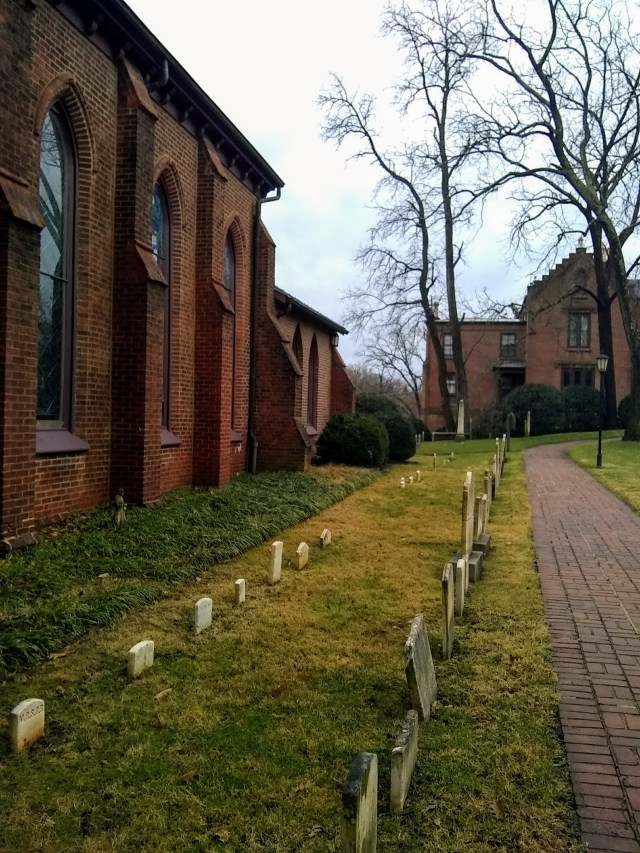
To that end, I spent a lot of time over Christmas and the days that followed, as we went up to those mountains and down into that green valley, thinking about restoration. It showed up in my poetry reading for Christmas day and then I thought of it again as we walked through and over the cemetery full of lilting nineteenth century gravestones by the big Episcopal church in Staunton. I wondered about those graves, how they lay so still and quiet and temporary. How the promise of Christmas is not brand-spanking-newness, something never-before-seen, but even more miraculous: God making skin-to-earth contact, causing the lame feet to run at last, the long-silent lips to speak, and the dead to sit up in their grave-clothes and breathe fresh air. He makes the first things new and whole again.

Then on Saturday night we went to see Winter’s Tale, which begins so grim. “A sad tale’s best for winter,” Mamillius says. Leontes bursts out in a fit of unwarranted jealousy so lethal that by the end of the third act his wife and son are dead, and his best friend and daughter are so far banished that they are presumed so. But then in the final scene of the play, which takes place sixteen years later, the statue of Hermione, penitent Leontes’ now long-dead queen, steps down off its pedestal and takes him by the hand, alive again. He turns to the audience, to the heavens, to anyone who will listen, and says with awe, “O, she’s warm!”

So this theme of restoration kept coming up this weekend, but I’m not sure if I have anything to say about it except that it is. It exists. It’s all true. “She’s warm.”

Happy New Year.

IMG_20181228_154850512

December Inventory

I have a little brown paper Moleskine journal that’s gone with me almost everywhere this semester. When I first got to Vancouver I titled it on the inside cover: “Bus Poems: From Between and For Between.” And a couple months later, I wrote a Chesterton quote on the front: “The greatest of poems is an inventory.”

I ended up only writing one poem about the bus, but from the most recent nearly-illegible scribblings in the notebook, I can at least give you an incomplete, three-part inventory of the last few days. Whether it will manage to perform like a poem for you, I don’t know, but living it has felt like meter and rhyme.

First, my semester at Regent ended in a great rushing swell of rain and essay exams, both of which I sort of enjoy. On Friday night I went to a celebratory Christmas potluck where there was lots of good food and more and more fond faces kept coming in through the door. I talked and laughed and drank wine and, as occasionally happens, transformed like a butterfly into something resembling an extrovert. One friend told me I looked so happy, another said she felt like I’d been at Regent forever, and then another looked at a wet spot where I’d been sitting and asked if I had peed a little, so that brought me back down to earth. (I hadn’t, to clarify.) When I left around ten o’clock so I could still catch the bus at a reasonable hour, for a moment or two I had a hard time finding my boots in the piles amassed around the coat rack. I stood still and took a deep breath, overwhelmed by all the shoes and the feet and the beating hearts and the laughing hands. Then I laced up my ancient, salt-stained Timberlands and walked warm into the cold.

Then, on Saturday evening, my plane touched down on American soil and I felt like crying, though I’ve never even been in Dallas before and it was only a short layover. I’ve only used my phone while on Wifi since I moved to Canada, and as we taxied into our gate and I turned off airplane mode for the first time in four months, I felt as if trumpets should be sounding somewhere. Keeping my phone on airplane mode, using it pretty much only at home and at school, has felt symbolic. A classmate from China asked me a couple months ago what I thought of the word “foreigner,” and I said that, so long as it was not cruelly meant, I actually liked it, because it accurately described my state. And the little airplane icon in the top corner of my screen has served the same purpose: marked me as a wanderer, an outsider, far-from-home. Because of that little symbol, from the get-go I knew I was not obligated to know the way, the words, all the answers. Yet, in the four steady months that that tiny sign of transience glowed there, I have, without even noticing, learned quite a few small lessons about belonging—belonging not because I have made myself a place, but because a place has been made for me, not because I know the way, the words, all the answers, but because I was lost and now am found.

And finally, last night, a few hours after getting back into town straight from a wedding in Texas, I went to Caldwell’s upper school Christmas concert. From the time I was a teenager, this yearly concert has been important to me, has placed a warm finger on some exposed part of my sternum, and two weeks ago when I told a friend in Vancouver that it was one of the first things I was going to get to do when I got home, I found myself in tears at just the thought. But when I arrived there last night, instead of weeping in gratitude, my heart simply short-circuited and then noiselessly imploded, again and again. I slid in right before it began and sat next to Leslie, who I hadn’t seen since June, back when everything was different for both of us (but mostly for her). We listened to the first couple of songs arm-in-arm, holding tight as we could till our shoulders went a bit numb. Look at all their little faces, I whispered giddily when the high school choir got up on the risers. And after that final Hallelujah Chorus, I began to hug people and call it good. Canada’s good. So good. It’s good to see you. So good. Over and over, on and on. I had expected to be overwhelmed with gratitude at God’s faithfulness to me in giving me so many precious souls in so many places, so many heaps of Blundstone boots in so many foyers, but when I got in bed that night, still thinking of the sweet coworkers I’d seen and the dozens of little faces, I realized I was grateful for something more. I am grateful for his faithfulness to each of them. Because he has been faithful and continues to be. I am certain of it. I saw it with my own eyes. He is faithful to the once deafeningly anxious boy who enthusiastically echoed my own So good when I asked about his school year and faithful to the tough, smart girl who grimaced and told me that her first semester of college was “an adjustment,” faithful to the kid who used to sneer and now seems to mainly smile and faithful to the tired friends whose faces are fresh with the loss of those who loved them best. He has been intimately present with each of these people, has placed a warm finger on exposed skin, has invited them in where they belong.

Morning by morning new mercies I see

The Power and the Pity

Today I was riding the bus and it occurred to me that I am much more comfortable with God’s power than with his love. This was a large realization, but then my stop came and I had to get off and go to tutorial.

And now I am back home and I have a little time to think about that thunderbolt.

I thought of the countless times I’ve been told that the Lord loves me, not from the pulpit, not in song, not in a book that’s sold millions of copies, but by someone sitting next to me, who actually knows me, earnest in conversation. And whenever I hear it in that intimate context, some surge of frank disbelief rises up in my gut, and usually shows itself in my face. Sometimes the kind friend then tries to argue for the truth of the statement (“He does, Alice!”), but more often than not they already have their head bowed in the act of praying for me, so they don’t notice, and I just sit, weltering in discomfort over what the deepest part of me actually believes to be their poor theology. God would not love me, I think. He’s God. He knows better. Why spend your love on someone or something who so obviously, particularly from an Almighty vantage point, really has nothing to offer? Someone who takes up so little space and will inevitably fail at all the important bits? Why bother?

I’ve never said any of this aloud before, of course, and there’s a reason for that. I’ve never said it aloud before because it’s actual bad theology. The worst. It thumbs its nose at something utterly central to God’s character: it denies his pity. His love is not built out of particular affinities for certain people or some set of utilitarian desires like ours too often is. His love is built out of pity: pity that looks down from an Almighty, holy vantage point, sees his people whom he formed out of dust, and is moved, moved to crack open his ribcage and pour out everything within. And to be clear, though something within me still pushes back at writing this, or maybe because something within me still pushes back at writing this, God pities not just his people at large, or us, or you. All of those things are true, but more astounding, God looks down, sees me existing in my little self-made space, failing at all the important bits, offering nothing, and finds himself awash in his own love. And he breaks open his chest for me, a sheep without a shepherd.

Last week I sat in Old Testament during a lecture on the Psalms, and when Iain got to the concept of lament he used Psalm 22 as an example. He pointed out verse six which begins, “But I am a worm and not a man.” He said the Psalmist feels that his own suffering has degraded him, has made him less than human, something vile. Then he added gently, “But, of course, that’s not the truth of the matter.” And sitting in the third row, I started to cry–I guess because I’ve always thought it was.

Homemaking

Today, I have been in Vancouver for three months, but it feels like much, much longer. October contained about six months in it. Six good months.

I have been making things: poems, dinner, friends, outfits that might have too much color, Hebrew flashcards, displays of advent readings to go up all around Regent.

I have also been beginning to learn not to make some things: definite plans for next term and the rest of my life, arbitrary childish boundaries set around who I talk to and where I go, excuses.

For various reasons, some of which have to do with the words and images that crowd through my head while I lie trying to sleep and some of which have to do with more official, public spaces like class readings and lectures, I’ve been thinking a lot recently about God’s makerness and my makerness in connection to it. The Lord makes things—he made me—in fact, I think he made me to make things. But it is so very, very easy to take what he has given and usurp it: to dismantle it and set about constructing Babel with great and hurried diligence, when what was called for was an altar.

I am always writing a story that I want to be true. I am forever deciding who I should be and how that should happen: my brain is always ticking full of dialogue that will never be said, I float the people around me into the narrative on carefully articulated sub-plots, and sketch out the peaceful house where I may never live, all with the goal of creating the glowing woman I want to one day wake up as. At best this is dreaming, at worst idolatry.

And I’ve been doing it for a long time, too. In eighth grade I developed an enormous crush on Skandar Keynes, who played Edmund in the Narnia movies, if you’re not familiar. (There’s no reason at all why you should be.) I drew out a careful timeline of our impending relationship, which part of me genuinely believed—I can be a pretty convincing storyteller. It began with his sudden, imminent move from England to North Carolina and culminated in our marriage at the age of seventeen, at which I wore a multi-colored ball gown. So that’s another thing: I’m not patient.

I would like to write the story myself and I would like it to begin tomorrow, on time please. When it doesn’t, I castigate myself. I must have made a misstep, so it’s back to the drawing-board to find the error and rewrite, rewrite, make it perfect. Probably the most terrifying thing about my decision to move to Vancouver was that I was throwing away the entire script. I was leaving everything I thought I’d do, and everyone I’d ever known. A kind of empty dread filled me some days when I thought about going, but I knew I had to be free of the structure of expectations I’d created for myself. I had to burn it, reduce it to ashes, step out through the smoke into the open air.

Now that I am settling here, though, I keep catching myself starting new drafts for this new home, trying to set things in stone very quickly about how this all will be: how long my degree will take, who I will know, how I will live, what songs I will sing, and what words I will write. I think I often associate being able to feel truly at home with how quickly my own scaffolding of control rises into the air around me—so what if it begins to block the sun? It keeps me safe.

I wrote a month or two ago that God brought me here. And he did. But I keep forgetting. I keep forgetting that not only did he make me but he made this home and the people in it. I bear none of the responsibility for the goodness of this place, nor can I claim it.

Reading Week is beginning and yesterday I helped decorate the school for Christmas. To string the lights back and forth across the tall atrium we attempted to use a tall paint roller with an extra handle taped to the bottom, so it would leisurely unspool from one spot to another. It was not leisurely. The roller either would not turn or turned too fast, standing on the upper level I couldn’t hear the directions that they called, and more than once we dropped tangles of lights practically on top of innocent bystanders. I trotted back and forth in the bright sunshine from one side of the mezzanine to the other till I began to sweat. I would not have written that scene with any of those details, but we laughed, and now the lights are glowing.

And last night I ended up sitting on a couch, dripping with sharp, tired tears while three friends sat close and prayed. I would not have written this scene at all. All I did was sit, suddenly surrounded and warm. But they prayed for me like they knew me.

My Lord is so much more gracious than I am.

Friendship and the Weightiness of Laughter

Years ago, when our lives looked very different than they do now, my friend Abby used to call me up and begin the conversation with, “Alice, I’m wretched.” And then we would laugh. She would tell me everything that had gone wrong that day, and I would spend an hour laughing till my face hurt and we both wondered what we had done to deserve this goodness. This remains one of my dearest friendships, and I think that’s a central reason why. We take laughter seriously.

And when my friend Lauren and I were living together and we got stressed out we used to repeat to each other in high-pitched, giggling hysteria, “It’s fine, it’s fine, everything’s fine.” The joke, of course, was that everything wasn’t. But the indelible truth beneath the joke was that it would be fine: All shall be well, and all shall be well, and all manner of things shall be well. We laughed and were comforted.

When I stop and think I realize that nearly every important relationship I have ever had has had laughter seated at it weighty core. To laugh with a friend is to say, thank God you’re here and thank God all this isn’t up to us. Laughter, not derision or mockery or any thing with barbs on it, but the real kind, the gift kind, that some days begins in your eyes and some days begins in your gut, that laughter tells the truth. And the truth is that this business of being human is frankly a bit ridiculous, and we understand very little about how it really works. I mean, we get sleep in our eyes, we have toenails, we sometimes say nicer things about someone behind their back than we ever would to their face, and once I blacked out at a Walmart pharmacy and knocked into a display in full view of a crowd of people because I was too stubborn to stop walking. As I used to say about my students: we’re funny when we mean to be and funny when we don’t.

I’ve found that the people here who it’s already easiest to call my friends are the people who I laugh with, and, more than that, who are willing to laugh at me. So while laughter seems like the shallowest thing and simply the first, easiest way of communicating, used well it’s soul-baring. It can act as an admission of your own fallibility: that you’re a contradictory, limping creature with delusions of grandeur and everyone else in the room is too. So laugh.

Laugh because I wear purple tights and things that sparkle to compensate for my native shyness. (See, it works! It brings joy.)

Laugh because we’re too sleepy for this or laugh because we’re far too awake.

Laugh because we can’t remember or laugh because we can.

Laugh because we’re surprised to have failed or laugh because we’re surprised to have succeeded.

Laugh because we don’t know the words, or laugh because, suddenly, we do.

Laugh at our tears because their significance is not lessened by the reality that they will be dried in the morning.

Laugh without fear of the future.