Distance

This weekend I went home for fall break. Almost five hundred miles, but really only eight hours. Eight hours is close. Distance makes most sense to me in terms of time. They are cousins, you see.

My grandparents’ house in Missouri, for example, is two days away, and that’s as close as Wednesday, but then again, with a plane, it’s as close as tonight.

A mile is short when I drive it and long when I run it and perfect when I walk it, but an hour is always the same. So I prefer the hour.

Distance is usually time to me, but time is often not distance. I mean that nothing, no part of life, seems far to me right now. I feel as if I stand dead center.

When I was one my daddy built a swing on the big tree in our backyard.

When I was two my mama earned her doctorate.

When I was three my friend Danny would let me have his pudding cup at snack time.

When I was four my mom would put my hair up in little fountains on top of my head.

When I was five I prayed for a little brother every night.

When I was six I got one.

When I was seven I showed off to my friends by pouring chocolate milk on my pizza at lunchtime.

When I was eight Mary and I flew to California alone and the stewardess let me pass out peanuts to all the passengers in my cabin.

When I was nine Karen and I made peanut butter fudge by candle light on a snow day.

When I was ten I learned to knit.

When I was eleven I was in such a foul mood when we got to the Grand Canyon that my mother had to order me out of the car.

When I was twelve I was a flower girl for the first and last time.

When I was thirteen I stopped hating boys.

When I was fourteen Noah and I made up my imaginary big brother, Richard.

When I was fifteen I thought I was in love.

When I was sixteen I clocked a friend in the nose one night on a golf course, but she forgave me.

When I was seventeen my grammy died and the tree with the swing fell and I cried myself to sleep.

When I was eighteen I wrote a poem.

When I was nineteen my grandma called to ask how I did the green beans that one time.

And now I am twenty, and none of these things seem distant. Forty, when I will be greying, does not seem too far, and neither does eighty-three, when I plan on being quite white.

Before dinner just now I went and sat in the prayer room and read over the journal there, whose entries date back to before I ever came here. But those people, those friends, those interceding brothers and sisters seem very close indeed. I am intended to feel that way, I think, because they are close—their ink, my hands, our cries to the same living God.

One thing seems far, though. There is a wooden cross in the prayer room. People have laid their burdens upon it. They have written their fears and sins and trespasses on notecards and nailed them to the tree, with a small hammer that lies on the floor. Purple sharpie on the stipes praises Christ for freedom, for distance from sin.

“As far as the east is from the west, so far has He removed our transgressions from us.”(Psalm 103:12)

From east to west—why, whenever you get to one the other is still just as far away as it was to begin with. It can’t be done. They’re hours, days, eternities apart, a miraculously impossible distance.

As I Write This

I can hear a group of freshman boys serenading their sister hall down in the courtyard with “We Are Young.” I wonder what they expect to come of it…

I am waiting for an email from a professor giving me permission to take a quiz early on Wednesday, so that I can catch a ride home to North Carolina for the long weekend.

I am wearing my mother’s flowered dress, which has pockets.

I am wishing that today’s weather would hang around forever, so I could walk in it forever. This afternoon, Amy and I met a woman walking her goats on Pinchalong.

Our room is cluttered, but the carpet is vacuumed.

I am thinking about how I like pumpkin mini-muffins and friends and my church and poetry.

I am planning for tomorrow–I’m going to bake bread at Emily’s.

I should clean off my desk. It has notebooks and spoons and a mug and pencils and a calculator and a sweater and a hairbrush and post-its and needle and thread from a button I had to sew back on and an empty envelope that says “$Cash$” and a stuffed giraffe named Butterscotch and a letter I need to answer. And other things.

I have my knees curled up to my chin.

I’m remembering that I should go to bed early because I have Bible study at seven-thirty tomorrow morning at Beans on Broad.

The boys in the courtyard did two encores.

Thunder

The first night of my freshman year, I was lying in bed in the throes of homesickness when I heard the train whistle. “There’s a train two blocks from me at home.” I thought. “They have trains here, too!” And I went to sleep.

I came into this year sick to my stomach with fear, much more irregular fear than two years ago. And over the past week we’ve had thunderstorms. We never have thunder here. Thunder makes me think of home and summer evenings and my front porch and dinner soon and we-should-walk-in-the-gutter-like-when-we-were-kids. Thunder, like a train whistle, means comfort. And I’ve rejoiced in that.

Comfort is not bad. My corner is not bad. But Christianity is not intended to be cozy. When Christ said “Follow Me,” he did not preface it with “Come along, children, tea and scones at the next inn!” He said “Take up your cross and follow Me.”

We hear this and we fear and we hide. We don’t want to touch our cross, don’t want to think about what our cross may be, and don’t even try to make us carry it. It’s a dreadfully common fear. T.S. Eliot even put it into the mouth of the chorus, in their last speech in Murder in the Cathedral.

Forgive us, O Lord, we acknowledge ourselves as type of the common man,

Of the men and women who shut the door and sit by the fire;

Who fear the blessing of God, the loneliness of the night of God, the surrender required, the deprivation inflicted;

Who fear the injustice of men less than the justice of God;

Who fear the hand at the window, the fire in the thatch, the fist in the tavern, the push into the canal,

Less than we fear the love of God.

We acknowledge our sin, our trespass, our weakness, our fault:

(…) Lord, have mercy upon us.

Christ, have mercy upon us.

Lord, have mercy upon us.

I cower by the fire behind the shut door, but that is not as I ought. Tonight at church, Ethan quoted St. Basil. “If you live alone whose feet will you wash?” Whose indeed? I am not called to serve myself, to obey my own frightened, sin-riddled demands.

So even if the crosses we bear and hang upon are the crosses of ourselves, as Whittaker Chambers would say, even if what hinders us is our self-made, self-inflicted, self-devouring fear, we are still to follow. His is the only heel that can crush that fear, though it may “hurt like billy-oh.”

We preface the Lord ’s Prayer with “Now as our Savior Christ has taught us, we are bold to say:” If I can call Him who made me my “Father, who art in heaven.”  I can be bold to say and do so much else. I can stomp out the fire with a marshwiggle foot, open the shut door, and step out. The thunder is not only a comfort. It is a reminder, a call.

Things

It’s raining while I’m writing. And I’m thinking about things. Things I’m packing, things that are following me to Pennsylvania on Friday. Jewelry and clothes and books and paper clips and notes from friends and shampoo and paper and too many shoe boxes and bobby pins and boots and notebooks and two teddy bears of varying sizes and a couple very tiny ceramic pigs.

I’m working on a story right now, and the other day I had the distinct pleasure of listing the contents of a character’s room. The list was longer and less sensible than the one above. I really like it. I like imagining all those things piled together with no seeming order.

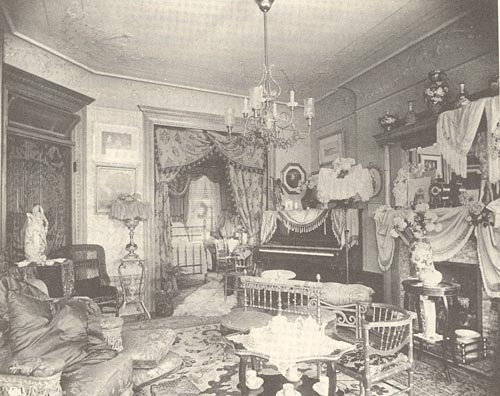
Though I don’t know many people rich (or silly) enough to have one, I have never liked the idea of a room that looks like this.

Image

It looks like the place Darth Vader would go to relax. Even the plants are dead. Give my little Victorian heart clutter any day.

Image

Beautiful, beautiful unmatching clutter.

Image

Touchable, holdable, lovable things.  Things that sit on your desk and wall, and say, “Remember?”(which leads to another “Remember?”…and another and another.)

Remember intercampus mail?

Remember the time Reb made you stop dressing your boy bear in girl clothes?

Remember when you wrapped food up in a napkin to look like a purse and sneak it out of the gala, but then you had to stop in the photo booth first?

Remember when Karen first fell in love with giraffes?

Remember that second day of seventh grade when you were so scared to go back that you threw up, but then you found a brand-new, sunshine yellow beanie baby in your backpack?

Remember your cousins when they were little and grinny?

Remember when George used to sign all correspondence “From a loving brother”?

Remember kindergarten when you were all set to marry Spencer Hill and be a rescue nurse in forsaken places like Nevada?

Remember when you got to fill a new (to you) room and year with these things, and smile at them? Oh, wait. No you don’t. That happens on Saturday. Excellent.

College’s Best-Kept Secret and How to Overcome It (I think)

Here are some reasons that I haven’t written in a while:

1) The next “favorite” on my list was favorite people, and when one really comes down to it, how does one write that entry? Could get a bit touchy, you know?

2) I’ve been working. Mopping floors and filing papers—quite enviable.

3) I’ve been writing. A little story for the new Mr. and Mrs. Upper along with the beginnings of something much longer.

4) I’ve been watching Good Mythical Morning.

5) I’ve been reading Suri’s Burn Book.

6) I’ve been slacklining. (Excuses are wearing thin at this point…)

7) Mainly, I just haven’t.

Before college the inhabitants of every corner of the earth converge to give you conflicting and vehement advice, but there’s one thing no one ever tells you. Unless you’re one of those mission driven people who gets an internship or works at a camp (and if you are, that’s fine, I still love you) then here’s college’s best kept secret: SUMMERS ARE WEIRD.

It goes like this. You come home and you think “Oh! I’m home! It’s summer!” and then you do nice home things and you go to work and you come home at the end of the day and you think “Oh! I’m home… Where is everyone? Oh. It’s summer.”

And that’s when it hits: you thought summer was going to be like partying inside of instagram, but it’s really more like sitting in your messy room looking at everyone else’s instagram, which you’re pretty sure (but not positive) that they’re all inside of partying without you.

So here’s some suggestions for my fellow weird-summer enthusiasts (or not so enthusiasts):

1) Read your summer books aloud: to your friend, to your cousin, to your teddy bear, to yourself.

2) Look up all those quotes whose origin you’ve never actually known, for that satisfying feeling of I-once-was-wrong-but-now-I’m-right.

3) Dry your laundry on the clothesline.

4) Go for a run in the heat, come home and say, “Welp, I did THAT.”

5) Turn halfway down the stairs into your regular hang-out spot.

6) Paint a room alone. Write secret messages in large letters then cover them up and giggle.

7) Try on old clothes and sit around in them for an embarrassingly long time.

8) Drive. Be loud in the car in whatever way you can think of.

9) Go to the farmers’ market on week days to make the venders feel loved.

10) Make lists. Surprisingly easy and surprisingly fun.

Do this and you will be left with a sore throat, extraneous knowledge, nice smelling clothes, a bunch of lists and no pictures or gas. Summer well spent.

Favorite Books

Just now I had the great pleasure of staring at my bookshelf for a couple minutes, deciding what to write to you about. I’ve had these shelves since Mary and I moved into this room when I was about five, and they sag a little with an assortment of classic literature, children’s books, and a growing number of writings on educational theory and policy. I skipped over ones I know you will have heard of. You know Laura Ingalls Wilder, C.S. Lewis, and Harper Lee, and if I have not already told you about I Like You and The Cozy Book, I’m sure I will someday, whether you want me to or not. Also, though I’m appreciative of all the ed books, I am not destined to crack any of those bindings with overuse. What I chose, perhaps unsurprisingly, was almost exclusively kid’s books.

There is something in childhood flights of adventure that is binding. It is the dyscatastrophe and the eucatastrophe, the moral imaginings of battle and redemption and grace. Not that most of these are adventure stories in the traditional sense, but they are written for people who are still small enough to see how grand this Story really is, who have not yet believed the falsehood of everlasting meaninglessness. Thus, when you read these stories, you have to read them like a child, like they matter, else you’re reading blind.

All of the below books fall into one of two categories. Either when I first read them I wouldn’t shut up about them, like I won’t shut up about the ASC in Staunton, VA, or, more simply, I cannot remember a time when their stories were not a part of my bones. They are listed roughly in the order that I first loved them.

The Melendy Books by Elizabeth Enright: (The Saturdays, The Four-Story Mistake, Then There Were Five, Spiderweb for Two) Mary and I sometimes reminisce about these as if Mona and Randy and Rush and Oliver and Mark were real live people we actually knew, as if we too used citronella to ward off mosquitoes, and had a Cuffy to boss us about. Their childhood was my childhood. Last fall, I read The Saturdays to Liesel, and was delighted to discover that it was the same wonderful book I remembered, only better.

The Story of the Treasure Seekers by E. Nesbit: She dedicates it “in memory of childhoods identical, but for the accidents of time and space.” I do sincerely hope that everyone’s childhood contained moments like this, when you went on some complex quest for honor (and adventure,) and anyone who told you it couldn’t be done was only “Albert-next-door,” and not to be heeded. Also, Oswald Bastable is my favorite narrator of all time.

Pinky Pye by Eleanor Estes: The bits of this book that I remember coming back to time and time again are the chapters that Pinky, the cat, supposedly writes herself on Mr. Pye’s typewriter while he naps. The entire story is also good for learning about how to properly enjoy a summer vacation, pygmy owls, and watching.

The Witches by Roald Dahl: You may know this one, but still, isn’t it marvelous? There’s an underground network of evil out to get you and only you, and you and only you can fight it. Grandmothers are wise; pretty women with candy are not to be trusted; one may sustain awkward battle wounds; Quentin Blake’s illustrations are quite perfect—good lessons all. (Also see The BFG.)

The Mennyms by Sylvia Waugh: (followed by Mennyms in the Wilderness, Mennyms Under Seige, and Mennyms Alone) Often when I describe this series to someone who hasn’t heard of it, (which is, it seems, everyone but myself) they get a look on their face as if I’ve smilingly advised them to eat raw meat. It’s about a family of life-sized rag dolls who live unobtrusively at 5 Brocklehurst Grove. The story’s solemn weirdness is just mundane and unselfconscious enough that the entire thing is utterly enchanting. Trust me on this one: Soobie alone is worth the read.

The Penderwicks by Jean Birdsall: When I first got this book for Christmas in 2005, I read it three times in row to myself, then aloud to my family who was stuck in the car with me. I couldn’t stop. It’s subtitled “A Summer Tale of Four Sisters, Two Rabbits, and a Very Interesting Boy.” All books should have subtitles like that. All of them.

The Ruby in the Smoke by Philip Pullman: I’ve never read The Golden Compass, and have no opinion to offer. This, however, is a marvelous little mystery about orphans and cursed jewels and opium dens. He writes chase scenes that actually interest me, and that’s quite a feat. (I am not, strictly speaking, a fast-paced action kind of girl. I like talk.) I have a specific memory of outlining the whole plot for Sarah Moon on Mrs. Liebmann’s board one day, when we should have been doing classwork.

The Thief Lord by Cornelia Funke: I like this book because of Venice, and I like this book because of Scipio, the thief lord himself. It starts as a story about friendship and growing up, then two-thirds of the way through, just when you’re quite comfortable, it begins to spit magic, forcing you to put in some effort and suspend disbelief you didn’t think needed suspending. But really, how could you be a child in Venice without a touch of the fantastic?

The Astonishing Life of Octavian Nothing, Traitor to the Nation: Volume I, The Pox Party by M.T. Anderson: You saw the title—what else can I say? “Historical fiction about the Revolutionary War” doesn’t begin to cover it. Somewhere between fact and fable, it wasn’t written, but lovingly created.

Caring for Words in a Culture of Lies by Marilyn Chandler McEntyre: This one is different. It’s not a children’s book. It’s not even a novel. A family friend and former teacher gave it to me as a graduation present two years ago, and though during its first reading I accidentally dropped it in the slimy spillway at my grandparents’ house, that doesn’t reflect how I feel about it in the slightest. I think everyone should read this book, particularly people who use words on a daily basis. It is about being good stewards of language, perpetually handing it with care and wisdom. In her chapter called “Read Well” she writes about why it matters “Our lives are lived in relationship to words, written and spoken, sacred and mundane. They are manna for the journey.” Golly, I love words…but that’s for another day.

Brief Thoughts on Amendment One

I am doing something I’ve never done before and will hopefully never do again: reeling you in with political sensationalism.

For those of you who either are not North Carolinians, or who have been living under a rock, my home state just passed an amendment to its constitution stating that marriage is between one man and one woman.  However, I don’t really have much interest in talking about the amendment per se, but in people’s response to it. They talk as if the passage of this amendment will utterly desecrate or rejuvenate civilization as we know it.

I think that you ought to care. I think that you ought to seek truth and vote. I believe that the law, in its place, is a very good thing. What I take issue with is people first reading then believing then perpetuating the idea that the outcome of this vote changes everything. Do not simply fall back on thinking in abstractions. That way lies madness. Laws do not change things. People change things by everyday acts of goodness and evil, and those people are changed by spiritual forces. The law cannot stop that. Do not pin your faith to the law.

The law neither saves nor destroys. It does not save because it cannot, and it does not destroy because, biblically, we do that ourselves by smashing our heads against it. God, in His grace, saves us from our own self-destruction. That’s how it works. The law is only a supporting character in the story, so wait on the Lord, live faithfully, and don’t have a cow.

Letter to Self

Having a hard time, dreariness, melancholy, feeling down, heartsickness, depression. There. I said it. Depression. You don’t frighten me!

That is why I have not been writing much. The writers I study in my english classes always  produce great masterpieces from the depths of despair (or at least produce something…), but for me it is simply not so. Perhaps it means I am not a real writer, or perhaps it means that my depression itself is “differently abled.” All I know is, it has certainly manifested itself in less productive ways.

I have spent a huge portion of time watching TV on hulu and generally neglecting personal hygiene. Cool. It is easier to forget how inadequate I’m feeling if I make no attempt to be adequate in the first place. It is easier to run and hide than it is to deal. Easier to pretend that the melancholic little thing I have become has never existed, and that these imaginary characters’ small stories in this next show have the power to infuse me with life again. They do not.

Neither do I really have the power to help myself. I know that. But, meanwhile back at the ranch, I’ve written myself a letter about “waking up and trying.” Because, while writing does not come eagerly right about now, the satisfaction in saying precisely what I mean is a warm, welcome relief.

Self,

I know you are having a hard time remembering about things like swelling opera and sloping fields in sunny Tuscany and the “giggle when a tickle takes.” You’ve been having an even harder time remembering about amazing grace and everlasting arms and Jesus, lover of your soul.

So let’s start with an easy question.

WHAT IS TODAY LIKE? Not only the color, but the texture, the scent, the tang?

How is it different from yesterday?

How is it better?

What do you miss and why?

That too much? No, don’t stare in the mirror and cry–answer me this:

How do you feel about your socks? Are you wearing socks? You ought to, we both know how cold you let your feet get before putting something on them.

Perhaps you ought to take a hot bath and sing a song.

Is it sunny out?

How about wearing a skirt today?

If you put on a skirt I’ll let you look in the mirror. Then at least there’ll be something worth seeing.

Why don’t you read something aloud?

Do you remember the sound of a good sentence snapping into place like brand-new elastic?

I bet you remember the man who wrote this:

I am gall, I am heartburn. God’s most deep decree

Bitter would have me taste: my taste was me;

Remember how he also wrote this:

I walk, I lift up, I lift up heart, eyes

Down all that glory in the heavens to glean out Saviour;

How do you think he wrote both? I know we’re getting to the hard questions here, but stick with me. I’m going as slow as I can.

Do you remember in Persuasion when Anne receives Captain Wentworth’s letter which is “not soon to be recovered from,” and they walk along with “smiles reined in and spirits dancing in private rapture”?

Do you remember in the Great Divorce when the man let the spirit destroy his sin but instead of dying it turned into a magnificent stallion and carried him up the mountain?

Do you remember when Jesus had to tell Mary not to cling to him, because she was so overwhelmed to find her Lord alive, and would not let go?

What I’m really asking is do you remember joy and do you still think it’s worth waiting for?

Do you remember how “having done all, to stand”?

You must be just a little more than “patience on a monument.” Chin up, toots.

Affectionately,

Alice

Happy Heart

I missed a week. I’m sorry. In the meantime I have been thinking deeply about blog ideas. I thought about writing about going running, about heartsickness, about boldness and hypocrisy, about summer jobs, about Hopkins and Emerson, and about the letter V. So here’s that blog entry:

I’m bad at going running; heartsickness sucks; I am not bold, but I am often a hypocrite; I need a summer job; Hopkins and Emerson are marvelous to read; and the letter V is very passionate.

But the blog entry I’m going to actually write you today goes something like this:

I have a folder on my desktop called “Happy Heart” and it is full of other folders which are full of pictures.

My dad took this in July when he ought to have been packing up the car so he and Mom could leave Brookfield. I had just been a mechanic and gotten the belt back on the mower. Also, don’t you love the lake? I miss it.

I love this person.

This is my backyard–mostly my mom’s garden. It was my desktop for a while.

This is my French professor from last fall and my current Symbolic Logic professor. They’re married to each other, and I’m sure they have no idea I’m in possession of this picture.

This is cool.

These are some of my cousins and me on my grandpa’s eighty-sixth birthday. We ate pie and I like them. This was my desktop for a while too.

I love this person too.

This is my dad and my grammy. I like their faces.

We have Storytime tonight. In Heidi’s room. And it’s gonna be  Just. Like. This.

My Very Long Sentence

If the furrows in the dirt were stray fingerprints, as if the entire field were old putty and someone had been fiddling with it while talking to their brother on the phone about the summer when they slept in the apple tree for three weeks until Beth fell out and broke her leg, and Adam took her in the wagon to the hospital, and Dr. Hayden set his first bone and it was Beth’s, and  they remembered it so hard and well that they were squashing the putty of the field down so flat that if that if you settled your feet in the dirt between two furrows and held your chin up like you had a reason, you could see the sunset in China,  now that would be a field to grow the kind of tobacco in that Grandpa grew when he hitchhiked into Royson County wearing only his brother’s overalls and his mother’s straw hat and bought a field from Widow Cohan, who had five sons in the army and whose daughter was mad but who never shed a tear over any of them, on the strength of his brown eyes and the way he held his shoulders, because that field was the one that Gil Cohan had farmed for three years before he went to fight for country and every night he walked the field in spirals and held his chin up like he had a reason and rhymed words to fend off the dark, so when Grandpa sowed that field it knew how to talk and give and grow poetry and the tobacco from it sold for 75¢ in the general store because it tasted like home and smelled like the hope of travel and if you had both those things in a tin of county-grown tobacco you held the world in your hand, and that’s something to remember hard and well.