Violent Graces

A few weeks ago I had a brief conversation with my friend Abbie about the nature of God’s grace, whether it is violent or gentle. To be honest, we didn’t really get into it–we were really talking more about Christian writers and who each of us tended to gravitate towards–but I have been thinking about violence ever since.

I have been thinking about what Marilynne Robinson calls Flannery O’ Connor’s “appalling imagination” and about how that imagination is pretty nearly reflective of the contents of the human heart. I have been thinking about Jacob wrestling with God all night, how he demands a blessing, and how, as the sun rises, he walks away with a limp. And I have been thinking of a Man dying naked and alone of asphyxiation on a wooden cross and knowing it was love.

Throughout human history, many of our truest examples of promise and mercy are red with blood. I believe that violence is usually ugly, and very often wicked and repugnant. The school shooting this week? I do not believe that it was grace. I believe that it was evil. I also believe that God can bring grace out of that situation, but even that is not what I’m talking about.

What I am talking about is our hearts, those hearts meeting God in a dark alley. Coming around a corner and finding the light of light, very God of very God standing there, right where we least expected him. He stands and he offers goodness and grace, but those meetings are so often violent because sinful people like you and me will naturally rebel against goodness. He is gargantuan and clear and bright. We are dusty and crumbling. The light is too brilliant, and it burns us clean and refines us, strips the rot out of our souls. The flames rise higher and higher around us, and we are not consumed.

But isn’t God gentle? Doesn’t he care for the orphan and the widow and the sparrow? Can’t his changes in our hearts be soft and his love be sweet? Perhaps Jacob did walk away with a limp, but didn’t the lepers leap for joy, and run? Christ bid the little children to come to him. I know he meant it.

I am going back to the basics here (I’ve been doing that a lot lately, for my own benefit), but God made us and God loves us. He knows the caverns of our hearts. He knows whether they need soft light or a sharp blaze. He knows how to mold with strong, sure hands. He both pays the fee and does the labor to make us whole, so he knows every part of the job.

I am making a muddy-eyed conclusion, as I usually do, but I think that for most of us children of God, our relationship with the Lord’s grace will be like that of Paul. He goes towards Damascus with murder in his heart, and is knocked down and blinded by the light. Then as he lies in the darkness, God sends Ananias as a bearer of grace to pray for him and baptize him. He gains new sight and a new name. When he leaves that place, everything is different. This is most of our stories, told again and again and again. It is the story of our daily lives. We learn love slow.

“Twas grace that taught my heart to fear, and grace my fears relieved.”

First Year Teaching and Unpaid Debt

I’ve been making notes for this entry since last October. At first I was going to wait a few years to actually say this stuff to the internet-at-large, but I can’t help myself: here we go.

I planned to write a long list of advice for first year teachers, like the one I wrote a year ago when I finished college. But I discovered within about two days of becoming a faculty member alongside wonderful people who wanted to see me succeed, that for every piece of advice there is an equal and opposite piece of advice. So basically, even with the best support system in the world (which, including my parents and former teachers and friends who are a phone call away, I may well have had) you’re going to have to figure it out on your own in the moment, or you’re never going to figure it out at all. And that’s absolutely okay. So that’s what I have to say about that.

But if not advice, what? I guess just a rambling reflection, which is mostly what I do on here anyway. I have grown and changed this year perhaps more than I have in all four years of college. Every day that I have taught, without fail, I have felt both very young and very old. A while back, at play rehearsal I turned to a coworker and said, “There’s five years between me and them, and ten years between me and you, but I feel so much closer in experience to you.” “Yup.” she said. “Weird.” I said. And yet I cry at Caldwell choir concerts, because they inevitably make me feel seventeen again, and while there is something precious about that feeling, it is not quite comfortable either. But being in-between is most of what life is, so this is absolutely okay too.

Looking back I think I went through most of first semester in a bit of shock. I remember one day in September when Lisa came around to take attendance, I told her with a mix of bravado and desperation that they were all present, though I hadn’t even bothered to count them, much less look at my roster. I would doggedly stay up late into the night, making powerpoints and organizing notes, feeling my heart turn to heavy iron whenever a new email appeared unexpectedly in my school inbox. On the rare occasions that I was in a context other than Caldwell, I still couldn’t manage to talk about anything other than school and my students, no matter if my listeners were interested. (Still not great at that, but I’m getting better. I’m becoming more normal again.) Here is a somewhat-exact excerpt of notes I kept for myself throughout that first semester:

Sixteen-year-olds are adorable.

Sixteen-year-olds are little turds who don’t know that teachers have feelings.

At least I haven’t cried in front of students yet. That’s a victory.

I love being observed. It’s the freaking best. It makes me feel safe.

Almost-literal blind exhaustion sometimes hits while driving home.

I stay up late because I want time to myself before I go in the next morning.

It is so hard to get up in the morning. SO hard.

Why does my life have so many binder clips in it now?

Is it going to be like this all year?

IMPORTANT: That day sixth period worked quietly. 11/6. Let it be remembered. [Note: I actually wrote a poem about this day. It’s called “An Ode to My Students’ Silence.”]

But I survived. And stayed marginally sane to boot. I kept in touch with friends who were also first-year-teaching, because the front of a classroom can be a starkly lonely place. It is good to feel as if you’re in the trenches alongside someone else (and now that I’ve briefly taught World War One, that’s an especially vivid metaphor). I watched all of Boy Meets World, and though I remain doubtful that it’s really very kosher to regularly assign essays on a whim at the end of class just because the topic pertains to an issue in your favorite students’ lives, I was reminded that even in the world of nineties sitcoms, it is still possible to be a truly fine teacher and that doing so doesn’t center around making your students happy. And then late one Sunday night in November, when I felt just awful, I found this:
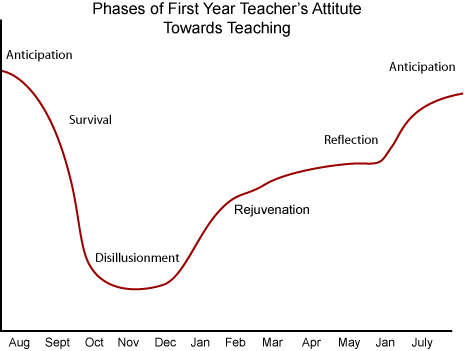
fqjsm

I’m not typically a big charts and stages person, but this is absolute it-gets-better gospel truth. Believe it, cause it’s real. By December, according my notes at the time, I had “all warm fuzzy advent feelings after seeing them sing and getting gifts from them and having them treat me like a real human being and not just a grade machine.” Things were looking up. I was going to be okay and so were they.

In fact, there are a few students to whom I wish I could write individual thank you notes for encouragement they didn’t even know they gave. Highschoolers can cause more pain than they know–but their kindnesses, even unintentional and very small kindnesses, can bring so much joy. The times a student has gone out of his or her way to actually make my day better, I have usually cried (though not in front of them.) And it was a fairly normal but unexpected thing one single student did way back in early December that made me decide not to up and quit when I was feeling a bit desperate.

Really perhaps the thing I have learned most thoroughly this year is the thank you note thing: the value of appreciation and expressing gratitude. When I was a sophomore in college I wrote Dr. Brown a thank you note once and she made a huge deal out of it in front of the rest of the students, and said that sometimes she felt like Christ healing the ten lepers with only one coming back to say thank you. I thought this story was hilarious–I adored Dr. Brown, but she was comparing herself to Jesus, for goodness sake–and would tell it over and over to my English major friends. I no longer think it’s funny. I know exactly what she meant. When you teach and you care that you do it well, you are fighting on the front lines of humanity. You’re teaching the human mind to reach its potential, holding out the world in your hands, trying to get the faces in front of you to comprehend it, to feel their own smallness. There’s so much pressure to get it right, but when you do get it right, often nobody notices, and this is discouraging. To give more than you take, that is what every good teacher does, but no mere mortal can give out of a dry well. We all need water.

So, knowing that, and knowing what I know now especially, I want to shyly and belatedly be grateful to the people who taught me. I didn’t know what it took, and even if I had, I’m not sure I could have understood.  Thank you. Thank you for what you did for me: for crying with me, for laughing with and at me, for graciously thinking it was endearing when I told you bluntly that your class was “not my happy place,” for reading picture books aloud, for letting me run to your room in tears when I first discovered Billy Collins, for handing me that mysterious and wonderful envelope before the New York trip, for letting me sit on a desk during your planning period and just talk and talk and talk. And thank you for what you did for all of us: for heavy worry, for long patience, for giving us the best of what you loved, for volunteering to be Atlas with the world on his shoulders and believing it to be worth the trouble, for finally entrusting each of us to Jesus when it was all that you could do.

I see it a bit more clearly now. Second semester, when my responsibilities began to pick up pace, and when my heart learned to hold on anyway and smile in the wind, I started to care less about what my students thought of me and more about the students themselves. And I didn’t know that in a job in which I was supposed to be the helper, I would routinely feel so helpless to really love them well. So unable and weak. They need so much charity and compassion and help. I know this because I need this things too. I know this because, in our need and inability, we are the same.

Despite all of the doing and learning and trying, the appreciation and the lack thereof, I am discovering a secret which probably most teachers who’ve gone before me know. Education, when you really try to do it right, is debt. An extensive and painfully shining web of unpaid and often unacknowledged debt. We’re all bound and knotted together by it. We give and are given to over and over again, then march off triumphantly into the sunset, as if our spoils are our own, while the ropes of debt tug at our heels. Some days I can’t keep straight who is demanding restitution from whom. There is a colossal owing, and we, none of us, can possibly pay it back. And this, I think, is where education all goes bad or is hatched, where we begin to ceaselessly demand the pound of flesh from one another, or relinquish ourselves to the waist-high waters of grace.

This has been a long and meandering entry, but really there is one reason I have written it: I am preaching to myself. I am saying: “Alice, you feel as if you’ve worked hard and given much, but what you have given is that which was first given you. Your deficits are deep and wide, but they have been filled by a love that is deeper and wider. Your debts have been cancelled by the great Forgiver of debt, the Payment himself. Forgive your debtors as your debts have been forgiven. Look at the world and look at the hands that hold it and remember that you are small. See that your Lord is large and great. Love with liberty and with joy.”

Oh, to grace how great a debtor daily I’m constrained to be. Let that grace now, like a fetter, bind my wandering heart to Thee.

Thankfuls about Teaching

I have just spent all afternoon grading a test on American Democracy and the West, and I am tired.

But on Friday, after my last class, during the peace of a seventh period planning hour, I was sorting through paper and books and I thought to myself, “Oh, I like my job.” Please note: that is the first time that thought has ever “risen unbidden,” in my mind, as they say. That is the first time this year that I have been able to be thankful for my circumstances without prompting.

Not that prompting is a bad thing. A prompting to be grateful is the conscience. A prompting to be grateful is the Holy Spirit. But when, every once in a while, thankfulness arises easily (as it should) then that is grace and I will celebrate.

So here I am, a few days later, trying with all my little might to catch the tail-end of that spontaneous gratitude. I am going to tell you what I love about teaching.

I am thankful for my students. I am thankful for the students who ask questions, especially those questions that begin with something other than “What do we need to know about…” or “Did we go over…” I am thankful for the students who take responsibility for their actions and attitudes. I am thankful for the students whose hands shoot up like air-propelled rockets during class discussion. I am thankful most of all, perhaps, for the students who work so hard that, no matter the final grade, I can feel the sheer effort and earnestness radiating off each page they write for me. I hope they know that I love them, and sometimes even admire them.

I am thankful for the people I teach with. I am thankful for their advice and trust and constant, present support. I am thankful for the pumpkin-shaped basket full of candy in the workroom. I am thankful to sit on roll-y chairs around a big table and eat lunch with them each day. Last week, when there was an open mic hour in forum to for students to thank the teachers, I wanted so badly to get in line with the rest of the kids who were waiting to speak. I am grateful for the sanity these men and women bring. But most of all I am grateful for—more than grateful for, awed by—their steadfast compassion and prayers both for my students and myself. I ceased to be their pupil years ago, but they are still teaching me so much.

And I am thankful for teaching itself. At its best, teaching is a little bit like writing in real-time. (I guess, at its worst, it’s like that too. Like a really poorly organized essay that doesn’t have a thesis statement or even a prompt…) I am thankful for test-writing, which I have quickly discovered is the secret glory of teaching. I am thankful to be pushed to study and then communicate history which I know is shaping me as I watch it shape my students. Stories, especially those that really happened, have the powerful effect of washing over in waves and re-shaping the clay of my soul.

At the core, I suppose I am most thankful to be part of something which is so much bigger than I. In the grand scheme of the educations of these forty-five people, I am the least important facet. Certainly for now, they rely on me, and because of that, as the apostle James says, I’ll be held to a higher standard, so I must give my utmost and beyond. But the responsibility for their minds and the “weight of their glory,” as Lewis would call it does not end with me. I am thankful that though the calling before me may sometimes feel like a burden laid upon my back, we are never asked to carry a burden any farther than Golgotha. At the foot of the Savior, we may drop our weights and duties, for they were His to begin with, and we may worship with empty hands.

A Couple Things I Miss

I am home sick from work because my head feels like an over-inflated balloon, so clearly now is the time to write. There are many good things about teaching, (and I hereby pledge to write to you about them in a couple weeks, just in time for Thanksgiving,) but oh, how I miss writing.

The problem is not that I don’t have the time to write. I’ve never believed that as an excuse, anyway. I always managed to write when I was a student, both in high school and college. If there is time to breathe, there is time to write.

The problem, I think, is that I haven’t yet learned how to let teaching act as a catalyst for writing. Writing is never really born out of itself, you know. You see something or read something or hear something, E.B. Browning writes of the “gold and purple” of her husband’s heart or Don Draper takes his kids back to see his childhood home, and suddenly a wonderfully itchy little ball begins to form in your midsection, and you’re off. It’s that little outside idea which ignites the whole wonderful Rube Goldberg process of getting words onto paper. Unfortunately, I have yet to learn how, as a teacher, to pick up on those little hints to kick-start the machine, and right now my life has time for precious few other sources of inspiration.

I come home, want to write, and review my options: I could begin work on a fourth draft of novel #1, but really I should wait for an agent to help me do that. Right? Right. That’s what they tell me. Well, to attract that agent I should get a few stories published in reputable magazines. This means I should I actually write a few stories. But the only idea I currently have is for a little Flannery O’Connor knock-off, which would probably turn out to be pretty useless. I could work on organizing chapters and scenes for novel #2…But does my room really need that clutter of scribbly index cards when novel #1 still requires so much ripping apart and pasting back together? So I come sidling back to my blog for the first time in almost a month. Hello. I’m rusty with my words, but I’m making an effort.

There is something else I miss. Besides the writing. Something more basic and more valuable. A couple weeks ago I was talking to one of my best friends from college and she mentioned that she might have a family wedding down in my area next fall, and would come and see me. “Jacks, really? Please come.” I said, “I would cry.” I meant it as a joke, I really did, but then there were tears on my cheeks. I miss my friends. I have good ones.

I don’t just mean the girls I went through college with. I mean my sister in Tennessee and my Karen in Madrid. I mean so many of you. Friendship is a wonderfully incomprehensible thing. One can pick up friends in the strangest and most sudden ways, lose them states away, and then find them again years later like the missing right half of your favorite pair of socks. How did this happen? I wonder sometimes. How do you and I find so much to say to one another? And why is it that we would rather be silent together than apart?

Lewis, who I rather think knew a lot about friendship, wrote this:

“In friendship…we think we have chosen our peers. In reality a few years’ difference in the dates of our births, a few more miles between certain houses, the choice of one university instead of another…the accident of a topic being raised or not raised at a first meeting–any of these chances might have kept us apart. But, for a Christian, there are, strictly speaking no chances. A secret master of ceremonies has been at work. Christ, who said to the disciples, “Ye have not chosen me, but I have chosen you,” can truly say to every group of Christian friends, “Ye have not chosen one another but I have chosen you for one another.” The friendship is not a reward for our discriminating and good taste in finding one another out. It is the instrument by which God reveals to each of us the beauties of others.”

This idea that God meant us for one anothers’ lives, to stretch and grow and comfort each other in our own certain ways brings me a particular quiet delight. He knew our friendships would extend over miles and months, that our worries and prayers for one another would form fine threads connecting us from here to there to the next place, elongating till their length could wrap round the whole world. Those continuing threads of affection are what He intended. I am so thankful.

Oh, look… Somehow my God has given me a small, but perceptible, path from discontent to gratitude. How good it is to miss things. How near to nostalgia lies joy.

Meaning What I Say

I feel as if this blog has turned into a rather haphazard space over the past few months and for that I apologize. If you want to know what I’ve been busy doing, particularly for the past couple weeks, my main occupation has been going around and telling people how tired I am. I have quite a nice little speech about it now: I begin by talking about emotional exhaustion and end with a few glistening little tears. Very affecting, I’m sure. And it is true. I do always strive to mean what I say. If I tell someone that I am tired, or I say that I am alright in that staunch, plaintive way, I will feel tired and alright for the rest of that day and possibly most of the next, because I have said that it is so.

But I am other things besides tired. Tired is not the only thing. So I will tell you the rest of those things now. I will say them, and help myself along the road to meaning them.

I am amused. I am amused by this semester’s eclectic “Things Done” list. I am amused by Dr. Brown’s excitement that she knows someone who has seen T.S. Eliot. I am amused by the inexplicable ways some people indent their emails. I am amused that last night at two o’clock I found myself sitting on our table complacently eating sweet potato and rutabaga because I could not sleep.

I am hopeful. I am hopeful for my little novel. I am hopeful for the midterm essays I have due tomorrow and that perhaps I will do laundry soon. I am hopeful for my friends, for their courage and their patience. I am hopeful for coming spring.

I am awed. I am awed to write and to breathe and to sometimes sing. I am awed not only to have found a friend in Ernest Hemingway and Flannery O’Conner, but in Ralph Ellison and even occasionally William Faulkner. I am awed that sometime recently I seem to have stumbled into a venerability which allows me to call myself a woman, and not merely a girl.

And I am certain. I am certain that my God is good. I am certain that I am His. I am certain that He means all this: the long cold spells, the singing birds in the still-bare trees, the rising sun in the clouded sky. I am certain that my God always and eternally means what He says.