A Different Kind of Studenthood

This may take a while to write, but as I’m beginning, I’m sitting in a room full of freshmen who are writing an in-class essay. There’s a hum of heavy breathing and pencils on paper and turning of pages as they refer to notes in their books. It seems both familiar and distant.

I have been teaching for a year and a half and still it still catches me unawares sometimes that I’m no longer a student. That I’m no longer passing papers down the row, or digging my binder out of my backpack, or throwing caution to the north wind when an essay prompt is set in front of me. The sun is not slanting through the window in the back corner and warming my back, like it is for the kid who sits by the wall. I am up front driving and pulling and pushing. Sometimes my shoulders hurt at the end of the day from the weight of it.

In the moments when it does get calm, though, calm in the midst of the hourly storm, sometimes I remember myself in high school. I liked it. I was a good kid. I cried a lot but I was happy. I was generally sweet and smart. The best things I did were read and write. Also once I gave twenty dollars to a friend just because she needed it. That was the highlight of my good-doing.

I was sensitive. I used to take in every little thing, feel every motion around me, bend with all my weight. I remember laughing and screaming and crying. I remember really, really caring that people saw me laugh. (I did not care if they saw me cry.) Funny. All of my memories are so loud, even though most of the people I went to high school with probably remember me as quiet.

For the past week or so, I have been feeling stabs of envy toward my students. I wish I was still free to ride the waves of my feelings, wallow in my stinging misery, let wild, self-conscious joy overtake me. When I was a teenager, I was very certain the world was mine. It felt lived in. On selfish days, on narrow days, I look at those loud kids I love, and I want the world back.

This is ludicrous, of course. I have re-written this paragraph five or six times in an attempt to tell you why. I have tried to lead into it several ways, but now I will just give up and tell you. God is bigger now than he was back then. Not always closer or easier or clearer, in fact, sometimes just the opposite, but larger and greater and stronger and more, oh yes. How could I ever return to a diminutive God?

That is not all. I “see the choices a bit more clearly.” When I was sixteen and seventeen, I was only just beginning to believe that failure existed. Now I am at what seems to be the designated age for coming to terms with failure. As is, I think, usual, I am finding failures in myself in droves and having to decide each by each, with every failure that rises out of my gut, whether I will fight it or kneel to it. These are the options. Or they would be the options if I served a God who would fit in my pocket.

But because I do not, there is grace. Because I do not, I may give my failures away. Acknowledge them as my bastard offspring and offer them up for destruction to a God who is very large and getting larger by the second. A God who will break me and change me and shape me as the sun warms the back of the tired, nervous kid who sits by the wall.


In Praise of Light and Salt

My grandfather died a week ago tonight. (Don’t worry, not many more entries will begin this way.)

He left us less than three months after his wife of sixty years, which is not surprising, but no less hard. This feels like the second half of a whole is gone. In September, when my Grandma died, we felt truncated and sober. Now sometimes we lose the feeling in our legs and we must reach down and check that they’re still there–he did show us how to stand on them, didn’t he?

On Monday night we prayed and my mom said that it felt like some of the light and salt had gone out of the world. It did–it does. There is no better way to explain him than to tell you how he lived.

In 1954, he graduated from medical school in Iowa, got married, and, in 1956, moved down to a tiny town in north central Missouri to  start a practice. And he stayed. While other doctors moved in and out of town, he always stayed.

In college I wrote a paper on small-town doctors, and in the process I interviewed both my grandparents. I dug that paper up last night and reread it and found myself smiling at the difference in the stories each of them wanted to tell. My grandma, who had a love of a good story and an even greater love of her husband, showcased him as the compassionate hero of the town. She talked about the time the child with the suicidal mother called in the middle of the night and he had to go and talk her down by himself, because the sheriff decided he wanted a full night’s rest. She talked about how he regularly treated the local prostitutes, one of whom would periodically slit her wrists, and then call him at his house for a ride to the hospital. The other had such great respect for him that she named her son after him and once asked him to testify for her good character in court. (He declined.)

Grandpa told different stories, though. Smaller stories, which always focused not on himself, but on the things he got the opportunity to learn or to love. He told me about coming out to the barn once and finding a lamb that had gotten into the feed box and was gorging himself. Annoyed, he knocked it out and went on with his chores, and when he came back later it was dead. “That was a good lesson to me not to be too harsh with people as well as animals,” he told me. He always said these things in a soft, light tone, not as if he were preaching it to you, but as if he were preaching it to his own heart and it was just possible you might benefit from it too.

He also talked a lot about delivering babies. Delivering babies was his favorite thing. I knew that, but I asked him why. “Everybody’s happy, even the baby,” he told me. “The baby’s crying, but happy.” He loved life, he loved its beginnings, and he loved its preciousness just as he loved the God who saw fit to give it to His people. Probably half the population of Brookfield over the age of twenty-five was delivered by my grandpa. Sometimes, growing up, I would be approached by strangers who told me wide-eyed how he had attended their entrance into the world: farmers, Walmart greeters, tired single mothers in screen-print t-shirts. All of them spoke of him not only with respect, but with a sort of foreign joy. When these same people would approach him, he would tell them, with quiet but evident pleasure, “Oh, I didn’t recognize you. You’ve changed.”

I meant to say more, but I am worn out and a bit overwhelmed by even beginning to tell these stories and here is why: we all, my siblings and cousins, even my mom and her brothers and sisters, we all grew up being told what a good man our Dr. Howell was. My grandma ceaselessly sang his praises to her children and later to her grandchildren. Not only my mother, but also my father, consistently used him as an example to us of patience and humility and godliness.

But here is how I am wonderfully baffled: this was not just the mythos surrounding a beloved figure. Everything we experienced of him bore it out. It was all true. I am sitting alone on my bed right now miles from most of my family, but I can confidently speak for all of us: he was the best man we knew. He is still the best man we know.

This is important. I am typing very slowly now because I am fighting for the words to tell you how important. For a while in his seventies and eighties my grandfather led a Bible study at a maximum security prison about an hour away in Moberly, Missouri. When the prison officials first asked why he wanted to do such a thing he simply said, “Well, I believe that the Word of God changes lives.” He said this because in the early 1940’s in Cumberland, Iowa, the Word of God changed his life. The Word changed his life and continued to change it. My grandfather and his kind are important, because in a world full of fear and violence and bitterness, where even as Christians we cling harder to irony and mockery than to truth, they are proof that God can clean a sinful heart so new and clear that goodness can shine through it like morning sunlight and fill the room. They are proof that holiness is real and strong and will triumph. And that holiness is what Jesus means for each of us.

About two weeks ago, when we got to my uncle’s house for Thanksgiving, I walked into the kitchen and Grandpa was hunched over the table, thin and gaunt, focussed on finishing a sandwich, breathing heavily with each movement. I asked him how he was. “Greatly blessed,” he said. He knew. Oh, he knew.

Ho! Everyone who thirsts,

Come to the waters;

And you who have no money,

Come, buy and eat.

Yes, come, buy wine and milk

Without money and without price.

Reading, Writing, and Living

I finished two books over Thanksgiving break. One of them I started way back in August, but that’s neither here nor there. Both were strongly recommended to me by teacher-friends and roughly the size of bricks: East of Eden and A Prayer for Owen Meany.

I finished the first on the three-and-a-half hour drive from a Minneapolis airport hotel up to my uncle’s camp, way north of Duluth. Although there were parts that made me feel cold and unsure, the last quarter of that book made me warm. It’s a story about overcoming evil, but wonderful and frightening: it’s about overcoming evil within ourselves, about the ultimate powerlessness of sin in the face of mercy. So I liked that.

And then, three days later, on the drive back down to the airport, I finished Owen Meany. Or rather, I meant to, but the lead up to the final scene that I knew was coming got me more and more worked up and, although I never get car-sick, I began to feel nauseated and laid the book down on my lap. I sat crushed in the backseat of the little rental car with my aunt and my brother and looked out the window at Minnesota’s shades of white and grey and wondered when reading had become such a harrowing experience.

When I was a kid, reading was like breathing–I did it inside, outside, on my bed, on the couch, on the floor, in the bathroom, under the table. But even as a child I knew there was a limit, that there was such a thing as too much. Once, when I was probably nine or ten, I read four books in one day, and each time my mother or some other demanding force pulled me to the surface, I came up for air snarling and unhappy. I was so deeply immersed that the world of my books seemed more real than the world around me. From that day on, I judiciously set myself a “no more than three books a day” rule (which now, as an adult with access to Netflix, I have no trouble sticking to.)

But the way I felt last Monday, driving to the airport with Owen Meany in my lap, reminded me of that four-book day. I knew how the story was going to end–each detail of the last scene was painstakingly, loudly foreshadowed and even explained. But I was drowning in it. Eventually we got to the airport, and before even going through security, I bought a bottle of orange juice, sat down, and read the last fifteen pages or so, through the ending that I had been both anticipating and dreading. My stomach still felt queasy. “You don’t read enough.” I told myself over and over. “You’re just not used to this kind of emotional involvement anymore.” The TSA officer who checked my boarding pass told me to smile, and I gripped the novel through my purse, wanting to slam it into his face, notify him of what I was experiencing.

Finally, a few hours later, just before landing in Midway on a very crowded plane, I wrote a poem. I have been writing one every Monday for the last few months, so I figured that though I still felt awful and also unsure of where the barf bags were, I would go ahead and get it done. It began as a poem telling God what it was that I needed at this dreadfully harrowing emotional moment in my life and then, a brief two stanzas later, it ended with him telling me that he already knew. Oh. He knew.

I put my notebook away and felt warm and comforted and, for the first time all day, hungry. Writing gave me instant relief. Input and output: the novel had run right through me, been let out at the end by my poem, and I was clean and new, like a glass pipette.

I’ve been thinking about all that this week, coming up with morals and conclusions about the ultimate purpose of the story-telling and the written word and self-expression, both our own and other people’s. But I keep getting stumped on one thing: what about living? What about real experience? What about each second that ticks and each movement of our hands that never gets recorded or even remembered, but still is the thing which shapes us most intently, wears the grooves into our souls?

That Friday, while helping my mom with our belated Thanksgiving dinner, I sat at the counter in my aunt’s kitchen making rolls. I tasted a corner of the dough, and the soft tang of the yeast brought me an overwhelming sense of missing. The recipe is a family friend’s, passed down by my grandma, but the person those rolls made me miss was my sister far away in London. She is the one to make them every year in our house, to turn up the music in the kitchen, to roll them out, to crowd them in that pan, to pack away the leftovers, to eat and eat them for days after the holiday. I was doing a shoddy, lumpy job compared to her.

Later that evening, we sat in the living and sang Thanksgiving hymns (which several family members claimed to know very few of) and I again thought of Mary, who knows all the words, all the notes on piano, who loves to sing along, and loud. I slipped out of my seat, sat halfway down the basement stairs and cried.

In the actual living of our lives, feelings of missing and longing and love and assurance and doubt rope their way around our hearts and are not dealt with by the writing of one poem, or by the writing of twenty, I would guess. But he knows, God already knows. And he “keeps us with repining restlessness.”

Our hearts are restless till they rest in You.

The Fixed Land Receding

Writing is getting harder than ever. I hate that.

I can find the time, and sometimes I can even find the ideas, but there’s a paralysis that creeps up my arms and into my throat when I try to paste words together into thoughts, and it’s getting more and more difficult to fight through it. Like I said, I hate that.

Lately I have been praying that foolish, wonderful prayer for God to teach me fear and trembling. I remember in the prayer room at Grove City, both in the communal journal and on the butcher paper on the walls, our precious overabundance of English majors used to write out John Donne’s sonnet in earnest to their Lord: “Batter my heart, three-personed God, for you as yet but knock, breathe, shine, and seek to mend…” Sometimes I smile and shiver when I think of all the ways He must be answering those prayers. Then I think of my own prayers and immediately want to pull my knees tight to my chest. Fear and trembling…

Of course, my life is pretty stable, I am returning for a second year of teaching at Caldwell, with almost exactly the same load I had last year, and I am living with my best friend of 14 years in an apartment less than a mile from the house where I grew up. I have never been an adventurer.

And along with getting ready for school, I’ve been watching a lot of Friends. It’s been fun. I’ve been thinking, though. It’s a show that’s supposed to be this iconic look at what it’s like to be in your twenties, how you need something to center yourself on, how you need (wait for it) your friends. Because it’s at this point in our lives that many of us realize that we are finally out there, in the big old world that’s been so criticized and lionized to us. And what and how are we going to do from here?

Perhaps the first thing everyone my age has noticed is that friendships are harder now. I have many friends but I have to work and work to love them and to hear them. I have to set up phone dates and answer texts. Even for the friends here in town, we have to constantly invite one another into our lives, add seeing one another to our to-do list, make the time even when we don’t have it.

When we do get together, we catch up. And I will tell you a dreadful secret: I am sick of catching up. I love these people, and I want very much to know how they’re doing, but at some point I’d like the conversation to progress into something more. (I first realized we were really and truly grown-ups when people my own age started politely asking how my family was.) I’d like to actually participate in living with one another, instead of just getting the recap highlights reel.

We talk about our jobs, our attempts to find them, and our attempts to find the work of our own hands in them. I will say, it’s been a peculiar joy to me to see so many friends light up: This is it! This is hard and this is good. Or even, This job is not what I meant at all, at all. But now I think I know where I’m headed, and once I get out of here, I think I even know how to get there.

I often walk away from these conversations thinking about teaching and high school. When I first got up in front of a class last fall, I was startled at how familiar these kids seemed to me. Their laughter and their shrugs, their bitterness and innocence showed me myself at sixteen and myself at twenty-two. But I was somehow simultaneously shocked to find that there was also a great chasm between us. I am stunned by the minute and large ways you change and grow as you enter the long corridors of your twenties. This is the age when the sounds in your head at last quiet down, when, for better or for worse, you can finally hear yourself think.

And so here each of us twenty-somethings sits… Lonely is not the right word, although it’s a very real possibility for many of us. Solitary is better. Alone with our souls and the Lover of our souls. Other people still matter, oh how they matter, but they don’t have the power over us that they used to. We are discovering that we “hang always upon the cross of ourselves.” “The mind has cliffs of fall,” and we have begun to peer down over them to learn the depths and the heights. There are tall, bright waves crashing at the bottom.

In Perelandra, C.S. Lewis’s science fiction retelling of the Fall, the one command the green lady must obey is to never spend the night on the “fixed land.” When she goes to sleep she must lie down on one of the floating islands in the seas of her world, and trust God that she will wake up in a place where he still cares for her, even if it’s quite different than any place she imagined or knows.

I am twenty-three, I have clambered onto a floating island, and the fixed land is receding in the distance. I am calling out for it as I watch it go. I am afraid. I know: this is not safe, but it is good.

On Flying

We are two weeks out from the start of school, and I am beginning to get nervous. There is so much to do and think of and plan and write down, not to mention all the time I obviously need to spend worrying about the things I can’t control. Of course, back-to-school nerves are probably one of the more common feelings in the world. There’s a newness and a freshness to that first day that can never compare to the first of January. It’s all short haircuts and tans and deeper voices and words that move faster than they did before and smiles that aren’t yet tired.

But sooner than we expect, all of the gloss and new-clothes smell will wear away and we will be left with those Mondays where our greatest accomplishment is getting out of bed in the morning. I am content in the understanding that some days, even some weeks, 6:43 am may be my proudest moment, so long as I remember that as I stand bleary-eyed in front of a mirror and march into school with a heavy bag on my shoulder, so much above and beyond me is being fulfilled and achieved.

As a child I didn’t necessarily believe I could fly, but neither did I quite believe that I couldn’t. I understood that as far as physics were concerned if I climbed up onto a roof, and took a running leap with my arms outstretched, that the air would not catch me. The ground would catch me, along with all my broken bones. And yet I was fairly sure that the business of soaring and dipping and twisting through the trees and into the clouds didn’t just concern physics. It made a sort of inherent sense to me that though my arms didn’t look or behave like wings (and in fact looked and behaved very much like arms) that didn’t mean they couldn’t actually be wings underneath. If, you know, some day…I did decide to try… I had an eager, soft little heart that loved the air and the heights better than the bruising, itching ground.

Last week we went on a family vacation and the cabin we stayed in had a swing. I swung on it only once, the day we got there, and just a couple minutes on it resurrected a whole hearty body of forgotten loves which I had allowed to be buried by a host of teenage and adult fears of  indeterminate origin. I remembered that swinging is one of the few physical activities that I have never thought makes me look foolish, I remembered my starved appetite for the wind in my ears and my clothes, and I remembered the pure, unexamined desired to get close and into the center of the blue sky. I realized I had never really changed my mind. I am twenty-three and am not quite convinced that I can’t fly.

I‘ll be very clear with you, I have been grumpy today: I was sullen with my sister and got more upset than perhaps was justifiable over a car insurance meeting that went too long. (I almost kicked the cat.) But I want so much to remember that there is a sky. I want to lay my fear down on the concrete curb and look up to see if it might be a good day for flying. I want to be able to remember that swing at 6:43 am in February. I want to be able to set aside my cynicism (just a grown-up brand of fear), and feel the wind from my Lord’s treasuries. The hope in my seven-year-old eyes gazing out into the sky from our backyard swing is no less real than the heavy fears of February. In fact, it might be real-er.

My Mother and Lessons in Grace

If you come right down to it, summer has never been my favorite season. I don’t mind the heat, and I love the sandals and the dresses, but eventually everything gets kind of murky in all the long hours there seem to be. I always start off excited for the freedom, but then I get a bit lost in it. Even when I make myself plans like reveling in all the reading and writing I can’t do during the year, even then, I get a bit lost.

But lately I’ve been grateful for my mother. It has taken most, if not all, of my growing up years to understand what a phenomenon she is.

I remember when I was very small hearing my dad refer to her as pretty, which, at the time, was very shocking to me, because she was my mother. I expressed my skepticism, and she looked at me with her eyebrows raised. “You don’t think I’m pretty?” “Well, no!” I said. My parents just turned to each other and laughed like grown-ups did. I remember being very offended. (Turns out my mom is beautiful.)

And I asked her once in high school if she worried about us when we were out late, and she said breezily, “Oh, no, I just start planning your funerals.” At the time I thought this was her way of saying no, of course not, but it occurred to me, years later, that it was actually her way of saying yes, of course.

I like to tell these stories, but they do nothing to communicate the steady, everyday effect she has had on me. Just now, I happily, willingly, practiced my cello, and yesterday I changed out of sweatpants into shorts before I took a walk in the heat. These small acts seem unremarkable, but they took years of dedication on the part of my even-more-stubborn-than-me mother. I have moved out now and she takes great care to invite me over for dinner at least once a week, and text me often to meet her to take a walk.

And it occurs to me more and more as I tell her all my worries, and try her patience with my tears, that she has never once offered me the easy way out. She has always, insistently, offered me the way in: make yourself go, make yourself write, make yourself read, make yourself eat well, make yourself pray, and always make your bed. Her cures for my ailments never offer a break from life, but instead life itself. She is the one who suggested I write a paper to present at an academic conference in the middle of my first year of teaching, for no other reason than because I could. Her perennial lesson is to use what’s been given you. Read the book because it’s good, and wear your hair down because you can. You’ve been given hands, feet, a brain, a home: use them, use them, use them.

Grace is hard. To accept good things, to lose the world and gain your soul, is painful. I thought that I learned this in college. But now I am beginning to think that I will be learning it over and over again, with fresh pangs, for the rest of my life.

I have been given freedom: take it up, like a cross, and use it, use it, use it. Thanks, Mama. I’m learning.

10311933_10152051899016400_4895253154327407191_n

Houses of Memory

For weeks now I have been dealing with things: unpacking and repacking them, dusting them off, sorting them out, holding them in my hands, throwing them away.

About two weeks ago, my mom and my aunt and I went to out to my grandparents’ house in Missouri to pack it up, to begin to get it ready to sell. We moved them up to Minnesota almost ten months ago, and since then the house has sat still, their aging black lab wandering aimlessly and heavily in and out of his dog door to garage, being fed by a family friend, the swimming pool hosting gleeful clans of mosquitoes. Various children have come by a few times: the fridge was cleaned out, the books were sorted, choice pieces of furniture were taken. Most of the beds got clean sheets. But that has been it.

When we got into town we went by Walmart to get cleaning supplies: paper towels, trash bags, work gloves, lighter fluid, and matches. Over the course of five days we sorted through about half the house. My grandparents lived in that house for more than fifty years, and for people who I know have stored up their treasure in heaven, they have so, so much stuff.

Highlights included a book of Ronald Reagan “full color” paper dolls, three Chinese checker boards, a forty-year-old speed reading course neatly packed in its own blue case, hundreds and hundreds of cassette tapes, three doctor’s bags full of hypodermic needles and prescription medication dating back to the seventies, drawers and chests full of baby and doll clothes, a 1993 picture of grandkids at a family funeral which someone had had produced as a jigsaw puzzle and then never opened, a ziplock bag of stockings neatly labelled as “Not Best Stockings”, designer ties mixed in with the polyester ones, boxes and boxes of microwave popcorn, dozens and dozens of Mason jars (some still containing homemade jelly,) and boxes of old forgotten family correspondence, all along with seven dead mice, thousands of mouse droppings in drawers and corners and plastic bags, and one small wasps nest.

We sorted things into piles to sell, to give away to the local charity shop, to take home with us, to go in the dumpster, and yes, largest of all, to throw on the fire out back. I carried huge bags out to toss onto the flames, and sometimes I would stand and watch them burn: all of these things which had sat so patiently at the back of a crawl space or at the back of a drawer, now gone so fast. Pages and pages of old medical journals turning ashy black, their edges curling and disintegrating. Boxes of ant-infested sugar cubes turning into syrupy brown rivulets, burbling down the side of the heap.

On our drive out to Missouri my mom told me about the paper she was writing for the conference she and my dad are at this week, and she explained that in ancient times, when education placed a great emphasis on memory, particularly memorized oratory, teachers taught their pupils to use a device called the “house of memory.” As a young man memorized his speech he was supposed to build a big house in his mind and walk through it as he recited. Each room was supposed to remind him of a different point or counterpoint, and then lead smoothly onto the next point in the next room. If you stayed safe within your illusory house as you spoke, you would not get lost in your own words.

I am very good at remembering: my sister and I have a running joke that I remember her own life better than she does. And because I am good at memory, I prize it very highly: to remember what has happened feels like having all the answers stored away for a rainy day.

And my grandparents’ home has always served as a tangible house of memory for me: It is the center of my extended family, the place I can remember all of them and all of our Christmases and summers. As we packed up the end room, and piled old appliances and furniture in the middle for the dumpster, I kept looking around and thinking about my uncles who grew up here when this was “the boys’ room”: they have gotten tall and grey, but the wooden paneling and the bright blue carpet still remembers them as scruffy loud little boys, reading Peanuts books, just as the now busted out doctors bags remember all the patients my grandpa cared for so faithfully, and the Mason jars remember my Grandma’s hard, satisfying work over a hot stove.

I know that memories can be a burden. But I also know that my grandparents are so old and have forgotten so much. If I cannot remember things for them, I wish I could at least hold onto the things that saw them when they did remember. But I know that it is better to try to live with empty hands.

Tomorrow I am moving into my first real apartment, so I have spent the last several days packing. While I do not hoard, there are certain things I have quite a lot of: I have a lot of dresses, tights and blankets, I have twelve boxes of books, and I have huge amounts of paper: mostly in ratty old notebooks of different shapes and sizes. Most of these things (except some of the paper) will come to my new home. I will not stay there forever: the new memories I will make in the rooms will become old, and I will leave them behind. It’s unavoidable, I’m going to forget. I’m going to forget my sixth grade email address and why I chose it. I’m going to forget what my cousins looked like when they were babies, I’m going to forget what year I took that favorite class in college, I’m going to forget students’ names, I’m going to forget what I did on my nineteenth birthday.

And someday I will probably forget that my grandma read Proverbs at the breakfast table. But she did not read Proverbs to her children and grandchildren so that we would remember that she read Proverbs at the breakfast table. She read Proverbs so that they would they would teach us to strive to “get wisdom” and “keep understanding.” And they did. They do. She would not mind if I forgot all the rest, so long as I remember that.

The old that is strong does not wither / Deep roots are not reached by the frost.

First Year Teaching and Unpaid Debt

I’ve been making notes for this entry since last October. At first I was going to wait a few years to actually say this stuff to the internet-at-large, but I can’t help myself: here we go.

I planned to write a long list of advice for first year teachers, like the one I wrote a year ago when I finished college. But I discovered within about two days of becoming a faculty member alongside wonderful people who wanted to see me succeed, that for every piece of advice there is an equal and opposite piece of advice. So basically, even with the best support system in the world (which, including my parents and former teachers and friends who are a phone call away, I may well have had) you’re going to have to figure it out on your own in the moment, or you’re never going to figure it out at all. And that’s absolutely okay. So that’s what I have to say about that.

But if not advice, what? I guess just a rambling reflection, which is mostly what I do on here anyway. I have grown and changed this year perhaps more than I have in all four years of college. Every day that I have taught, without fail, I have felt both very young and very old. A while back, at play rehearsal I turned to a coworker and said, “There’s five years between me and them, and ten years between me and you, but I feel so much closer in experience to you.” “Yup.” she said. “Weird.” I said. And yet I cry at Caldwell choir concerts, because they inevitably make me feel seventeen again, and while there is something precious about that feeling, it is not quite comfortable either. But being in-between is most of what life is, so this is absolutely okay too.

Looking back I think I went through most of first semester in a bit of shock. I remember one day in September when Lisa came around to take attendance, I told her with a mix of bravado and desperation that they were all present, though I hadn’t even bothered to count them, much less look at my roster. I would doggedly stay up late into the night, making powerpoints and organizing notes, feeling my heart turn to heavy iron whenever a new email appeared unexpectedly in my school inbox. On the rare occasions that I was in a context other than Caldwell, I still couldn’t manage to talk about anything other than school and my students, no matter if my listeners were interested. (Still not great at that, but I’m getting better. I’m becoming more normal again.) Here is a somewhat-exact excerpt of notes I kept for myself throughout that first semester:

Sixteen-year-olds are adorable.

Sixteen-year-olds are little turds who don’t know that teachers have feelings.

At least I haven’t cried in front of students yet. That’s a victory.

I love being observed. It’s the freaking best. It makes me feel safe.

Almost-literal blind exhaustion sometimes hits while driving home.

I stay up late because I want time to myself before I go in the next morning.

It is so hard to get up in the morning. SO hard.

Why does my life have so many binder clips in it now?

Is it going to be like this all year?

IMPORTANT: That day sixth period worked quietly. 11/6. Let it be remembered. [Note: I actually wrote a poem about this day. It’s called “An Ode to My Students’ Silence.”]

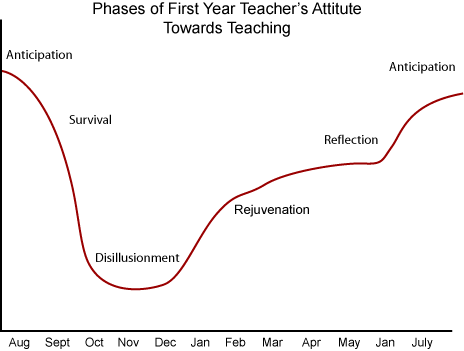
But I survived. And stayed marginally sane to boot. I kept in touch with friends who were also first-year-teaching, because the front of a classroom can be a starkly lonely place. It is good to feel as if you’re in the trenches alongside someone else (and now that I’ve briefly taught World War One, that’s an especially vivid metaphor). I watched all of Boy Meets World, and though I remain doubtful that it’s really very kosher to regularly assign essays on a whim at the end of class just because the topic pertains to an issue in your favorite students’ lives, I was reminded that even in the world of nineties sitcoms, it is still possible to be a truly fine teacher and that doing so doesn’t center around making your students happy. And then late one Sunday night in November, when I felt just awful, I found this:
fqjsm

I’m not typically a big charts and stages person, but this is absolute it-gets-better gospel truth. Believe it, cause it’s real. By December, according my notes at the time, I had “all warm fuzzy advent feelings after seeing them sing and getting gifts from them and having them treat me like a real human being and not just a grade machine.” Things were looking up. I was going to be okay and so were they.

In fact, there are a few students to whom I wish I could write individual thank you notes for encouragement they didn’t even know they gave. Highschoolers can cause more pain than they know–but their kindnesses, even unintentional and very small kindnesses, can bring so much joy. The times a student has gone out of his or her way to actually make my day better, I have usually cried (though not in front of them.) And it was a fairly normal but unexpected thing one single student did way back in early December that made me decide not to up and quit when I was feeling a bit desperate.

Really perhaps the thing I have learned most thoroughly this year is the thank you note thing: the value of appreciation and expressing gratitude. When I was a sophomore in college I wrote Dr. Brown a thank you note once and she made a huge deal out of it in front of the rest of the students, and said that sometimes she felt like Christ healing the ten lepers with only one coming back to say thank you. I thought this story was hilarious–I adored Dr. Brown, but she was comparing herself to Jesus, for goodness sake–and would tell it over and over to my English major friends. I no longer think it’s funny. I know exactly what she meant. When you teach and you care that you do it well, you are fighting on the front lines of humanity. You’re teaching the human mind to reach its potential, holding out the world in your hands, trying to get the faces in front of you to comprehend it, to feel their own smallness. There’s so much pressure to get it right, but when you do get it right, often nobody notices, and this is discouraging. To give more than you take, that is what every good teacher does, but no mere mortal can give out of a dry well. We all need water.

So, knowing that, and knowing what I know now especially, I want to shyly and belatedly be grateful to the people who taught me. I didn’t know what it took, and even if I had, I’m not sure I could have understood.  Thank you. Thank you for what you did for me: for crying with me, for laughing with and at me, for graciously thinking it was endearing when I told you bluntly that your class was “not my happy place,” for reading picture books aloud, for letting me run to your room in tears when I first discovered Billy Collins, for handing me that mysterious and wonderful envelope before the New York trip, for letting me sit on a desk during your planning period and just talk and talk and talk. And thank you for what you did for all of us: for heavy worry, for long patience, for giving us the best of what you loved, for volunteering to be Atlas with the world on his shoulders and believing it to be worth the trouble, for finally entrusting each of us to Jesus when it was all that you could do.

I see it a bit more clearly now. Second semester, when my responsibilities began to pick up pace, and when my heart learned to hold on anyway and smile in the wind, I started to care less about what my students thought of me and more about the students themselves. And I didn’t know that in a job in which I was supposed to be the helper, I would routinely feel so helpless to really love them well. So unable and weak. They need so much charity and compassion and help. I know this because I need this things too. I know this because, in our need and inability, we are the same.

Despite all of the doing and learning and trying, the appreciation and the lack thereof, I am discovering a secret which probably most teachers who’ve gone before me know. Education, when you really try to do it right, is debt. An extensive and painfully shining web of unpaid and often unacknowledged debt. We’re all bound and knotted together by it. We give and are given to over and over again, then march off triumphantly into the sunset, as if our spoils are our own, while the ropes of debt tug at our heels. Some days I can’t keep straight who is demanding restitution from whom. There is a colossal owing, and we, none of us, can possibly pay it back. And this, I think, is where education all goes bad or is hatched, where we begin to ceaselessly demand the pound of flesh from one another, or relinquish ourselves to the waist-high waters of grace.

This has been a long and meandering entry, but really there is one reason I have written it: I am preaching to myself. I am saying: “Alice, you feel as if you’ve worked hard and given much, but what you have given is that which was first given you. Your deficits are deep and wide, but they have been filled by a love that is deeper and wider. Your debts have been cancelled by the great Forgiver of debt, the Payment himself. Forgive your debtors as your debts have been forgiven. Look at the world and look at the hands that hold it and remember that you are small. See that your Lord is large and great. Love with liberty and with joy.”

Oh, to grace how great a debtor daily I’m constrained to be. Let that grace now, like a fetter, bind my wandering heart to Thee.
Lessons from Cinderella and Jake Barnes

I’ve watched a lot of movies since the beginning of college–most of them alone, on a computer screen. I like watching things this way. I feel free to criticize or adore whenever and however I want. I get to watch on my terms. Funnily enough though, when I give myself that choice I almost always choose criticism. I’ve gotten in the habit of quietly dissecting and improving and making-over most everything I watch. But last weekend I went and saw the new, live-action Cinderella with my family. I put my feet up on the empty theater seat in front of me, and let the whole thing carry me away.

It’s a beautiful movie shot in all the color you could wish for and told with complete openness. It looks at grief and joy and meanness and hope and tells each bit as straight as it can. I loved the end: when Cinderella is found because the sound of her voice carries out the open window and her unasked-for forgiveness makes her stepmother sink down and lean against the banister of the stairs with the weight of it. But I think the moment I loved the most was when Cinderella walks into the ball. She has arrived a bit too late for comfort, and she comes down the stairs by herself, with no one to announce her. Strangely, what was most evident to me was not that she is beautiful or hoping to find Kit, but that she is walking into a room alone. I have walked into a room alone, you have walked into a room alone–some days it is the bravest thing that we do. She descends with all eyes on her: nameless to all of them and probably already loathed by every woman in the room. Step by step she approaches the bottom of the stairs, and she has no idea what will happen when she gets there.

Then, late this past Monday night, I found myself on a little mental jag, when I should have been going to sleep. I lay in bed and thought about Jake Barnes in The Sun Also Rises: where he begins, and where he goes, and, most of all, where he ends up. He pines over Brett, letting his own physical inability to have her smash the side of his face down in the dirt and pummel him with punches again and again. He lets his wounds, real and imaginary, take him over and he throws away his self-respect and his aficion for bullfighting by letting Brett have, and ruin, the hopeful young Romero. But that’s not the way he ends: after everything that happens in Pamplona he literally goes into the sea alone, washes, and comes out clean.

And that’s when I thought of it: Jake’s like Cinderella. Perhaps this is silly and those of you who love Hemingway or fairy tales more fully than I do are looking askance, but let me try to explain.

When Brett sends for Jake, he signs the wire with love and loyally goes, but somehow he has unhooked her from his soul: he eats more than he drinks as they have lunch together, and the last image of the book–the raising of the policeman’s baton–means that Jake is willing to seek manhood and courage and meaning wherever he may have them, and lay the wounds of war and love to rest. This is him walking into the room alone, perilously free of the self-pity and self-sabotage he has had to protect him for so long.

All the good stories tell the same truths (this is why I love literature) and the principles which motivate Jake and Cinderella at their best are very near to one another. Though community and closeness and hands that hold onto yours are very important, there are things that can really only be learned alone. To walk into the room, to “have courage,” to “be kind,” to “get to know the values”: these are ultimately acts chosen by, and affecting, the individual soul.

As I have been thinking about this I keep remembering that this sort of independent bravery is  what I want for my students. The ones of whom I’m the most proud are the ones who are able to love their classmates without being swayed by them, who have found their own feet and are learning to stand on them: to walk down the steps, to raise whatever baton they’ve got.

But then I laugh, because really, who am I kidding? If I am telling the whole truth, I must admit that this freedom is what I want for myself–not to follow the scents and sights around me but instead, to be prepared to be separate, to be new and be different, to transform instead of conform. I want to be willing to find goodness and meaning outside of where the world has told me it must lie, and, though strange eyes may look on, to allow myself to be cut from a different cloth.

Two Weeks

I am a first year teacher, and all year I’ve struggled with how to write on this blog–how to tell the truth, but tell it slant. There have been discarded entries (which I never had in the past) and few which did not really come out how I intended them to. There has also been a lot of staring at the blank page. I want so much to give a clear picture though, because writing helps me understand. The past two weeks have been strange and full and often strangely, fully good, and I want to tell you about them, but even these 336 hours have seemed to contain a lifetime.

I went to play practice for hours every afternoon and night and decorated the set with my favorite books stacked along the back wall.

As part of their prank, the seniors built a ball pit in the room I teach in. So I taught about Imperialism for a few minutes, but then I let my students sit in it and play with all the bright colors, while they wrote letters to someone they were thankful for. And I got to wear a princess crown all that day.

We prayed together during the junior girls’ Bible study and as a faculty at lunch one day–for those who are sick and those who are scared. (Those people are sometimes us.)

Lauren Robinson and I both graded all 44 senior thesis papers in a week and a half. I sat on the floor behind her desk on Wednesday afternoon madly calculating final grades, while the freshmen giggled their way through speech presentations. Late that night the two of us painted the rock, barefoot, with Paul Simon on full volume in her truck. They all passed.

My front tire got slashed by some unknown enemy.

I went down to the gym for a few minutes to watch the juniors and seniors have their last dance lesson. I was charmed by what a good time most of them seemed to be having, but was also deeply grateful that I was no longer out there on the floor.

I ate brunch with Sarah Moon, and we talked about things that were not students and teaching, and it all felt very surreal.

I averaged about four hours of sleep each night.

Students brought me food and Starbucks unbidden and I didn’t know what to do with myself.

It briefly seemed as if my social security number had been stolen by someone in Vermont, and I laughed very hard and happily at the prospect of someone wanting my identity. (It turned out to be a clerical error.)

I got tired of giving critical notes to the students at the end of rehearsal, and just decided they were all cute and could act however they wanted. (Thank God for multiple directors.) Instead, I wandered around Target and Walmart trying to find all the shades of foundation that our supply boxes were running out of and wished I knew something, anything about make-up.

While walking back in from letting my chaotic sixth period do their reading questions outside, I tripped and dropped my large stack of grading all down the stairs. I couldn’t think of anything to say, so I sat down and just looked pathetically back at my students, and they picked it all up in a stunned silence.

I watched our pride and joy, You Can’t Take It With You, from the audience each night and it was still funny every time, even when the fireworks didn’t go off. I laughed and I grinned and sometimes I felt very, very sleepy

And then I turned twenty-three, which is simultaneously much older and much younger than I feel.


Sometimes, in these past two weeks, I have felt blessed and unaccountably successful. At other times, I have wanted to find a small, cozy hole, crawl into it until we reach July, and then bring the calendar to a full stop, preferably for quite some time. But after oversleeping this morning and then cleaning the bathroom while listening to Andrew Peterson, I feel smaller, more on kilter, as if I can fit comfortably into my skin again–I think I had been leaking out of it for a while.

When I write I try to organize and find meaning between all the little things, but it is not always easy. Sometimes I must be content to believe that the truth is somewhere between “Life is pain, highness,” and “Love is all we have left in this world, Grandpa.” I must trust, trust, trust, that my God knows the substance of all this: the bungled works cited pages, the loudly laughing teenagers, the spray paint that took days to wear out of the creases of my fingernails, the chai tea lattes on my desk. He knows what all these little shadows mean.

For now we see in a mirror, dimly, but then face to face. Now I know in part, but then I shall know just as I also am known.