Going Back Home

On Wednesday, my dear old freshman hall had a progressive Thanksgiving dinner in the apartments. I have loved these, my girls, since way back, even before this entry more than three years ago.

Here is how we were Christmas of freshman year:

Image

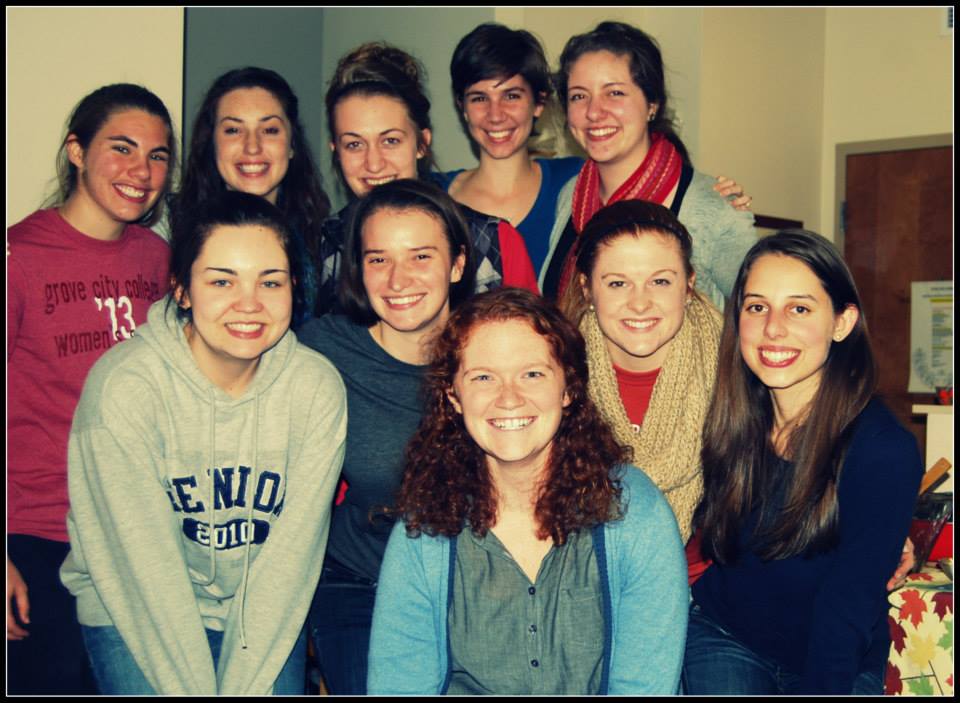
And here is how we are Thanksgiving of senior year:

Image

Just look at how cute we were then and how grown we are now.

Sometimes when we sit around we like to talk about the old days on the Fam Pan: the days of parties in the bathroom and poop posters and yelling down the hall for noms and Storytime and leftover ice cream eaten in the hall-butt and doors that stayed open all the time. We like to remember and say, Man, I wish we all saw each other more. I wish we could do that again.

But the future is already coming fast towards us in a big frightening wave of built-up expectations and unpaid bills. We sometimes feel that we’re in danger of being washed out and away to sea. We want to go back. Take us back.

Nostalgia itself is comforting. We are pleased that we can remember, that we’re wise enough to look back and know that the good times were good. (Real perceptive. Well done us.) But, of course, what we really want is not to go back to the past, but for our pasts, or at least our favorite parts of them, to become our futures. We want the safe yesterdays which we loved to be transplanted to our tomorrows to do over and over again. (As if the future wasn’t its own self, as if God didn’t have plans for it too.)

It’s funny because we’ve got nostalgia all wrong. The divine point of the longing we feel is not to fill it, but to know it, to understand what it is we long for.

There is a painful gaping hole in each one of our chests and sometimes we can feel the wind whistling through it. The hole will not be filled by wading into our pasts, or even our futures, and picking through for the best bits: the late nights up with dear friends, the long exhilarating road trips, even the dripping popsicles and small sticky faces in the summertime. We can stuff all the dreams in the world into that misshapen hollow to try to fill it and yet we’d still be able to look down and see right through ourselves to the other side. Really, as far as the eye can see, the hole is not going to be filled at all. Its edges will continue to ache.

But then again, the eye can’t see very far. It is shortsighted and weak, and would be blinded by the wonder of Him for whom the heart truly longs.

Someday, we’ll go back home again, really home, to the God for whom we were made, and our shoulders and eyes will strengthen so that we’ll be able to bear the weight and the sight of the Glory that will fulfill our feeble longings.

So for now, when we remember, we must remember that.

Things to Do, Things Did, and All Saints

I’ve been keeping a journal for a while now—two years on Saturday, actually. It’s a bound notebook that my friend Heidi decorated for me sophomore year and every day I write two lines in it about what I did, what I saw, what happened. I do it, I suppose, so that I can read and remember. For example, the entry for October 27, 2011 reads, “Am Lit midterm – sweater over flannel – Bible Study – felt better about tenure.” I don’t usually write about what I wear, but apparently it felt important to me that day, and not that this will clear things up much, but one of the entries the day before had been “cried about tenure.” Whatever that means. The next October 27th was a bit more even-keeled: “cleaned at JB’s – lazy afternoon – Lunch w/ Lu – did no homework whatsoever.” That was a Saturday and this year the 27th was a Sunday: “Quiet morning – coding w/ John in early aft. – early church – All Saints Vespers – just a Sunday : ).”

I’ve never been successful at keeping a journal before, but this seems to be sticking. I like lists, and keeping track, and knowing what happened when and how, and reading over and watching old worries grow and then fade back into oblivion. I’m a record-keeper.

I’m not alone. Here’s a favorite to-do list by Johnny Cash himself:

Image

I’m willing to bet he did real good on all those things, except that last one. I think we keep these lists because we figure if we know all these little things, if we have it all stored up, when the time comes we’ll be able to see the big important things better somehow.

I’d been thinking about that and then Sunday night I went to the All Saints Vespers and thought about it some more. I thought about keeping track for not just two years of college, but through long centuries, through so many lives and deaths and prayers and graces. Christina Rossetti promises her hesitant audience, “Yea, beds for all who come,” and that’s a lot of beds. Really, though, beds for Christina herself, Jonathan Edwards, Eric Liddell, my Grandpa, Flannery O’Conner, Joan of Arc, Aunt Jean from camp, Paul, Corrie Ten Boom, Tolkien, Rahab, Dietrich Bonhoeffer, Gerard Manley Hopkins…“all saints” is a lot of saints. Why do we keep track?

Well, because on Sunday evening I kneel with brothers and sisters of mine and pray aloud to Him “whose nature is always to have mercy.” We’re all members of the marvelously sprawling society of the previously lost and we must stick together, so as to remember what it means to be found. We know the taste of grace, and when we forget it those around us and before us will remember. “But the mercy of the Lord is from everlasting to everlasting on those who fear him, and His righteousness to children’s children…” (Psalm 103:17) The work of the cross stretches farther than you or I can see.

So all the scribbles and notes and records of practicing and cleaning and lunches had and walks taken are an anchor till the “yet more glorious day.” I will keep marking things down in homage to those who did so before me. Around the turn of the fifteenth century a woman named Julian of Norwich wrote in the midst of illness, “All shall be well, and all shall be well, and all manner of thing shall be well.” Everyone from T.S. Eliot to my own mother has read and believed her words. I don’t know if they’ll get nearly as much from me, but I’m trying. I’m making lists, keeping track.

Pieces

I don’t usually write these things late, but I haven’t been able to sleep much lately, so here I am. Hello. I haven’t had much of an appetite either. My gut has been full of pointless nervous energy and I feel like I’m in pieces. I do not feel whole.

Today I got up and boiled some chicken for later, and put on a favorite dress from freshman year, and went to chapel, and came back to finish studying for my Civ Arts test and wander around my little apartment in concentric circles. Finally I headed up to campus, and took the exam, and went to an English-major-tea, and came back to cook dinner for some friends. (Well, really, they did a lot of the cooking. And all of the cleaning up.) They made me play my cello and I like them anyway. Afterwards one of my dearest friends came over and told me something very hard and I sat and listened and hurt for her. Then I read a chapter of Elizabeth Enright aloud and hugged her.

Those were the pieces of my day and I cannot put them together as I would like, or at least, not yet. So I’ll just tell you what else I’ve been thinking about.

We’ve been studying Da Vinci’s Last Supper in Civ Arts, and Dr. Munson says that Philip is his favorite. Jesus has announced that one of his disciples will betray him and Philip has risen from his seat and pointed to himself. He has seen the blackness of his own heart, and he knows the traitor must be he.

I have a very clear memory of one day in fifth grade walking back from PE class. After we filed past Mrs. Hedgecock’s room, she emerged, irate. She claimed that one of us had pounded on the door as we passed and disrupted her lesson and she was determined to find out whom. Nobody fessed up. I cannot remember why it was so important, but Mrs. Hedgecock, Mrs. Thomas, and Coach sat us all down very seriously and told us to put our heads down. They told us to raise our hand if we were guilty. Even if, perhaps, they said, we thought we could have done it on accident and had a slight lapse of memory. If there was the smallest chance it was us, we were to raise our hand. Well, I reasoned, I didn’t remember what I had been up to when we’d been walking that part of the hall. I was sure my mind had been wandering, though, so I put my hand in the air. When we put our heads up, all three teachers were hiding smiles. We immediately asked who it was. (So much for anonymity…) Ah, well, they said, only one person had raised their hand, and they were quite sure this person wasn’t the culprit, so best just to move on… The issue was dropped, and I sat quiet and red-faced in the corner.

I haven’t learned my lesson, though. I am still strangely eager to take blame. And I don’t want to let go of it, either. I cannot speak for Philip, but I still snap my eyes shut tight, and thrust my hand in the air. It is easier to take the guilt than to learn love, to learn mercy, to give, to take, to crack open my chest to the elements.

And here, at the solution, is where I am stuck, and the cursor just blinks at me. I will hazard a guess into the white space, though. I need to stop raising my hand in response to a call for confession, and instead start bodily throwing myself at the feet of the Great Blame-taker. I need to stop saying morosely, “I did that. I did that thing.” and start crying, “YOU TAKE IT. I CANNOT! I CANNOT!” Then He, in His goodness, will take not only my guilt, but me. And He will make me…whole. I cannot conceive of it right now, but He will mend pieces of which I can make no sense.

 I am so weary.

The Next Thing

You guys, blog entries don’t always solve my problems like they should. That’s why I write them, you know: I get upset and thinking about something and I start composing like mad in my head, then within a day or two I get it all out on the page in a big hunk of cathartic vomit, then everyone tells me how nice it is and I pat myself on the back and feel much better and go on my merry way. Unfortunately, a few weeks later I realize I’m still pretty screwy in the same old ways, and I already wrote about it, so there’s nothing else to do now. Drat.

One particular entry has continued to sit in my gut, though I wrote it months ago. It is the one about living up to my own expectations, making a dreadful little god of the woman I think I ought to be.

This tendency has all been especially apparent lately with my attempts to write fourteen novel pages every two weeks for my independent study. Somewhere along the line I’ve convinced myself that not only must everything I write turn out brilliantly, but it must be wonderful from the first draft, that the plot of an entire book must knit itself together seamlessly in the first attempt. So, with that in mind, I sit down to write every day and vacillate routinely between terror and despair.  I mean, if I can’t do a simple novel right on the first try, what am I worth?

I’ve been stumbling along anyway, sending weak kicks in the direction of the imaginary-Alice-who-can-do-all-things, and gratefully soaking up encouragement from Dr. Potter, and the book I’m reading on fiction writing, and the friends who say I’m over-thinking it.

And yesterday my mom sent me an essay in the mail called “The Judgment of Memory,” by a man named Joseph Bottum, who was, at the time, editor of First Things. It was mainly about memoir writing, about our tendency to write about our parents and childhoods (my parents are brave to encourage this habit of mine), about the way in which we dilute our own memories, about the way in which modern writers shy away from story and myth and substance, and instead give marvelous little detailed descriptions of things between which they are ultimately unable to draw a connection.

This conflict between focusing on details or plot is not just present in writing, in the way I squeeze words onto a page, but in my own life, in the way I spend my time, in the way I occupy my mind, in the way I rest. It is comfortable to look at small things like myself and my words and my to-do post it note for the week. It is uncomfortable to try to fit grand archetypes and ideals into my compact, inelastic life.

Details come easier because they can be added unto the all-powerful vision of ideal-Alice. The story comes hard because it is His. She does not exist in His story: there’s only Him and me. In fact it’s mostly Him. He was in all these places first. He “father’d-forth” all I see and all I know. Joseph Bottum writes that “In the end, every sentence with the word I in it is a lie: self-justifying, self-righteous, self-conscious, self-sick.”

So, what to do? How to follow along as He tells the story?

Way back freshman year, I wrote a frustrated little entry called “Weather and The Woman Question“ and Mrs. Liebmann commented and told me not to worry, just to “Do the next thing.” (That advice immediately skyrocketed right up there with “Don’t take yourself too seriously,” and “Say what you mean.”) It is not really as hard as I like to pretend to figure out the next thing. The next thing after this is to practice my cello, to write a page, to finish my laundry. I know how stories go. I’ve got lots of examples of lives well-lived.

For Christ, the next thing was usually something like eating dinner or going to bed or praying or talking to his mom or making a table. Sometimes, though, the next thing was healing a lame man, or casting out a whole horde of demons, or overturning a bunch of tables. One day the next thing was to be forsaken and to die. On Sunday, the next thing was to get up and walk out of a tomb.

Which means that the next thing for you and for me is really, simply this, from Luke 8: “Return to your own house, and tell what great things God has done for you.”

Lord Bless Saturday

I have had a lot of thoughts in my head this week. My little mind has been overwhelmed with details and ideas and nineteen credits and conflicting plans. Last night I got the chance to talk to several dear friends from home. I told one of them that even though the weekend was here, I couldn’t seem to figure out how to rest: whether to be with people to escape from my own harried thoughts or to sit by myself and wait out the storm in my head.

I’m still not sure. Right now I’m emotionally undone: there are too many people and things to care about. I so much want to love it all well, and I feel like I’m doing only a passable job. But lists are easy and soothing, and so, in inexact order, here is my advice for myself this weekend:

1. No Quad business until Tuesday night when it’s time for coding. None.

2. Do not offer to cook for anyone until Thursday at the earliest. You already have too many leftovers.

3. Ask for help when you need it.

4. Fold your laundry.

5. Remember that you are incapable of irrevocably screwing up your life with one decision about classes.

6. Don’t go anywhere besides church on Sunday.

7. Make it a priority to read well rather than finishing everything.

8. Wear t-shirts that you like.

9. Lock yourself away somewhere with your novel pages. Try to write words that make sentences and when you are too frightened to go on, pray to the One who “shall enlarge your heart.”

10. You are small. Just because everyone else seems to be able to handle it perfectly, doesn’t mean you must. The only thing you must do is ask loud and clear, as John Donne does, for “that grace to begin.” That’s all that’s required. Christ has done the rest.

Waiting

I will warn you right now: I am not writing because I have anything good to say. I am writing lost.

I had two conversations today with two different friends about two different topics, which all turned out to be eerily similar. They were conversations with people whom I care about and trust, in which I cried and they asked questions and gave advice. This is normal. There are a lot of nice people in my life and also I cry a lot. The general consensus is that Alice is a cuddly, weepy, very-open book.

But both of these conversations were different than usual. They did not spend very long in my familiar little landscape of problems. For some reason both of them veered off towards the unknown—towards places I had not planned for them to go. They were asking questions whose answers are hidden behind walls in my soul.

I did not know I had walls in my soul. I thought I had no secrets. I was frightened. I wanted tell my friends, “No.” I wanted to get up and walk away and never come back. But there are rules and precedents about how you treat your friends and so each of them earnestly scaled the walls and started gently poking around in my sooty heart of stone and its strange, sulfurous crevices of blame.

Their careful questions overturned in me harsh, short answers, and their glaring advice made me writhe. “No, it is dark down here! Do not bring a light—it hurts my eyes!” I wanted to say. “These things are not for seeing—they are for forgetting.”

Finally I told them each that I was waiting. I told them that understanding and healing and all-manner-of-things-shall-be-well would come in God’s time. (So that they should never again try to go beyond those walls. I would not be dragged back there again.)

I’m really good at waiting. At sitting, at being the last found in hide-and-seek, at stagnating, at rotting to dust in the corner.

Before I may live there are many things my God must kill, but before He does that I must admit that they live. But I’m not ready. I can’t. I’m waiting.

A Back to School Entry

Right now my computer is nestled on an improvised little cooling pack I constructed from the hotel ice machine so that it won’t overheat. This is not a joke. I really want to write to you. Tomorrow morning I move in for my last year of college. I’m nervous—I didn’t think I would be, but I am.

Coming back to school after summer always seems a little unreal. Three months is just long enough that college has stopped feeling like a concrete part of my everyday life and become just a story I’ve been telling myself for a while—something to entertain me on slow days. Yet it’s a story I’m about to be thrown into. A story about a little apartment, and two final semesters full up with eighteen credits each, and stacks of pretty old plates bought from Goodwill, and a novel waiting to be written, and baking on a Sunday, and Latin to be learned, and Fam Pan pot luck dinners, and looking for a big-girl job, and a magazine of which, for some funny reason that I can’t remember, I’m going to be editor. Though I’m an hour south of its beginning, I still don’t quite believe it. It all feels so foreign.

But sometimes I do believe it—that I am going back tomorrow to places and people in which my own tears and joys have worn hollows. And then I am scared.

In seventh grade I went to a new school, a school that was not Caldwell. I cried the whole first day. They did not know what to do with me so they bumped me from one classroom to another.  I sat in the back of each by the little row of computers till the teacher tired of me, and my contemporaries craned round at me and asked curiously “What you cryin’ for?”  (For them, of course, it was simply the first day of school, not the end of the world as they knew it.) The second day, I was so frightened to go back that I threw up. My dad made me go anyway, and I made a friend.

A year ago, I was waiting to move into, not a new school, but a one which had already been mine for two years. I was as scared as my seventh grade self, though I handled the fear a little better, I think. I didn’t throw up, but I sat up for most of the night and read The Man Who Was Thursday in its entirety. I’m fairly certain I sobbed through the last couple chapters. After move-in, I was generally happy, but it took the anxiety weeks, maybe months, to wear away. (I don’t remember. I keep close track of many things, but not of that.)

As for tomorrow and this week and this year, what I am afraid of are the lurking disappointments, the weeks I cannot carry, the nights I cannot sleep. I am afraid because tomorrow, when senior year begins at last, it will no longer be my own pet fairy tale—Someone else will be telling it.

But then, He told seventh grade, and He didn’t do too poor a job. I made several close friends and we had long involved sleepovers. I learned nothing of academic value. I made up a secret language. I got my first dramatic haircut. I was beaten to death in a class skit about slavery. I was the star of the seventh grade cello section. My skin got a little thicker. I learned to loathe busy work. My fashion sense hit an all-time low involving oversized hoodies and ripped jeans. I made a couple cool dioramas. I was happy in a place in which I’d planned to be miserable.

He told last year too and I started winning at game night. I wrote a story I really liked. I watched in awe as friendships healed. I gave a paper at the Herbert conference. I went through a brief and unenthusiastic running phase. I fell in love with my classical ed class. I learned a little more about grace. Sarah and I made a “Things Done” list. I received my weight in Wall Street Journals and built a somewhat successful table from them. Dr. Messer asked me if I’d be senior editor of The Quad. I cleaned Dr. Brown’s house. I performed a scene in Shakespeare class while on the verge of fatigue and was told that I portrayed Imogen with a “kind of frail madness.” My God gave me so much beyond my desserts.

He will tell this year too. I don’t know what turns it will take, and I’m sure the denouement is beyond my comprehension, but if I wait upon Him He will renew my strength. He will walk with me. He will grow my fear to awe. He will show me Himself.

Coming Up Clean

I’ve just put lotion on my ankles to soothe my bug bites and I am tired. I’m in a slow and simple mood this evening, so I’ll just tell the story from the beginning, though it is not spectacular. Perhaps because it is not spectacular.

Last Friday I got up at four forty-five and my dad drove me to the airport in Raleigh. I met Mary in Nashville at about eight-thirty and we set off driving up through Kentucky and Illinois. We stopped at a rest stop around lunch time and made sandwiches on top of her trunk out of rye bread and cookie butter. We laughed so much that some nice people at a nearby picnic table asked us to join them. We are so magnetic. However, we said ‘no, thanks’ and instead walked around and contemplated ousting small children from the see-saw so we could have a go. But, of course, we had already had our turn on that same see-saw when we were their age. We’ve driven this road so many times.

In St. Louis, I unwittingly pulled off at a gas station in a rather shady neighborhood. We got out of the car and did one quiet circuit of the little convenience store, then just climbed back in and kept going. By the time we got up to Macon and turned onto 36 a few hours later, my chest felt light like it always does when I pass through that place at that time of day. The fields stretched wide arms, speckled with hay bales, and the road rose to meet us, leading up into the low, late-day sun.

We got to Grandma’s in time for dinner, and then took a walk with my cousin Hannah up to the cemetery across the highway, where we typed in the secret code at the entrance for old time’s sake. My grandparents have arranged for plots there. Hannah read aloud from To Kill a Mockingbird while Mary and I did dishes.

The next morning Mary and I began the two-day task of taking our grandparents and aunt up to camp. My grandpa is frail. He cannot lift his feet well. He uses a cane and he struggles to lift his head up high enough to look straight ahead of him. His sweaters never seem to go on right and are always hitched up over his collar. He shuffles. Our trip was full of halting steps and slow. We stopped at a Walmart north of the Twin Cities to pick up about ten things Grandma had forgotten. I had to relearn much of that sort of patience which has fallen out of use at college.

And yet, that last thirty minutes of the drive held the same glow. Grandpa started telling us miles beforehand how much the topography looked like camp, then we passed The ICO and a moment later the great big Story Book Lodge signs came round the corner and we were home. It is sixth or seventh on my list of homes, but I knew it was higher for everyone else in the car, so I borrowed from their awe and comfort.

I can’t tell camp in order. You never can, especially a family camp. Mary and I stayed in the Ark, which was very cozy with two beds and its own alarm clock. I spent lots of time with cousins. We attempted a couple games of Monopoly, which will never be enjoyable, but also went kayaking, met Hannah’s friend-boy (not boyfriend,) played Old Maid with Grandma and Sally, and drove over to Virginia after evening meeting one night to see Wolverine. It turned out that it was in 3D, which no one except the boys was pleased with, but giggling and snarky comments have improved many a cousin film.

On Thursday we threw Molly a little family party for her eighteenth birthday. We made Mary Brammer’s Black Forest Torte (a family classic), Faith passed out glow sticks, and when Joe would not come down in time to sing, our Aunt Sally scaled the stairs to retrieve him. (That was our favorite part.) We took lots of pictures. I was impressed with how we have grown up. I don’t mean that we have gotten taller and more employable, though we have, but that I saw in my cousins something better. I saw that they are kinder, more willing, harder-working, more thoughtful, and unabashed (though perhaps, with each other, we have always been that.)

But noticing more than I used to includes the less savory. I saw problems with good people in a good place. I saw imbalances, injustices, frustrations which I knew would go unaddressed, things which made me itch to change and fix them. But that job was not for me.

Instead, after every meal, Mary and Molly and I stood behind the counter to receive the rush of dishes. We scraped and stacked the platters at record pace, consolidated bowls of ranch dressing and emptied pitchers of water and milk. Afterwards we helped with pots and pans—I was always on dry-and-put-away duty. Mary had set up her slackline, which magically attracts people of all ages and sorts in clusters, so she took great joy in knowing the names of all the little kids and their intricate relations. I just liked knowing that the wide rubber scrapers went in a certain drawer in the bakery and that the cutting boards went under the microwave. It made me feel important.

On Wednesday evening my cousin Charity was baptized down in the lake along with three other teenagers. (I can call them that now that I no longer am one.) The sun was setting way over behind the island and I watched as each of them came up clean, at sharp angles with the water, their hair dripping smoothly back from their faces, their arms crossed over their chests, leaning into the arms of their fathers. Then they would slosh back to shore and stand shivering in a towel to be hugged by their family.

I thought about coming up clean out of the water and out of the “soul-cleansing blood of the lamb,” not just once but over and over. The best message of the week was on Friday morning. Ben Scripture talked about trading in excuses for simple confession. We confess and Christ is eager to intercede. We are always needing fresh washing, new garments, but they always come free. They come free and they come strong. I must let my Father cleanse me of frustrations and weights which are not mine to carry. They are His, as I am.

We left camp on Saturday morning. Sunday morning we passed the fields of smooth, white windmills in northern Iowa. I remembered why even when we were younger, my cousins and I always got so quiet at this stretch of highway. They are unimaginably big and rather beautiful, but they are also frightening to me. They call up a small, stubborn Don Quixote out of my chest, ready to fight a hundred other battles which have not, in reality, been given to me.

So I came back to Missouri in peace, handing my grandpa his cane at rest stops along the way, and stopping at a Russell Stover outlet for my grandma. Back to the only place I am comfortable hanging all my laundry out to dry, even my most inexcusable underwear. The pool filter needs to be run. This is the job my Father has given to me, so I will come up clean, tend to those bug bites, and have a chat with my sister. There’s more road before us.

How We Look

Just to quickly get you up to speed: my mother bought a ping pong table, I bought an ice tray that makes cubes shaped like lightning bolts, Kate Middleton had a baby who will be king and her hair still looks gorgeous, and at the moment I’m holed up in my Dad’s library study at UNCG, wearing the ancient sweater and corduroys he keeps in here over my own clothes, because this place is cold.

It’s with a few healthy tons of trepidation that I’m writing this entry today. It’s something I’ve wanted to write about for a long time. I’ve been afraid of saying the wrong thing, but at last I’ve decided to just go ahead and put this out there. Maybe I feel ready for this because I’ve finally achieved Gandalf-and-Solomon-level wisdom, or maybe I’ve just been reading enough C.S. Lewis that I think I have. I’m not sure.

What I have to say is about the way we look, specifically the way we women look, how others look at us, how we look at each other, and how we look at ourselves. There are two prevailing cultural attitudes, both strong, which tend to sit in our guts and battle it out all day long.

First, there is the all-powerful objective of female beauty that every man, woman, and child knows and accepts to some extent. I generally have pretty high self-esteem when it comes to my looks, sometimes too high, but I find that if I look at Vogue for more than fifteen minutes, though it was just to see the clothes and though I thoroughly understand the risks, afterwards my own reflection looks faded and plain in the face of such mighty photoshop. Features of which I was previously proud look second-rate and pitiful in comparison to the powerfully glowy women in glossy color.

In order to combat these images and the unhealthy habits which follow in their wake for some, we are told (mainly by the internet) that we are all gorgeous and bikini-ready, that the best thing is health and confidence, to love our scars and our flaws, and that what really matters is just to have beautiful insides. Well, it’s hard to adore acne scars, (they have not yet tried to force us to think acne itself beautiful, thank God,) and my actual heart is not a very attractive thing—to the best of my knowledge, though its ability to keep me alive is admirable, it’s slimy, filled with fast-moving blood, and is currently making sounds like a mudsucker.

So with all these quiet comparisons of one benighted attitude to another and the size of our own waists with that of the girl walking past us on the street, we come to the muddled conclusion that we are supposed to love ourselves and fix ourselves into a more lovable state, all while seeming to care a great deal about the female self-image in general, but not what we see in our own mirror. By no means should we think and talk about the way women look any less than ninety minutes a day, and with each analytical session, we should come to an increasingly complex understanding of our physical appearance, such that we must eventually write a book (or blog entry) to purge ourselves and begin anew. Essentially, we learn that secretly it is part of our duty as women to be slowly and subtly exhausted by the fact that we have bodies and they are visible to the naked eye.

Well, perhaps I am not Solomon or Gandalf or even C.S. Lewis, but I was raised by two fairly wise people and one of the most valuable things they’ve bestowed on me is a healthy sense of the ridiculous, which I’m just now clumsily learning how to use. By all means, take your God and your work and your play quite seriously, but upon most occasions it’s best to assume that you are a bit silly. As Liesel and I used to tell each other, “People are funny.” You are a funny, truculent child, who never quite understands what he is being taught, and who, when he does begin to grasp truth, immediately misunderstands it on purpose and endeavors to be offended.

But I’ll tell you, there is mystery all wrapped up in humor and incredulity—we laugh at things we don’t understand, at things which don’t make sense, which are beyond our comprehension. Our physicality is part of our humanity—we are physical beings as well as spiritual (see the incarnation)—but it’s obvious that our bodies are pretty ungainly and silly for sacred vessels. C.S. Lewis says that the fact that we have bodies at all is “the oldest joke there is” and Saint Francis regularly referred to his physical self as “Brother Ass.”

So as women who own mirrors and occasionally see other women, what does this mean? Well, I’m only just now trying to figure that out, but I’ve made a little progress. Remember your body is on loan, but that you’ll have it for a while, so treat it with affection. Look in the mirror and laugh, walk away and forget what you saw. Buy lovely clothes and sometimes wear them. Stand up straight. Accept compliments gracefully, but walk away and forget those too. Make friends with those you’re tempted to be jealous of or judge. Use nice-smelling conditioner. Think you’re beautiful or think that you’re not, but don’t think it very often, and remember that in either case that fact has no bearing on the incredible reality that Christ died for you.

For our bodies, all beautiful and silly and ugly like they are, are just a small, funnily-warped reflection of a glory ahead of us. But I don’t understand that yet, so, for now, I’ll just wait and look and laugh.

Letting Her Die

When I was a little girl I had all sorts of plans for the great lady I was going to be when I was grown up. I was going to be elegant and kind and sought-after and I was going to wear the best sort of clothes and have one of those bell-like laughs you read about in less-truthful books. I was going to be infinitely wise and glisteningly beautiful and able to leap tall buildings in a single bound.

Sometimes, when I am having a good day or week or month, I flatter myself that if eight-year-old Alice showed up on my doorstep she would suitably impressed. She would think that I was Her. I get all warm and fuzzy when I think that and then a little voice in the back of my head says, “Of course, she’d be wrong.”

Because little Alice is pretty easily satisfied, really. Give her mascara and some sparkly stuffs and she’s delighted. The goal self, the dream self has grown since then.

She now knows everything worth knowing and has read everything worth reading. Her clothes now are not only good, but are completely singular and they never wear out or need dry cleaning. She never runs out of gas or leaves awkward voicemails and she always knows what to make for dinner. She is impervious to fire, water, poor grades, rejection, and heartbreak. She has a group of friends who are just diverse enough that they all still get along, and just talented enough that their abilities complement Hers. She never has to be brave because she is never afraid.

Her legend in my mind continues to grow. Even comfortable self-deprecation is just another round-about way of reminding myself of who she is and who I am not. And every time someone gives me one of those extravagant compliments—the kind you get from people who don’t know you well enough yet—She absorbs it. A friend says I am well-spoken? Well, I know I’m not, words only occasionally come out of my mouth in the right order, but She will be, along with brilliant, and beautiful, and best-selling (just to dip into the B’s).

During those good times when I’d like to have little Alice round for tea, I almost think She’s real—but then my own feet will trip over themselves and I’m back where I begun. One of the reasons Sophomore year hurt is that I was so clearly not what I should be. I was not Her. It’s not that She never cries, but She doesn’t exactly bust open at the seams and ooze anxiety for months on end.

This panic has been coming back to me in smaller doses this summer. I’ve struggled to write, because nothing I write is good enough—all of my words limp and plod, already weary after five minutes on the page. They do not measure up and neither do I.

So  then I turn to my reading, which is currently very overwhelming (I’m backlogged with four summers’ booklists) with books that I don’t think I’m going to enjoy very much at all, but I know I can’t possibly be Her until I’ve learned to.

And as for the music she is supposed to like I am so intimidated by the thought of it that I avoid listening to anything at all, except alone in my car. Every way I turn right now, She seems to have laid out expectations for me. She’s getting pretty pushy.

It’s time I stopped feeding the tyrant. My dream-self is getting fat with my own expectations for Her, anyway. Bloated. I do not know how to stop except to simply get up and walk away from Her, to spend my summer re-reading favorite children’s books and plugging away at my story, chanting quietly, “I’ll revise later. I’ll revise later.” That will do for a while.

But really, if she is to die, for good and all, like Ozymandias, I’m going to have to come before my God and let her be torn away. And then I will need to be washed and then I will need to begin to learn freedom like the widow bringing her mite, and the fear of the Lord like Paul. It’s a long, arduous process. But He has promised me that it is finished, that He has done it, and that He loves me. So I, like little Alice, will be satisfied.