Violent Graces

A few weeks ago I had a brief conversation with my friend Abbie about the nature of God’s grace, whether it is violent or gentle. To be honest, we didn’t really get into it–we were really talking more about Christian writers and who each of us tended to gravitate towards–but I have been thinking about violence ever since.

I have been thinking about what Marilynne Robinson calls Flannery O’ Connor’s “appalling imagination” and about how that imagination is pretty nearly reflective of the contents of the human heart. I have been thinking about Jacob wrestling with God all night, how he demands a blessing, and how, as the sun rises, he walks away with a limp. And I have been thinking of a Man dying naked and alone of asphyxiation on a wooden cross and knowing it was love.

Throughout human history, many of our truest examples of promise and mercy are red with blood. I believe that violence is usually ugly, and very often wicked and repugnant. The school shooting this week? I do not believe that it was grace. I believe that it was evil. I also believe that God can bring grace out of that situation, but even that is not what I’m talking about.

What I am talking about is our hearts, those hearts meeting God in a dark alley. Coming around a corner and finding the light of light, very God of very God standing there, right where we least expected him. He stands and he offers goodness and grace, but those meetings are so often violent because sinful people like you and me will naturally rebel against goodness. He is gargantuan and clear and bright. We are dusty and crumbling. The light is too brilliant, and it burns us clean and refines us, strips the rot out of our souls. The flames rise higher and higher around us, and we are not consumed.

But isn’t God gentle? Doesn’t he care for the orphan and the widow and the sparrow? Can’t his changes in our hearts be soft and his love be sweet? Perhaps Jacob did walk away with a limp, but didn’t the lepers leap for joy, and run? Christ bid the little children to come to him. I know he meant it.

I am going back to the basics here (I’ve been doing that a lot lately, for my own benefit), but God made us and God loves us. He knows the caverns of our hearts. He knows whether they need soft light or a sharp blaze. He knows how to mold with strong, sure hands. He both pays the fee and does the labor to make us whole, so he knows every part of the job.

I am making a muddy-eyed conclusion, as I usually do, but I think that for most of us children of God, our relationship with the Lord’s grace will be like that of Paul. He goes towards Damascus with murder in his heart, and is knocked down and blinded by the light. Then as he lies in the darkness, God sends Ananias as a bearer of grace to pray for him and baptize him. He gains new sight and a new name. When he leaves that place, everything is different. This is most of our stories, told again and again and again. It is the story of our daily lives. We learn love slow.

“Twas grace that taught my heart to fear, and grace my fears relieved.”

My Mother and Lessons in Grace

If you come right down to it, summer has never been my favorite season. I don’t mind the heat, and I love the sandals and the dresses, but eventually everything gets kind of murky in all the long hours there seem to be. I always start off excited for the freedom, but then I get a bit lost in it. Even when I make myself plans like reveling in all the reading and writing I can’t do during the year, even then, I get a bit lost.

But lately I’ve been grateful for my mother. It has taken most, if not all, of my growing up years to understand what a phenomenon she is.

I remember when I was very small hearing my dad refer to her as pretty, which, at the time, was very shocking to me, because she was my mother. I expressed my skepticism, and she looked at me with her eyebrows raised. “You don’t think I’m pretty?” “Well, no!” I said. My parents just turned to each other and laughed like grown-ups did. I remember being very offended. (Turns out my mom is beautiful.)

And I asked her once in high school if she worried about us when we were out late, and she said breezily, “Oh, no, I just start planning your funerals.” At the time I thought this was her way of saying no, of course not, but it occurred to me, years later, that it was actually her way of saying yes, of course.

I like to tell these stories, but they do nothing to communicate the steady, everyday effect she has had on me. Just now, I happily, willingly, practiced my cello, and yesterday I changed out of sweatpants into shorts before I took a walk in the heat. These small acts seem unremarkable, but they took years of dedication on the part of my even-more-stubborn-than-me mother. I have moved out now and she takes great care to invite me over for dinner at least once a week, and text me often to meet her to take a walk.

And it occurs to me more and more as I tell her all my worries, and try her patience with my tears, that she has never once offered me the easy way out. She has always, insistently, offered me the way in: make yourself go, make yourself write, make yourself read, make yourself eat well, make yourself pray, and always make your bed. Her cures for my ailments never offer a break from life, but instead life itself. She is the one who suggested I write a paper to present at an academic conference in the middle of my first year of teaching, for no other reason than because I could. Her perennial lesson is to use what’s been given you. Read the book because it’s good, and wear your hair down because you can. You’ve been given hands, feet, a brain, a home: use them, use them, use them.

Grace is hard. To accept good things, to lose the world and gain your soul, is painful. I thought that I learned this in college. But now I am beginning to think that I will be learning it over and over again, with fresh pangs, for the rest of my life.

I have been given freedom: take it up, like a cross, and use it, use it, use it. Thanks, Mama. I’m learning.

10311933_10152051899016400_4895253154327407191_n

First Year Teaching and Unpaid Debt

I’ve been making notes for this entry since last October. At first I was going to wait a few years to actually say this stuff to the internet-at-large, but I can’t help myself: here we go.

I planned to write a long list of advice for first year teachers, like the one I wrote a year ago when I finished college. But I discovered within about two days of becoming a faculty member alongside wonderful people who wanted to see me succeed, that for every piece of advice there is an equal and opposite piece of advice. So basically, even with the best support system in the world (which, including my parents and former teachers and friends who are a phone call away, I may well have had) you’re going to have to figure it out on your own in the moment, or you’re never going to figure it out at all. And that’s absolutely okay. So that’s what I have to say about that.

But if not advice, what? I guess just a rambling reflection, which is mostly what I do on here anyway. I have grown and changed this year perhaps more than I have in all four years of college. Every day that I have taught, without fail, I have felt both very young and very old. A while back, at play rehearsal I turned to a coworker and said, “There’s five years between me and them, and ten years between me and you, but I feel so much closer in experience to you.” “Yup.” she said. “Weird.” I said. And yet I cry at Caldwell choir concerts, because they inevitably make me feel seventeen again, and while there is something precious about that feeling, it is not quite comfortable either. But being in-between is most of what life is, so this is absolutely okay too.

Looking back I think I went through most of first semester in a bit of shock. I remember one day in September when Lisa came around to take attendance, I told her with a mix of bravado and desperation that they were all present, though I hadn’t even bothered to count them, much less look at my roster. I would doggedly stay up late into the night, making powerpoints and organizing notes, feeling my heart turn to heavy iron whenever a new email appeared unexpectedly in my school inbox. On the rare occasions that I was in a context other than Caldwell, I still couldn’t manage to talk about anything other than school and my students, no matter if my listeners were interested. (Still not great at that, but I’m getting better. I’m becoming more normal again.) Here is a somewhat-exact excerpt of notes I kept for myself throughout that first semester:

Sixteen-year-olds are adorable.

Sixteen-year-olds are little turds who don’t know that teachers have feelings.

At least I haven’t cried in front of students yet. That’s a victory.

I love being observed. It’s the freaking best. It makes me feel safe.

Almost-literal blind exhaustion sometimes hits while driving home.

I stay up late because I want time to myself before I go in the next morning.

It is so hard to get up in the morning. SO hard.

Why does my life have so many binder clips in it now?

Is it going to be like this all year?

IMPORTANT: That day sixth period worked quietly. 11/6. Let it be remembered. [Note: I actually wrote a poem about this day. It’s called “An Ode to My Students’ Silence.”]

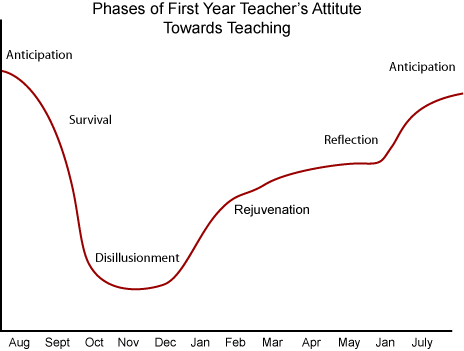
But I survived. And stayed marginally sane to boot. I kept in touch with friends who were also first-year-teaching, because the front of a classroom can be a starkly lonely place. It is good to feel as if you’re in the trenches alongside someone else (and now that I’ve briefly taught World War One, that’s an especially vivid metaphor). I watched all of Boy Meets World, and though I remain doubtful that it’s really very kosher to regularly assign essays on a whim at the end of class just because the topic pertains to an issue in your favorite students’ lives, I was reminded that even in the world of nineties sitcoms, it is still possible to be a truly fine teacher and that doing so doesn’t center around making your students happy. And then late one Sunday night in November, when I felt just awful, I found this:
fqjsm

I’m not typically a big charts and stages person, but this is absolute it-gets-better gospel truth. Believe it, cause it’s real. By December, according my notes at the time, I had “all warm fuzzy advent feelings after seeing them sing and getting gifts from them and having them treat me like a real human being and not just a grade machine.” Things were looking up. I was going to be okay and so were they.

In fact, there are a few students to whom I wish I could write individual thank you notes for encouragement they didn’t even know they gave. Highschoolers can cause more pain than they know–but their kindnesses, even unintentional and very small kindnesses, can bring so much joy. The times a student has gone out of his or her way to actually make my day better, I have usually cried (though not in front of them.) And it was a fairly normal but unexpected thing one single student did way back in early December that made me decide not to up and quit when I was feeling a bit desperate.

Really perhaps the thing I have learned most thoroughly this year is the thank you note thing: the value of appreciation and expressing gratitude. When I was a sophomore in college I wrote Dr. Brown a thank you note once and she made a huge deal out of it in front of the rest of the students, and said that sometimes she felt like Christ healing the ten lepers with only one coming back to say thank you. I thought this story was hilarious–I adored Dr. Brown, but she was comparing herself to Jesus, for goodness sake–and would tell it over and over to my English major friends. I no longer think it’s funny. I know exactly what she meant. When you teach and you care that you do it well, you are fighting on the front lines of humanity. You’re teaching the human mind to reach its potential, holding out the world in your hands, trying to get the faces in front of you to comprehend it, to feel their own smallness. There’s so much pressure to get it right, but when you do get it right, often nobody notices, and this is discouraging. To give more than you take, that is what every good teacher does, but no mere mortal can give out of a dry well. We all need water.

So, knowing that, and knowing what I know now especially, I want to shyly and belatedly be grateful to the people who taught me. I didn’t know what it took, and even if I had, I’m not sure I could have understood.  Thank you. Thank you for what you did for me: for crying with me, for laughing with and at me, for graciously thinking it was endearing when I told you bluntly that your class was “not my happy place,” for reading picture books aloud, for letting me run to your room in tears when I first discovered Billy Collins, for handing me that mysterious and wonderful envelope before the New York trip, for letting me sit on a desk during your planning period and just talk and talk and talk. And thank you for what you did for all of us: for heavy worry, for long patience, for giving us the best of what you loved, for volunteering to be Atlas with the world on his shoulders and believing it to be worth the trouble, for finally entrusting each of us to Jesus when it was all that you could do.

I see it a bit more clearly now. Second semester, when my responsibilities began to pick up pace, and when my heart learned to hold on anyway and smile in the wind, I started to care less about what my students thought of me and more about the students themselves. And I didn’t know that in a job in which I was supposed to be the helper, I would routinely feel so helpless to really love them well. So unable and weak. They need so much charity and compassion and help. I know this because I need this things too. I know this because, in our need and inability, we are the same.

Despite all of the doing and learning and trying, the appreciation and the lack thereof, I am discovering a secret which probably most teachers who’ve gone before me know. Education, when you really try to do it right, is debt. An extensive and painfully shining web of unpaid and often unacknowledged debt. We’re all bound and knotted together by it. We give and are given to over and over again, then march off triumphantly into the sunset, as if our spoils are our own, while the ropes of debt tug at our heels. Some days I can’t keep straight who is demanding restitution from whom. There is a colossal owing, and we, none of us, can possibly pay it back. And this, I think, is where education all goes bad or is hatched, where we begin to ceaselessly demand the pound of flesh from one another, or relinquish ourselves to the waist-high waters of grace.

This has been a long and meandering entry, but really there is one reason I have written it: I am preaching to myself. I am saying: “Alice, you feel as if you’ve worked hard and given much, but what you have given is that which was first given you. Your deficits are deep and wide, but they have been filled by a love that is deeper and wider. Your debts have been cancelled by the great Forgiver of debt, the Payment himself. Forgive your debtors as your debts have been forgiven. Look at the world and look at the hands that hold it and remember that you are small. See that your Lord is large and great. Love with liberty and with joy.”

Oh, to grace how great a debtor daily I’m constrained to be. Let that grace now, like a fetter, bind my wandering heart to Thee.
Seeing To It

Last night I went to the grocery store for milk and bread and things, left the milk behind at the cash register, and did not even miss it till about eleven this morning. I worked on revising my novel for nearly four hours, then walked up to campus this afternoon to see friends and thought about how glad I will be not only for the snow to melt but for the spring rains to come along and wash all the salt and grime away and give the earth’s face a good washing.

A couple weeks ago I was reading Matthew for my New Testament class and I came across Judas.

Then Judas, His betrayer, seeing that He had been condemned, was remorseful and brought back the thirty pieces of silver to the chief priests and elders, saying, “I have sinned by betraying innocent blood.”

‘And they said, “What is that to us? You see to it!” Then he threw down the pieces of silver in the temple and departed, and went and hanged himself.

The chief priests buy a field with the money and name it after blood, then Matthew moves the narrative back to Christ facing Pilate. Pilate washes his hands, because he cannot handle the crisis in front of him. So Jesus carries the cross and “sees to it.” Jesus and Judas both die.

So when I read that passage above, I wanted Judas to turn around before he ran to the temple with his tainted silver. I wanted him to look once more at the condemned Man, I wanted the betrayer to look at the One he had betrayed, and perhaps see the way innocent blood might save a sinner. Instead he spattered his corrupt blood over his sins to try to pay, because paying was all he knew, and left behind the legacy of a field fit only for strangers’ bones. The chief priests gathered up the price of their own long-awaited Messiah’s life off the floor of a temple that was meant for Him.

Judas tried to “see to” his guilt himself, because he saw only himself. He looked at his Lord’s impending death upon the cross and saw only his own sinful actions. He did not see Christ sweating blood in the garden because He already knew what lay ahead. He did not see Christ cry to his Father, “Why have You forsaken Me?” or announce what He had finished. Judas looked only at himself, and did not understand the way Jesus meant His death, meant the spilling of His blood, meant the saving of His people.

On Sunday, Judas had begun to rot and Jesus had risen and told His friends to rejoice. He told them not to be afraid, that He was with them always. Judas thought that his traitorous kiss meant a grim and dismal end, but my God, the God whose “unoffending feet” I have determined to look to instead of my own, carried the mark of that betrayal through crushing death into new life and victory. He shall see to it that Fields of Blood and stony hearts are made new.

Fairy Lights

Billy and Ashley got married this weekend. It was a sweet haphazard wedding, we ate lots of pie, Ashley forgot to throw the bouquet, I hugged cousins, and neither of my grandparents fell on the ice that coated northern Minnesota, so really the whole thing was a roaring success.

Last night my mom and I had a connecting flight from Chicago coming home. Now, I am not a city person. Three days has always been more than enough for me, and on top of that there is a nagging voice in my head which tells me I should love nature best. You know, #creation and all that. But we had a long, clear descent into Chicago at about seven-thirty their time. Seven-thirty when everyone is home and eating dinner and doing homework and watching TV and making plans and finishing laundry. Seven-thirty when all the lights are on, and dim little headlights reach out in front of sojourning cars, and streetlights duck behind trees and back out again as you pass ten thousand feet above them. There are patterns in the street plans, you know; they wind and gloam, stretching themselves into the darkness. Floodlights cast their own drops of gold, and downtown blocks form complex, glittering mountains that wink and beckon. And it is all so very vast. Forgive me if I ignore that preachy voice in my head, and tell you that is the view I love the best. I could be one of those people who live in a suspended glass box for weeks on end, just so long as mine was particularly high.

I don’t have any real metaphor to draw. I’ll leave that up to you if you’re so inclined. I’m just coming to terms with the fact that my imagination is usually wrong, because often Reality won’t fit inside of it at all. So I simply want to tell you how much I love heights and fairy lights and grandeur and distance, things endowed with impossible grace.

The God of the Mountain

Tonight I am the Queen Orual bringing my complaint against my God. I do not understand. I do not understand His mercy, His love, His disregard for justice, for my proper desserts.

I can look at men who are responsible for millions of deaths and say, “My, that’s awful. That’s real bad.” But it does not look as rotten as the microcosm of my own heart, my slimed, oozing, bought-back heart.

That He would make me, know me, and yet love me, and die of my scourge that I might be healed… It does not fit into this world I have built to live in.

When you strip away all those things people say, all those pats on my shoulder, I’m pretty simple-minded. As Ethan said last week, “Grace is not intuitive.” It seems that I understand sin and nothing more. I have no face yet with which to see His. I am not gall or heartburn, but blind eyes and a mouth unopened in praise or in hunger.

I do not understand. I cannot understand. Grace for my sin is too terrible a good and I am frightened.

Nevertheless, I will eat the glowing coals of righteousness and mercy, though they burn my lips. In fear and trembling, I will open my mouth and give thanks.

Rich Condition

A week and a half ago, during the drive back up to school I made this list of things I was thankful for.

Friends who periodically lose their voices

Birthday cake

The opportunity to read books and write papers

My sister’s slackline

My sister

Weddings

The south

Leaves on trees

Mille Bornes

My grandparents

Driving by myself

The promise of summer jobs

The perhaps of eventual teaching jobs

Storybooks

Heroes

Computer battery life

Sun

Pretty dresses

Mothers who sew things magically overnight like the tailor of Gloucester’s mice friends

Not wearing make-up

Growing up

Chairs that recline

Not going to the dentist

Mountains

Game night

The fact that there is a man named Roger Beverage running for Sherriff Somewhere in West Virginia

Small boys In Subway with bowl cuts

Scenic overlooks

The Family Pantry

Dinner

Double spring

The interim between then and now has contained some less than pleasant days, but let me tell you some nice things.

-Sarah and I are officially living on third floor West next year, with a bathroom all to ourselves. I will forever remember MEP with fondness, but can promise not to miss it in the slightest.

-I registered for classes last night, and (along with Pre-Calc and Baby Physics) am taking Creative Writing, Sacrament and Lit, and Fantasy Lit next semester. Wonderful, wonderful.

-Today I got up and dressed up for Friday for the first time in quite a while. Then, with the rest of my Educational Policy class, I went to Dr. Edwards’ lecture for the Vision and Values conference, instead of watching the movie he’d assigned us for our class hour. He sent us an email later which said “You all are very kind. Disobedient. But kind.”

-This afternoon Laura and I went on a walk down Pinchalong, and sat on the edge of a cornfield for about twenty minutes. The field was raised so right at eyelevel we could see the stubble of the stalks all crowded round with big bright dandelions, and behind them were barely-leafy trees and a grand blue sky. There was sun and wind and roosters from that one weird house crowing in the distance. We decided that it was almost like finding Nowhere.

-In a few minutes I have a date with Heidi and Maddie to discuss making a big old wonderful breakfast for the Family Pantry in a couple weeks. Then I’m going to children’s theatre, then to finally watch that movie with the girls from Ed Policy.

I can easily describe this year in one word: humbling. I can no longer seem be able to do anything the way I’d like, or be anything I think I ought to be able to be. I am incapable, broken. Sometimes I feel like those words must be written on my forehead. I know that this is God “breaking the back of foolish pride,” and it is good, but it has been long. Every time I think I must surely, surely have learned enough, something else I had been counting on breaks down, and I must run for cover to the Rock. I must keep returning to Him till I clearly see that all else really is sinking sand. The first verse of one of my favorite hymns ends in this way:

Perish every fond ambition,
All I’ve sought or hoped or known;
Yet how rich is my condition!
God and heaven are still my own.

That, I suppose, is the lesson of the year. My condition is rich. I have faithful friends whose goodness continues to bless me, I have truly wonderful parents who will love me no matter what, I have two wonderful homes (at the very least), I have clothes and books and papers and pencils which make me quite happy, and I’m getting a really good liberal arts education, for heaven’s sake! Yet I have all these things by the grace of God. They are His. And, by the grace of God, so am I.

Grace

I have had a harder week than usual. I had a baffling poetry journal due Friday, along with several other big assignments, it snowed again, and on Thursday, in aerobic conditioning, we did kickboxing. (I know there are many people in my life who would probably pay to see me kickbox, and actually, watching myself in that big mirror really was quite entertaining. But tickets aren’t yet for sale. Probably never will be, actually.) I am tired and I am needy, but this week, I have been given grace. My friend Heidi has been sending out prayer requests for specific girls each day, and Thursday was my day. I was so very blessed to know that so many people who love me were praying for me at once. God heard their prayers, and gave me the grace to live and blog again.

I’ve been thinking a lot this week about the nature of the grace extended to us in Christ. There was an “insuperable barrier,” and that, of course, was the law. 1 Timothy 1:8-11 says, “But we know that the law is good if one uses it lawfully,  knowing this: that the law is not made for a righteous person, but for the lawless and insubordinate, for the ungodly and for sinners, for the unholy and profane, for murderers of fathers and murderers of mothers, for manslayers, for fornicators, for sodomites, for kidnappers, for liars, for perjurers, and if there is any other thing that is contrary to sound doctrine, according to the glorious gospel of the blessed God which was committed to my trust.” That is me: lawless, insubordinate, contrary. That is all of us.

Here is my favorite part: When God, “according to His glorious gospel” wanted to save us, He did not give us the power to obey the law He had made for us. He did not make us capable. He said, “As long as the law exists, you will not be able to perfectly fulfill it. But I will fulfill it for you. WATCH ME.” God didn’t just give us rest, He gave us himself, the Prince of Peace. He didn’t just give us strength, He gave us Himself, the God of all might. He didn’t just give us  the power to love, He gave us Himself, and He is Love.

When we take the Lord’s supper it is symbolic of the truth that He is our bread and our wine, the sustenance of our soul, mind, and  body. In John 6:57 Jesus declares “As the living Father sent Me, and I live because of the Father, so he who feeds on Me will live because of Me.” This is what Gerard Manley Hopkins meant when he said we must “glean our saviour.” He is the only source of life. Without Him we fade and crumble. Every particle of our energy must be had from Christ. God loves you and I enough that He gave us, not a gift or even many gifts, but the Source of all good and perfect gifts. 1 John 4:10 says “In this is love, not that we loved God, but that He loved us and sent His Son to be the propitiation for our sins.”

This means something else, though. We are to be “little Christs,” and “imitators of God.” What do we do? What do we give Him? Ourselves. God did not give us power, because He did not want the fruits of our labor. He gave us Himself, because He wanted us, and nothing less.