Caldwell

Anyone who knows me well knows that this entry has always been inevitable, and the last few weeks have provided me with the perfect opportunity to write it at long last. Over Grove City’s intersession I did a two week internship at my dear old alma mater, and what follows is a “reflective essay” I turned in yesterday to the people at Grove City. Beware—it’s long. I have lots of thoughts…

I started at Caldwell in the fall of 1997, almost sixteen years ago. My connection with the school is older than that of all of the administration, and most of the faculty. I remember when each building was built, when each modular disappeared. I have cried in almost every room on the second story of the Smith Building, and I know the name of every Caldwell graduate before me. My name is written in sharpie in an undisclosed location on school property. I think it says something idiotic next to it like, “Class of 2010—Lifer.” So it’s nearly impossible to distance myself from these boys with the t-shirts under their polos and the girls whose shirts won’t stay tucked into their skorts, who straighten their hair and clip in a big navy bow. But perhaps distance would be more of a hindrance than a help just now.

Caldwell’s strength has always been closeness. They call themselves (or should I say we call ourselves?) a community school. Teachers and administration love their students, and with sometimes-necessary encouragement from the faculty, the students love each other. This has not changed, and I pray it never will. I stepped in for Mrs. Upper when she had a family crisis, was reminded en masse by my math teachers of the silly things I used to write on my test when I couldn’t do the work, and, best of all, I got to be with Mrs. Liebmann when she got the call saying that, for the fifth year in a row, her scans are clear. She does not have cancer.

Because of these people, Caldwell has never suffered for kind hands and free hugs, but what has always been a struggle, I think, is excellence. Particularly at the end of my high school career, I got quite a fair number of A’s that I knew, even at the time, I had not earned, and in the past two weeks, I witnessed, on occasion, some pretty dismal student work. Soft grades overflow from the teachers’ kind hearts and pens, and what’s missing is a desire not simply for the happiness of the student, but a desire that they be good, and generous, and wise. They will find it hard to become men and women who live in God’s grace if they feel entitled to kindness.

The key to excellence in Caldwell’s case may simply be revitalizing their classical foundation. The Sayers essay is an Appendix in the school handbook, and still required reading, I think, for new families. The tenants of a classical school have come and gone in the time I have known and loved this school, but they are raising their head again. A little manifesto entitled “Standards of Excellence” is posted in nearly every room in the Rhetoric school, including, oddly enough, the staff bathrooms. When I was in high school, Latin wasn’t offered above eighth grade, but now it’s on the curriculum straight through graduation, for those who want it, a move of which Dorothy Sayers would approve. Also, in the years, since I’ve left they’ve played around with a humanities program in the Dialectic and Rhetoric school, which currently means that the history, literature, Bible, rhetoric, and writing teachers all collaborate to a great degree. Aside from the almighty senior thesis, which has been around for a while, Rhetoric students now have a regular oral component to their humanities exams. I am also pleased to announce, that, though I never noticed it much in my time there as a student, the Trivium is quite alive and fairly well.

I didn’t spend a huge amount of time in the grammar school, but when I did, it was oddly refreshing. I read a Jan Brett book called The Hat to three groups of kindergarteners and three groups of first graders. They were enthralled by the pictures and several insisted on counting the empty clothespins on the clothesline with each new page, and reporting back. They are indeed Sayers’ little Poll-parrots. I only wish I’d known their names so that when I needed one of them to turn around and stop talking I could’ve said something more than “Honey. Honey. HONEY.” I also got to read with some fourth graders, and for reasons unknown, the teacher, who is a good friend, gave me all boys. They listened well, were bright, and every single one of them was eager to read aloud. I wonder when it is that boys stop publically caring about school, stop raising their hands when a question is asked.

I only got to be in the dialectic school for one afternoon. Elspeth Glasgow, Grove City grad extraordinaire, had me in to help lead a discussion her seventh graders were having on whether or not Abraham was lying when he said Sarah was his sister. The half of the class I had always had at least three or four hands wiggling in the air at once. None of them seemed the least shy about contradicting each other. We talked about the difference between lies and deceit, and they gave some fairly impressive examples of falsehoods and evasive language. Occasionally, I could see their native “pertness” giving way to real intelligence and thoughtfulness.

I spent most of my two weeks in the Rhetoric school, and the majority of that time in Mrs. Liebmann’s room, which got me very familiar with the freshmen and the juniors. One momentous day I took score for six back-to-back exam review games and learned everyone’s names pretty thoroughly, I hope that in some small way this helped me blend in with the community Mr. Greer is working so hard to further in the Rhetoric school. The first day of exams the administration brought in a popcorn machine for a snack between periods. And for the second day, Mr. Greer bought fifteen boxes of brownie mix and some eggs and asked the teachers to take them home and make a couple batches. You know what? They did. Happily. But then again, these are the people who plan on chaperoning a “Rhetoric Retreat” this Thursday and Friday, who are going to share cabins with these students, watch them do the polar bear plunge, and oversee the making of bubble gum sculptures. God help and bless them.

This is supposed to be what Sayers calls the poetic stage, but so many of them are not there yet, or have certainly not arrived there with a vision or purpose. I suppose that’s the teacher’s job to give. Mrs Liebmann’s method of encouragement in this area is to require commonplace books. They have to copy twenty or thirty quotes which they like each week, and write a short response to one of them. I got to grade a couple batches of these, and I found them more interesting and touching than I expected. One boy whom I had watch cut up in class began, “This is a quote from my sister’s calendar” and proceeded to write in earnest about the ways his own classmates spread sunshine and cheer. Multiple girls poured out their worries about friends and image and fear. The exercise is clearly a good place to begin in self-expression. The students have to ask themselves, “If I am to be this sort of person, whose shoulders ought I stand on? Which words will I hold most dear? I think this is true and good and beautiful, but why?”

One of Caldwell’s most beloved programs in past several years is the choral program, presided over by Mrs. Twigg. I sat in on both concert choir and Caldwell Singers, the auditioned group, and sang along. I had forgotten what hard work it is. I have no idea how I had enough energy to do that three times a week in high school. Halfway through concert choir I stopped singing and just watched. I looked around at the kids and wondered if they knew it made them a better person. I wondered if they knew what they were saying when they called a song beautiful. I wondered how often this evident patience and hard work extended beyond their harmony. But I supposed that even if, like me, they had to wait a few years for all the benefits of art to begin to manifest themselves, the risers and the filing cabinets of sheet music would not be in vain.

This last stage of the trivium is the hardest, I am sure. You are suddenly accountable for more than your work or even what you say, but for yourself. All of a sudden you must be a self who is worth being and expressing. Other people require it of you and, more frighteningly, you find you require it of yourself. It is easier for many of them to simply not try, or look as if they don’t care. A group of ninth graders I had told me that yes, of course they had read for the discussion that day, but it had been before Christmas so they didn’t remember any of it. I told them that was just as good as not reading at all. They were missing the point on purpose. They are old enough to know that living by the letter of the law alone will not suffice. One of the reasons I found the lower schools so refreshing, is that I did not really have to try to get the kids’ attention. They were told to listen and engage, and so they did. The rhetoric kids, however, make you work for it, and I need plenty of practice and patience. In The Seven Laws of Teaching Gregory lists ways of “kindling and maintaining” attention, which I am far from internalizing.

But they are missing so very much when they don’t heed both their teachers and their text. I observed a class of juniors who were having a very solemn discussion on “To His Coy Mistress.” I was just sitting in the corner, and didn’t think I ought to monopolize the conversation, but as I listened them discuss the speaker’s worldview, and the logical syllogisms of his argument, which are all well and good, I wanted to say, “You guys. This is funny. Isn’t this funny? Just a little bit? He’s got an in-joke with the audience, and he’s all pleased with himself and thinks she’s going to fall for it, and we’re laughing right back because we know she probably won’t.” I didn’t say anything, though. Perhaps I should have. Perhaps they need more help to see these things than I think.

My actual experiences at the front of the classroom were sometimes challenging. Of all of Gregory’s seven laws I struggle the most with the language of teaching. I am at college right now, where I am always trying to sound smarter and more elevated, but in front of high school kids it is really only imperative that they understand, not that I seem brilliant. I got along fairly well most of the time with the three periods of ninth graders I had. They are friendly and patient, though I was momentarily stumped for correct words when a girl innocently asked me to explain what a brothel was. Leading the senior’s Great Divorce discussions was harder. Mr. Greer was sitting right there and those kids were freshmen when I was a senior. Some of them are friends. It was hard to be Socratic and bright, to ask the right questions even when there are so many kind faces eager to give a helpful answer.

The most encouraging results I saw were, predictably, not results inspired by my teaching. I watched Marie Conner give an excellent explanation of the Hays Code and Mrs. Liebmann give a lecture I know she loves on Romanesque and Gothic architecture. I could see that they grasped not only the facts, but the awe, the unbelievable scope. The real proof of learning was evident in the oral exams I sat through. I sat in on one section each of ninth, tenth, and eleventh grades, most of whom were proficient in varying degrees. About a week beforehand the kids are given the list of twenty-some questions, and on the day of reckoning they have to pick one out of a hat, take notes and marshal their thoughts for five minutes, then sit attentively through the rest of their classmates’ 3-5 minutes speeches. Waiting their turn was the hardest, I think. They are still kids. It all serves not only as an assessment, a benchmark, but it fulfills Gregory’s law of “review and application.” Of course, not everything stated with certainty from the front of the classroom that day was quite right. Apparently, though I was not there for it, one student claimed the Africans brought over jazz in the early nineteenth century, and as for what I did witness, particularly with one of my favorite plays, I often had to resist the urge to run up and help and correct and explain. One student, whose family both Caldwell and I know of old, got up, did a very good job, and in the midst of his talk made a crack about “a classically-trained scholar like myself.” I know he was mostly joking, lightening the exam-day mood, but I wonder what else that meant to him. I’m sure he could explain the trivium in his sleep, because he’s been through it himself, but what else does he know? I’m curious. Maybe I should have asked.

Perhaps my most useful activity in the past few weeks, though it was small in retrospect, was the grading I did. I graded a set of non-AP essays on Huck Finn. I could tell who had tried and who could have tried harder. I graded a set of poetry annotation assignments, a whole slew of vocab quizzes, and bits and pieces of different humanities exams. It is clear that I am hard, perhaps too hard. Mrs. K got calls from parents complaining about the strict grading of the poetry assignments, but if she doesn’t mind then neither do I. I am young and new, and I heard that we are all like this. We grow out of it. But I hope I never grow out of a commitment to excellence, to giving feedback, encouragement, and challenges. I hope never to take the easy way out. I hope to treat language with care, and teach my students that it is imperative they do the same.

I wanted to work with senior thesis while I was there and didn’t get a chance, because the kids haven’t really started on it. Thesis was my favorite part of senior year. Huge paper, oral defense, study what you love: glory, glory, glory. I did, however, get to sit in on a writing curriculum meeting. Michael Hicks, one of those early Caldwell grads whose name I’ve known forever, was hired over the summer to teach writing, but right before school started he was diagnosed with Hodgkin’s lymphoma. So while he underwent treatments all semester, Debbie Holcombe, the mother of one of the ninth graders, stepped in. The meeting was a passing of the torch now that he is recovering. They both clearly cared a great deal that these students wrote well, that they knew lots of words and used them to say things worth saying. They desired a deep connection between meaning and language. They discussed, what is, in fact, one of Sayers’ main points, the desperate need for logical progression in student thinking. These kids took logic back in the day, but they have not yet learnt to apply it.

Many Caldwell students have, in fact, been living on what Sayers calls “educational capital” for a long time. They are nice kids with nice parents, but unless we and they work, and work hard, for something more, niceness will be worse than worthless. It will be the lie which keeps them from Grace. I want desperately for these kids to be excellent, good, reverent. But how do we get from here to there? I know very little of what is, I’m sure, the ponderous answer to that question, but I know that we must teach them, and in turn ourselves, that we are not made to be our own gods. We can plan, and take action, but we must take great care not to live upon what Lewis calls the “fixed land.” We must simply get up into each morning as it is given us, teach, learn, and worship without ceasing. If only my school does that faithfully, academic excellence and every other good thing will follow as it ought.

Friends

Last night I watched It’s a Wonderful Life in Harker Lounge with quite a few people whom I like very much. At the end George gets a copy of Tom Sawyer from Clarence with this inscription in it: “Dear George, Remember, no man is a failure who has friends. Thanks for the wings. Love, Clarence.” Well, I’ve been feeling real rich and successful lately.

I am so grateful for the people who surround me, who listen to me and who I get to listen to. I am grateful for friends who let me mark up what they write. I am grateful for friends who laugh at me, whether I am funny or not. I am grateful for friends who let me share their worries, and who don’t mind that sometimes I have nothing to mend their hurts but my own creased brow. I am grateful for friends who send short emails and leave long voicemails. I am grateful for friends who are generous and enthusiastic on days when I am neither. I am grateful for friends who sass me, who point and giggle when I am silly. I am grateful for friends who love my family and my past simply because they are mine. I am grateful for friends who remember what I told them long ago. I am grateful for friends who hold my hands while they talk to me. I am grateful for friends with whom to be silent.

I am grateful for these people who have, for whatever reason, found me worth their time. They remind me every day that my God is good. He is good to me.

Content

It’s Christmastime again. I know, it’s not December, but trust me, I’m not ready for this, and I need to start readying now. Friday night my family sang Christmas carols around the piano. (George boomed them out then slumped in his chair and pretended he hadn’t.) Saturday my dad and I drove back up to school and snowflakes flurried at the windshield, and I pretended that I didn’t like it, but I did. (Don’t tell.) On Sunday I made plans with friends to watch It’s a Wonderful Life and probably Shop Around the Corner too. Yesterday, I read a couple favorite T.S. Eliot poems about Christmas, “The Journey of the Magi” and “The Cultivation of Christmas Trees.” They are about death in life and life in death and the awe-filled Coming.

I am tired. Tired and full, and tired and waiting. I am full from this semester. I am full from running with Abby and writing poetry and early mornings and Sassy Tuesdays in Physics with Jackie (and Libby) and cleaning house and long showers and lunches with Laura and lunches with Heidi and weepy Friday afternoons and visits to the ABT hall and a carnation from my brother and rides to church with Haley and reading  good poetry and the Lizzie Bennet Diaries and playing in the pit for the musical and Monday-Wednesday-Friday lunches with the girls and dropping things in intercampus mail and pie in Fantasy on Tuesdays and writing a story with chapters and hugging people on the sidewalk and watching my five-year-old friend Josiah draw a picture for me and write “ALAS” at the top.

I am waiting for finals and Christmas, for travel and rest, for this to be over and what’s next to begin. I’m waiting for birth and for death, and T.S. Eliot speaks true—I’ll find both with the Child in the manger.

I am content.

Distance

This weekend I went home for fall break. Almost five hundred miles, but really only eight hours. Eight hours is close. Distance makes most sense to me in terms of time. They are cousins, you see.

My grandparents’ house in Missouri, for example, is two days away, and that’s as close as Wednesday, but then again, with a plane, it’s as close as tonight.

A mile is short when I drive it and long when I run it and perfect when I walk it, but an hour is always the same. So I prefer the hour.

Distance is usually time to me, but time is often not distance. I mean that nothing, no part of life, seems far to me right now. I feel as if I stand dead center.

When I was one my daddy built a swing on the big tree in our backyard.

When I was two my mama earned her doctorate.

When I was three my friend Danny would let me have his pudding cup at snack time.

When I was four my mom would put my hair up in little fountains on top of my head.

When I was five I prayed for a little brother every night.

When I was six I got one.

When I was seven I showed off to my friends by pouring chocolate milk on my pizza at lunchtime.

When I was eight Mary and I flew to California alone and the stewardess let me pass out peanuts to all the passengers in my cabin.

When I was nine Karen and I made peanut butter fudge by candle light on a snow day.

When I was ten I learned to knit.

When I was eleven I was in such a foul mood when we got to the Grand Canyon that my mother had to order me out of the car.

When I was twelve I was a flower girl for the first and last time.

When I was thirteen I stopped hating boys.

When I was fourteen Noah and I made up my imaginary big brother, Richard.

When I was fifteen I thought I was in love.

When I was sixteen I clocked a friend in the nose one night on a golf course, but she forgave me.

When I was seventeen my grammy died and the tree with the swing fell and I cried myself to sleep.

When I was eighteen I wrote a poem.

When I was nineteen my grandma called to ask how I did the green beans that one time.

And now I am twenty, and none of these things seem distant. Forty, when I will be greying, does not seem too far, and neither does eighty-three, when I plan on being quite white.

Before dinner just now I went and sat in the prayer room and read over the journal there, whose entries date back to before I ever came here. But those people, those friends, those interceding brothers and sisters seem very close indeed. I am intended to feel that way, I think, because they are close—their ink, my hands, our cries to the same living God.

One thing seems far, though. There is a wooden cross in the prayer room. People have laid their burdens upon it. They have written their fears and sins and trespasses on notecards and nailed them to the tree, with a small hammer that lies on the floor. Purple sharpie on the stipes praises Christ for freedom, for distance from sin.

“As far as the east is from the west, so far has He removed our transgressions from us.”(Psalm 103:12)

From east to west—why, whenever you get to one the other is still just as far away as it was to begin with. It can’t be done. They’re hours, days, eternities apart, a miraculously impossible distance.

As I Write This

I can hear a group of freshman boys serenading their sister hall down in the courtyard with “We Are Young.” I wonder what they expect to come of it…

I am waiting for an email from a professor giving me permission to take a quiz early on Wednesday, so that I can catch a ride home to North Carolina for the long weekend.

I am wearing my mother’s flowered dress, which has pockets.

I am wishing that today’s weather would hang around forever, so I could walk in it forever. This afternoon, Amy and I met a woman walking her goats on Pinchalong.

Our room is cluttered, but the carpet is vacuumed.

I am thinking about how I like pumpkin mini-muffins and friends and my church and poetry.

I am planning for tomorrow–I’m going to bake bread at Emily’s.

I should clean off my desk. It has notebooks and spoons and a mug and pencils and a calculator and a sweater and a hairbrush and post-its and needle and thread from a button I had to sew back on and an empty envelope that says “$Cash$” and a stuffed giraffe named Butterscotch and a letter I need to answer. And other things.

I have my knees curled up to my chin.

I’m remembering that I should go to bed early because I have Bible study at seven-thirty tomorrow morning at Beans on Broad.

The boys in the courtyard did two encores.

Again and Again

I’ve had things to write about. I just haven’t got round to it, see. So all these nice ideas were piling up in my head, threatening to form this big, old entry about things I like and things that are great and things I’m thankful for, and I thought, “Man! That’s so unoriginal. That’s been DONE.” And it has. Again and again. By me. Here and here and here and here and also here. (For example.) In fact, that’s most of this blog.

But funnily enough, in all that listing and enumerating I have yet to exhaust God’s blessings. Think of that. And I’m commanded to praise the Lord. Again and again and again. Isn’t it lovely when what you’re commanded to do and what you want to do is precisely the same thing?

So here we go, friend.

One thing:

Last week I went to a little meeting with the staff of The Quad and we had this discussion about why we read and what it means to be a good reader. And normally, that would have been just fabulous, but this time instead of participating properly, I quietly had myself a little existential crisis.

Why did I read? I knew all the right answers, about how it makes you more fully human and more fully alive and all that, but why did I, Alice, who had written multiple papers on this very topic, actually read? What were my real motivations? Was I only mimicking my parents? Did I really even like it? Was my whole life a façade?!?

So I sat in the corner and stewed and drank apple cider and did not contribute to the discussion. But then later, you know, I figured that if my life was a lie and all that, I probably would have had an inkling of it before age twenty. I’m fairly introspective (read: self-absorbed.) Also maybe, just maybe, I’m a normal person who reads for the normal reasons. Sometimes to escape, sometimes out of habit, sometimes because I have to, and sometimes that I may “know life and know it more abundantly.” So now I’m re-assured. And that’s a good thing.

Another thing:

We’ve had game night at the Edwards’ a couple times so far this semester. And it’s a little thing, but for me it’s also a big thing, (and after all this time I still don’t even really like games.) Sometime I’ll write another separate entry to tell you why, but no hurry. It’s going to be a part of my life for the next while here.

A third thing:

I have a smallish job this semester and it’s a gem. Every other week on Friday or Saturday morning I borrow my dear roommate’s car and drive to Mercer while everything is still dewy and chilly, with myself and the quiet and that one field of sunflowers by the side of the highway. And then I clean Dr. Brown’s house. This morning I did windows. Soap and rinse, time to dry and Windex. (Time to dry is my favorite part.) I’m tired at the end. I’m tired at the end because I did something. In the quiet morning, I did something.

And then I drive home, put on decent clothes, eat lunch, and go to class to read books. It feels marvelously like a double life. And I like both parts.

The next thing:

There’s something else that deserves a whole entry, which I’m hereby scheduling for late February. It’s the American Shakespeare Center at Blackfriars in Staunton, VA, or, as I like to call it, the happiest place on earth. I’m going over our break in February with Dr. Harvey and other delightful people for a one credit travel course to see four plays. There’re still spots open, so you should come too. Even if you think you don’t like Shakespeare, even if you think you don’t like anything, you will like this.

A particularly delightful thing:

One of my favorite things about this semester so far has been the friendships. Every day, I wake up shocked to discover how great it is to have friends. (God only knows why I’m surprised to find that this is blessing.) I’ve always had friends (really, I have—even in seventh grade when I specifically planned not to because I was only going to be at that school for a year and who really needs ‘em?) But this year, we’re upperclassmen, spread across campus, (or even states and countries) busy with non-intersecting things, and I seem to have entered into the wild, wonderful, and weirdly adult world of intentional friendship. The kind where you send notes and emails and say you and me tomorrow, kid.

It keeps surprising me what friendships grow and last, when I didn’t think they could. It even surprises me what friendships happen at all, and how once you get past the first layer of person there’s more of them underneath and more and more and more. C.S. Lewis wrote that “There are no ordinary people. You have never talked to a mere mortal.” It’s true, friend. And it’s kind of astounding.

The greatest thing:

Well, I suppose the best part is the again and again, the knowing of life more abundantly. Miss Jan, a dear friend from long ago used to sit at the fascinating piano in her living room that had keys and magical buttons, and sing the final verse of “Amazing Grace” this way:

“When we’ve been there ten MILLION years, bright shining as the sun, we’ve no less days to sing God’s praise than when we first begun!” (Again and again and on and on)

I Have a Corner

I live on the top bunk this year and that means I have a corner. Two walls and a close ceiling.

On them, I have puttied picture of family, notes from people who love me, dear postcards, and a list of scriptural principles that my grandma typed up for me when I graduated high school. (Quite an ordeal, typing.) I have two teddy bears up here, a stuffed giraffe, pillows, a quilt, a blanket. My bible and day journal live here, but my computer is never invited. I’ll type this entry later.

I have always been a hider, I think, particularly in the past year or so, but I know more each day that “my giant follows me wherever I go.” So this corner is not so much for hiding as for being held. I do not have a literal cleft in the Rock of Ages, but I have a corner. I am exposed—fair game for the devil, but something safe and strong is round about me.

I have only had this corner as I know it since Sunday, but already I have come up multiple times for comfort. I don’t mostly look at the things on the walls—really I mostly look out the window down into the inner quad. I’m still “a piece of the continent, a part of the main.” It’s just that the sea is more peaceful from this particular view. And when I climb down again, it usually stays that way.

Here’s what I mean to say: I want to share my corner. I want to share it with everyone from my roommate, to the lady who cleans our bathroom, to the stranger who doesn’t know me from Adam. (Eve?) Do strangers ever read this blog? I hope so. Just come all the way up the stairs from the cafeteria to 390 West. (The door sticks, but push it open.) Top bunk. It doesn’t matter if I’m here. You can climb up, and cry or pray or laugh or sleep or read or write or just sit. I’ll crawl up and bring you tea if you’d like, or I’ll leave you alone if you think I’m weird. (However, I’m fairly proficient at hugs, if you’re into that sort of thing.) Also, my roommate’s name is Sarah. She’s friendly. So come.

In our first creative writing class of the semester, Dr. Potter read us the parable of the talents and talked about how all God requires of his servants is to do what we can with what He has given us. Well, He’s given me a corner.

Things

It’s raining while I’m writing. And I’m thinking about things. Things I’m packing, things that are following me to Pennsylvania on Friday. Jewelry and clothes and books and paper clips and notes from friends and shampoo and paper and too many shoe boxes and bobby pins and boots and notebooks and two teddy bears of varying sizes and a couple very tiny ceramic pigs.

I’m working on a story right now, and the other day I had the distinct pleasure of listing the contents of a character’s room. The list was longer and less sensible than the one above. I really like it. I like imagining all those things piled together with no seeming order.

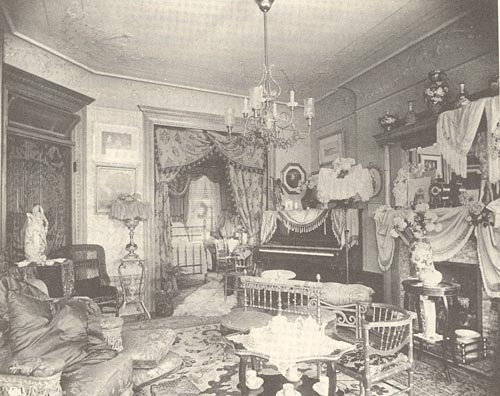
Though I don’t know many people rich (or silly) enough to have one, I have never liked the idea of a room that looks like this.

Image

It looks like the place Darth Vader would go to relax. Even the plants are dead. Give my little Victorian heart clutter any day.

Image

Beautiful, beautiful unmatching clutter.

Image

Touchable, holdable, lovable things.  Things that sit on your desk and wall, and say, “Remember?”(which leads to another “Remember?”…and another and another.)

Remember intercampus mail?

Remember the time Reb made you stop dressing your boy bear in girl clothes?

Remember when you wrapped food up in a napkin to look like a purse and sneak it out of the gala, but then you had to stop in the photo booth first?

Remember when Karen first fell in love with giraffes?

Remember that second day of seventh grade when you were so scared to go back that you threw up, but then you found a brand-new, sunshine yellow beanie baby in your backpack?

Remember your cousins when they were little and grinny?

Remember when George used to sign all correspondence “From a loving brother”?

Remember kindergarten when you were all set to marry Spencer Hill and be a rescue nurse in forsaken places like Nevada?

Remember when you got to fill a new (to you) room and year with these things, and smile at them? Oh, wait. No you don’t. That happens on Saturday. Excellent.

Frodo Baggins and Gospel Truth

In the last few weeks I’ve begun to really read the Lord of the Rings properly for the very first time. I’ve had them all read to me more than once, and I’ve seen the movies plenty, and I’ve always felt a little guilty that I didn’t appreciate them as I knew I ought. But now, for the first time since Annie and Karen and I formed our own “Council of Galadriel” in fourth grade, I’m really coming to them as an adult. Let me tell you a secret: THERE IS SO MUCH THERE.

I don’t mean just mean all the intricacies of Tolkien’s fathoms-deep lore, which I sometimes find fascinating and sometimes find annoying.  I mean wisdom. It is startling how willing the characters are to pronounce something good or evil. Barrow wights? To be feared. Orcs? Terrifically icky. Uruk-hai? Even more foul. The Balrog? The worst of the worst. Saruman? An infamous traitor. Sauron? Black and awful. But the Shire is all that is good. Gandalf is wise and infinitely trustworthy. Samwise is forever loyal.

We so rarely speak in definites. We are frightened to call things what they are. We do not like to talk about good and evil because it makes things hard. It means that if we intend to be good, there is a very real evil which we needs must pit ourselves against. And we might suffer and die and fail. Tolkien’s characters are not oblivious to this, yet we could learn much from them.

Aragorn hides from his opportunity for goodness and his ultimate destiny, even going so far as to look fairly objectionable at first meeting. Yet, “All that is gold does not glitter, all who wander are not lost; the old that is strong does not wither, deep roots are not reached by the frost.” The point is, Aragorn is absolutely, unequivocally gold. And so too, is the rest of the fellowship. Boromir wavers and falls. The ring, which exponentially increases the dreadful power of sinful desire and service to evil, affects his mortal nature, but we must not forget his departure. He dies valiantly protecting Merry and Pippin, and with his last breath, he tells Aragorn that he has failed. Aragorn denies it saying, “No! You have conquered. Few have gained such a victory.” Boromir dies the death of a  good man.

Perhaps the most striking are the Hobbits, because it is quite clear at the beginning that they do not really understand evil, because they have not known it. They know the goodness of food and friendship and the abundant blessings of the shire. They have hardly heard of Mordor. Again and again, one wise character after another points out that had they known the perils ahead they could not have mustered courage to come.

But even Frodo does not really know the darkness fully. At the Council of Elrond, when everyone has (finally) stopped talking, they sit in quiet desperation, wondering what is to be done. At length, out of the silence, the hobbit speaks. “’I will take the ring’ he said. ’Though I do not know the way.’”

It reminded me suddenly of a passage from book three of Milton’s Paradise Lost. The scene is heaven, and God the father is asking a question:

Which of ye will be mortal, to redeem

Man’s mortal crime, and just, the unjust to save?

Dwells in all Heaven charity so dear?

He asked, but all the Heavenly Quire stood mute,
And silence was in Heaven: on Man’s behalf
Patron or intercessor none appeared—
Much less that durst upon his own head draw
The deadly forfeiture, and ransom set.
And now without redemption all mankind
Must have been lost, adjudged to Death and Hell
By doom severe, had not the Son of God,
In whom the fulness dwells of love divine,
His dearest mediation thus renewed:—

Christ stepped into the silence and offered to take sin to the cross, as Frodo offers to take the ring to Mount Doom. Apparently, Tolkien knew his Milton, but I’ll tell you something else which Tolkien probably also knew: Christ was no Frodo. He knew the way ahead. He had no ignorance with which to swaddle courage. He knew every step of suffering, all the blood, sweat, and tears, He knew that if He did this thing, he would have to endure separation from His Father. For He was God on High, not a homey, hairy-footed hobbit.

And yet, with that terrible knowledge He makes Himself in the form of a man, all so that “From the ashes a fire shall be woken, a light from the shadows shall spring; renewed shall be blade that was broken, the crownless again shall be king.”

Adventure is out there!

I started planning this entry on I-40 East coming home from Nashville. That has been my nice surprise of the month: I got to spend this past week in Missouri at my grandparents’, which you will have heard about in entries like this one and especially this one.

I didn’t bring my little computer at all and so was basically sans internet and mostly sans phone for over a week. I sat in the Raleigh airport a week ago Friday waiting for my flight and my head was spinning. I had just finished powering through season two of Mad Men at such a rate that sitting there I kept thinking every man I saw was Don Draper. Not that North Carolina boys are a bad-looking lot, but my, my, Alice, let’s not get carried away. My brain was fairly addled, and I felt disembodied. I felt as if I was no longer quite in possession of a self.

So here’s what I did all week: I read Tolkien, I washed a few windows, and I worked on a story. I had one white night, I watched one Jimmy Stewart movie, and I cooked some beans. I cleaned my grandma’s cabinets and went to Walmart only twice. One lovely afternoon I floated in the pool with a book and a milkshake from Tastee Treat.

I woke up a little, I think. It was a slow waking. I did not notice that I felt particularly different. Perhaps I was simply spending less time noticing myself and more time noticing the breeze on the dam of an afternoon, how many pages I had managed to fill in my little notebook, and marvelous quotes from the Hobbit to copy into it, though what I am writing is not at all a conventional adventure story. All hearty things for a kid in my condition—nothing like a computer screen to make you dwindle.

Then on Friday evening I sat in my aunt and uncle’s house watching the opening ceremonies and at the soaring shots of the countryside and the sound of the children’s choirs, I felt a near-forgotten longing. By the time all those Mary Poppinses floated down to vanquish Voldemort I had nearly lost my head.

I wanted to go. Karen and I had planned since we were sixteen to go to the 2012 Olympics. We were supposed to be there! What was I doing watching it from the couch? At the very least I was supposed to be headed there to study abroad this year. Off to visit the dear homeland of the Pevensies, the Bastables, the Mennyms, Pongo and Lady, the BFG and every other dear friend. (There is no faster way to my heart than British children’s literature.)

And thus it was that without warning I found myself saying to my mom in the car yesterday: “What if I got a job in England next summer?” Because, of course, I need money, (even at the end of this summer, I’m still scrambling for work,) but maybe I can quietly trick my scared little self into an adventure, if I make the arrangements fast, before myself notices.

I have often felt frightened and trapped and every miserable thing for the last year or so, but in the words of the indomitable Bilbo Baggins when he is trapped in a dark tunnel, lost from his friends and pursued by narsty, narsty goblins:

“Go back? No good at all! Go sideways? Impossible! Go forward? Only thing to do! On we go!”

He does not even think of standing still.