An Open Letter to My Best Friend

Dear Karen,

In less than two weeks you graduate from college. And while I’m still baffled at how you managed to turn three changes of major into a degree in only seven semesters, I am so proud of you. I’m proud of you for letting your patience be stretched, for crossing the Mississippi, for keeping lists of books and movies, for knowing a whole different language, for quickly moving from dislike of avocadoes to a long, loyal infatuation with them, for being brave, for following your passionate love of purple wherever it leads you, and for always, always reaching out to those around you.

This January you’re going to Haiti for just a bit, and in the fall you are most likely headed to Hungary to teach English, but for the spring and summer, you will be at home, working and reading and waiting in the in-between. In the spirit of Mandy and Nancy’s detective notebook in days of yore, here are some things to do:

-Watch The Graduate exactly once and learn from Ben’s mistakes.

-Make at least two new friends.

-Visit me.

-Read all the Lord Peter Wimsey novels.

-Forget about being edgy. Remember about being kind.

-Make a t-shirt quilt.

-Use the word “wretched” when you feel angsty. It will make everything funnier.

-Re-read The Hiding Place as many times as necessary.

-Take your parents out for ice cream.

-Get that haircut you were wanting.

-Take walks in my neighborhood and hang out with my family.

-Give thanks.

-Buy dishes.

-Go hiking with me.

-Do that much-needed reconnaissance on Ballinger.

-Remember that the amount of frustration you feel when people don’t call or text or love you back is miniscule compared to how much of Jesus’ love you have yet to encounter.

-Don’t treat the next few months like waiting. Treat them like a worthwhile part of your life that God has actual, important plans for.

Last week I showed up at your front door to get you and watched as you chased your old Chocolate-puppy down the block in the rain, alternately expressing your awful anger at him and offering him cheese. I couldn’t stop laughing. Actually, I still can’t. Sorry for letting him out. But thanks for being the best person I know to be grumpy with.

For the record, you are also one of my favorite people to be happy with, to drive with, to talk on the phone with, to plan with, to buy dinner for. And even if we never get to realize together the dreams of going to England, or solving a grand mystery, or driving cross-country, or finally finding that fourth grade picture of us in our matching American flag bathing suits, please remember that I love you, Ka-ren. I’ve probably said that to you multiple times a week since middle school, often out of habit, but it’s always, always true. Thanks for the years of voicemails.

LYLAS forever and forever, no matter how bad my handwriting gets,

Alice

Image

I loved this day. This was a great day.


Going Back Home

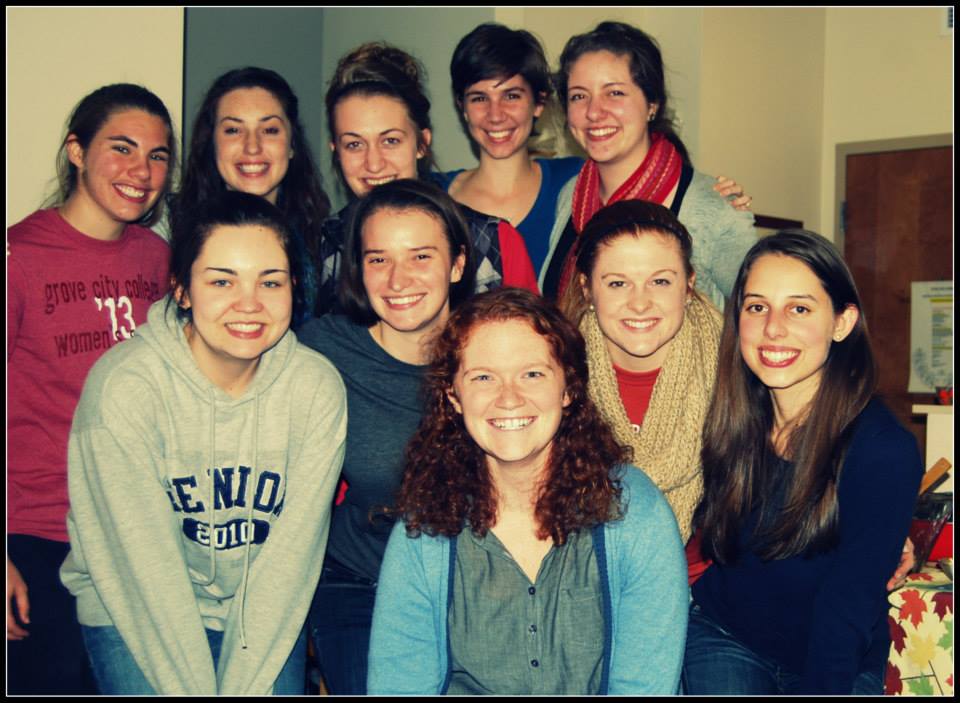
On Wednesday, my dear old freshman hall had a progressive Thanksgiving dinner in the apartments. I have loved these, my girls, since way back, even before this entry more than three years ago.

Here is how we were Christmas of freshman year:

Image

And here is how we are Thanksgiving of senior year:

Image

Just look at how cute we were then and how grown we are now.

Sometimes when we sit around we like to talk about the old days on the Fam Pan: the days of parties in the bathroom and poop posters and yelling down the hall for noms and Storytime and leftover ice cream eaten in the hall-butt and doors that stayed open all the time. We like to remember and say, Man, I wish we all saw each other more. I wish we could do that again.

But the future is already coming fast towards us in a big frightening wave of built-up expectations and unpaid bills. We sometimes feel that we’re in danger of being washed out and away to sea. We want to go back. Take us back.

Nostalgia itself is comforting. We are pleased that we can remember, that we’re wise enough to look back and know that the good times were good. (Real perceptive. Well done us.) But, of course, what we really want is not to go back to the past, but for our pasts, or at least our favorite parts of them, to become our futures. We want the safe yesterdays which we loved to be transplanted to our tomorrows to do over and over again. (As if the future wasn’t its own self, as if God didn’t have plans for it too.)

It’s funny because we’ve got nostalgia all wrong. The divine point of the longing we feel is not to fill it, but to know it, to understand what it is we long for.

There is a painful gaping hole in each one of our chests and sometimes we can feel the wind whistling through it. The hole will not be filled by wading into our pasts, or even our futures, and picking through for the best bits: the late nights up with dear friends, the long exhilarating road trips, even the dripping popsicles and small sticky faces in the summertime. We can stuff all the dreams in the world into that misshapen hollow to try to fill it and yet we’d still be able to look down and see right through ourselves to the other side. Really, as far as the eye can see, the hole is not going to be filled at all. Its edges will continue to ache.

But then again, the eye can’t see very far. It is shortsighted and weak, and would be blinded by the wonder of Him for whom the heart truly longs.

Someday, we’ll go back home again, really home, to the God for whom we were made, and our shoulders and eyes will strengthen so that we’ll be able to bear the weight and the sight of the Glory that will fulfill our feeble longings.

So for now, when we remember, we must remember that.

Sally

Today my sister and my mother and other sundry relatives are all converged at my grandparents’ in north central Missouri to celebrate my Aunt Sally’s birthday. She’s forty today, and everyone at the party bought matching t-shirts which say “Forty Years of Sally: Forever Young.” I am not there, I was not even a together-enough niece to send her a card, but I wish I was and I wish I had, so this will have to do.

My grandpa, the doctor, delivered six of his seven children, and when Sally, the last and the littlest, was born he was hesitant to tell my grandma that she had down’s syndrome, but I think she knew anyway. She was blessed with remarkably few complications, though she did have to have a metal rod put in her back. My grandma pulled her out of school in sixth grade and taught her herself: to read, to write, to fold the laundry, to know her Proverbs, to be good company.

She is our Sally: less than five feet tall, with tiny hands, size two feet, and her timeless silky straight hair, with its angular cut by the lady over on Highway F. Sally is stubborn, Sally is certain, my grandma’s word is gospel truth. Sometimes, if loud nieces and nephews unexpectedly decide to spend extra days in her house, she cries. Her bedroom is full of old dolls and Shirley Temple VHS’s and neat bags of miscellaneous treasures in long rows.  She thinks that my dad and my Uncle Dan are the funniest and best men in the world. (She might be right.)

She packs for any trip two weeks in advance, with a duffel just for socks. When I convince her to take a walk around the lake, though I hold her hand on the hills, and pick her daisies in July, she usually announces firmly, that “this is the last time.” She wanders slowly around the house, humming, and settles herself in a comfortable chair to flip slowly through a whole book, watching, listening, planning conversations that will never happen. (I do that too.) Sometimes my bent Grandpa lowers himself on the floor in front of her and she runs her little fingers absently through his white hair.

This past summer Mary and I came back to our cabin at camp one afternoon to find a box of Cheez-Its missing. An innocent bystander told us that Sally had been seen with just such a box. I marched around for a few hours in a great furor at the injustice and the invasion, and Mary and I eventually found her in the doorway of her own little cabin. She was already crying over something, but I confronted her anyway and she said that she was sorry, but they were all gone. She’d eaten the rest. And I realized. The girl just wanted some Cheez-Its. I knew about wanting Cheez-Its. I also knew about crying, so we left it at that.

A couple summers ago their fridge broke and as I was cleaning it out Sally was getting more and more upset that I was throwing away “Grandma’s good food.” Finally, as I was headed to the garage with some breakfast sausage, she followed me, muttering, and I stopped and turned, and put my hands on her shoulders. “Listen.” I said. “This is okay. Grandma asked me to do this. I’m helping. Just trust me.” She got a funny soft expression on her face and then held out her little arms to me and my heart melted all over the floor. (That was the same summer I tried to make crêpes and cried over them, and she kept stopping by the stove to pat me on the back and tell me my crumpled monstrosities looked “pretty good.”)

Sally is a creature of as-little-change-as-possible. She dances to my grandma’s preferred polka music, and works at the consignment shop at Senate Bill 40, and still sings the solo on the fa-la-la-la-la’s in “Deck the Halls” every Christmas.

Sometimes my cousins and I think Sally requires more patience than we can give. She takes the stairs one at a time with a loud grunt for each, holding tight onto the railing. She needs help washing her hair. When she is tired and overwhelmed she complains loudly about us in our hearing to her imaginary companions, shaking her finger menacingly. And so we regard her as stuck, miles away from enlightened minds like us.

But then I remember that freedom is not in speed or perfect cleanliness or even affability and normality. Freedom might, however, be in forty years of youth and simplicity, because I’ll tell you now that I’ve never heard such true abandon as Sally lowing out an age-old hymn in the shower.

Image

Things to Do, Things Did, and All Saints

I’ve been keeping a journal for a while now—two years on Saturday, actually. It’s a bound notebook that my friend Heidi decorated for me sophomore year and every day I write two lines in it about what I did, what I saw, what happened. I do it, I suppose, so that I can read and remember. For example, the entry for October 27, 2011 reads, “Am Lit midterm – sweater over flannel – Bible Study – felt better about tenure.” I don’t usually write about what I wear, but apparently it felt important to me that day, and not that this will clear things up much, but one of the entries the day before had been “cried about tenure.” Whatever that means. The next October 27th was a bit more even-keeled: “cleaned at JB’s – lazy afternoon – Lunch w/ Lu – did no homework whatsoever.” That was a Saturday and this year the 27th was a Sunday: “Quiet morning – coding w/ John in early aft. – early church – All Saints Vespers – just a Sunday : ).”

I’ve never been successful at keeping a journal before, but this seems to be sticking. I like lists, and keeping track, and knowing what happened when and how, and reading over and watching old worries grow and then fade back into oblivion. I’m a record-keeper.

I’m not alone. Here’s a favorite to-do list by Johnny Cash himself:

Image

I’m willing to bet he did real good on all those things, except that last one. I think we keep these lists because we figure if we know all these little things, if we have it all stored up, when the time comes we’ll be able to see the big important things better somehow.

I’d been thinking about that and then Sunday night I went to the All Saints Vespers and thought about it some more. I thought about keeping track for not just two years of college, but through long centuries, through so many lives and deaths and prayers and graces. Christina Rossetti promises her hesitant audience, “Yea, beds for all who come,” and that’s a lot of beds. Really, though, beds for Christina herself, Jonathan Edwards, Eric Liddell, my Grandpa, Flannery O’Conner, Joan of Arc, Aunt Jean from camp, Paul, Corrie Ten Boom, Tolkien, Rahab, Dietrich Bonhoeffer, Gerard Manley Hopkins…“all saints” is a lot of saints. Why do we keep track?

Well, because on Sunday evening I kneel with brothers and sisters of mine and pray aloud to Him “whose nature is always to have mercy.” We’re all members of the marvelously sprawling society of the previously lost and we must stick together, so as to remember what it means to be found. We know the taste of grace, and when we forget it those around us and before us will remember. “But the mercy of the Lord is from everlasting to everlasting on those who fear him, and His righteousness to children’s children…” (Psalm 103:17) The work of the cross stretches farther than you or I can see.

So all the scribbles and notes and records of practicing and cleaning and lunches had and walks taken are an anchor till the “yet more glorious day.” I will keep marking things down in homage to those who did so before me. Around the turn of the fifteenth century a woman named Julian of Norwich wrote in the midst of illness, “All shall be well, and all shall be well, and all manner of thing shall be well.” Everyone from T.S. Eliot to my own mother has read and believed her words. I don’t know if they’ll get nearly as much from me, but I’m trying. I’m making lists, keeping track.

One Little Room an Everywhere

First, for fall break, Elspeth was going to come up and visit. Then she emailed and told me she wasn’t going to be able to make it, so I came up with plans to go down to the orthodox monastery in Ellwood City, and ran around telling everyone I was going to be a nun over break. But then their guesthouse was full, (“no room at the inn,” Jackie and I decided,) so now break has come and I am holed up in my little apartment with thick socks on and corn and bacon chowder in the crockpot. My own sort of monastic living.

Wednesday afternoon I got a package from Elspeth in lieu of her visit, which contained tea, biscuits, a despairingly sassy mug, and my favorite of all: gummy Flintstone vitamins. I can’t get sick now, can I? I mostly sat in for the evening and begun reading As I Lay Dying, took a brief walk in the rain with my friend Mary, and discovered that, glory of glories, there is whole season of What Not to Wear suddenly available on Netflix. I’m not prone to these sorts of statements, but I’m fairly certain I could actually be friends with Stacey and Clinton. More than one episode has gotten me perilously close to crying, and I have definitely squealed—they just look so marvelous and happy, even if Carmindy the glowy make-up lady does slather an obscene amount of foundation on every single one of them.

Yesterday morning I borrowed Ali’s van and went out and spent more than fifty whole dollars on groceries for soups and things, then felt like superwoman carrying almost my own weight in foodstuffs up the stairs in one trip. I played hymns on my cello, and went out to wander around in the neighborhoods even though it was just about to rain. (Though really, it was just about to rain for all of yesterday, except for when it actually was.) This may be sacrilege or something in this cloudy part of the world, but I like the way fall looks beneath a thick grey sky. The colors are deep and saturated and drowsy. In the evening I went over to Haley’s and we made dinner and talked about Shakespeare and cross-country road trips and Dr. Brown herself.

I came home to plan for the little class on devotional poetry which I am hopefully teaching in January, and found I wanted something from my old creative writing syllabus from last fall. So I called my dad and he dug through my huge box of papers, and cheerfully read off the titles of everything from Classical Ed on back through junior year, in an effort to make me regret I ever asked. He was positively intrigued to find a poem I had written which he thought was about my mother’s rouge. (It wasn’t.)

In any case, I went to bed early and lay there reading more Faulkner, which I’m pretty sure I’m enjoying. There is something about sitting down and trying to actually write a novel myself which causes me to drink in other’s good prose like I’m parched. And though Faulkner jerks and spits and just generally behaves in an ornery fashion, he knows the way beautiful language works, that any voice can speak poetry, that a great part of reading and writing is listening. I fell asleep to his words last night.

The title up above is from a John Donne poem about being in love, which I am not. But though it’s just me here, I have plans to fill this little space with good cooking smells for hours on end, to scrub out the bathtub, to vacuum the thick carpet, to sit down at my computer and courageously introduce a villain into my story for good and all. For now, this little two-room apartment with its finicky lamps and pile of dirty dishes and sunlight sliding through the blinds is plenty enough for me.

Teachers

We’re getting older. In May, we’ll all graduate, (well, not all of us, but the particular subset of us that I’m thinking of) and we’ll head out into the wide, wide world to seek our fortunes and what not. For me that may very likely mean going back home, back to the place I came from. Many of my friends will not end up where they came from, but they’ll bring where they came from with them in some small part, wherever they go.

We come from our families and our homes, and experience is passed along and melts into us. I come from teachers. I do not mean the stand-in-front-of-a-classroom kind, though my parents are that, but that all my growing up years were strung together with adults sitting me down (or standing me up,) and telling me how: how to shuck corn, how to set up the wood stove so it was ready for lighting, how to tell if the pasta was done by just stirring it.

From the time I was four or so until my brother was big enough, it was my job to set the table. My dad pulled me aside the first time and said, “Do you know how to tell your left from your right? Look, you have a mole on your right arm, just there.” To this day it is strange to me that everyone’s right forearm isn’t marked in the same way. However did they learn? (Unfortunately, though, when my Granddad tried to teach Mary and me to play soccer at around the same time, I refused to do anything but sit on the ball and pretend I was hatching an egg.)

In the same deliberate manner as left-from-right, my mother taught me and my sister to do the laundry and clean the bathrooms. We hated Saturday, because it was chore day. We would hang around in our room and bicker instead of clean, and then come downstairs and drag the all the loose furniture out of the kitchen and dining room to mop, as our mother had taught us, and make a great long imaginary train in the center room out of the displaced chairs. (That was something we’d figured out on our own.)

When I was ten or so I remember my dad giving me lessons in dish-washing (something I suspect my little brother missed out on.) Glasses first when the water is cleanest, then silverware (don’t let the sharp knives get lost in the suds!) and plates next, and pots and pans at the last. I put a up a big weepy fuss every time I had to wash dishes for nearly a year or so—thank the good Lord for stubborn parents.

When I was just a little older my Grammy taught me how to iron, standing in our dining room: damp, warm, then dry and smooth, pressing in one sharp, long crease on the holiday tablecloths. It was a satisfying as washing windows: fast, definite results which, if you were careful, would last for wonderful months on end.

They did not contain their teaching to “how,” though. My mother read aloud from E. Nesbit’s retellings of Shakespeare and acted them out with our beanie babies, (Viola was my purple Millennial bear,) my Grandma and Grandpa have read Proverbs aloud at meals for as long as I can remember, and dear sweet Miss Jan used to sing with me at her piano.

I miss being taught in that off-hand, overflow sort of way. One night freshman year I had an assignment to scan a whole passel of Renaissance poetry, and I called my Dad in tears and just let him talk. He explained and proliferated for about fifteen minutes, and I listened not to his words, but to the sound of his voice and his neat, knowing sentences that led one to the next, and I was satisfied.

For now, I don’t have plans for grad school. I will be quite finished with studenthood in May, I think. But I cannot imagine that I will ever be finished, not simply with learning, but with being taught, with other people’s extraneous advice, their unsolicited “Do you know, Alice? Let me show you. You should know.” Yes. I probably should. Please do tell me all about it.

Pieces

I don’t usually write these things late, but I haven’t been able to sleep much lately, so here I am. Hello. I haven’t had much of an appetite either. My gut has been full of pointless nervous energy and I feel like I’m in pieces. I do not feel whole.

Today I got up and boiled some chicken for later, and put on a favorite dress from freshman year, and went to chapel, and came back to finish studying for my Civ Arts test and wander around my little apartment in concentric circles. Finally I headed up to campus, and took the exam, and went to an English-major-tea, and came back to cook dinner for some friends. (Well, really, they did a lot of the cooking. And all of the cleaning up.) They made me play my cello and I like them anyway. Afterwards one of my dearest friends came over and told me something very hard and I sat and listened and hurt for her. Then I read a chapter of Elizabeth Enright aloud and hugged her.

Those were the pieces of my day and I cannot put them together as I would like, or at least, not yet. So I’ll just tell you what else I’ve been thinking about.

We’ve been studying Da Vinci’s Last Supper in Civ Arts, and Dr. Munson says that Philip is his favorite. Jesus has announced that one of his disciples will betray him and Philip has risen from his seat and pointed to himself. He has seen the blackness of his own heart, and he knows the traitor must be he.

I have a very clear memory of one day in fifth grade walking back from PE class. After we filed past Mrs. Hedgecock’s room, she emerged, irate. She claimed that one of us had pounded on the door as we passed and disrupted her lesson and she was determined to find out whom. Nobody fessed up. I cannot remember why it was so important, but Mrs. Hedgecock, Mrs. Thomas, and Coach sat us all down very seriously and told us to put our heads down. They told us to raise our hand if we were guilty. Even if, perhaps, they said, we thought we could have done it on accident and had a slight lapse of memory. If there was the smallest chance it was us, we were to raise our hand. Well, I reasoned, I didn’t remember what I had been up to when we’d been walking that part of the hall. I was sure my mind had been wandering, though, so I put my hand in the air. When we put our heads up, all three teachers were hiding smiles. We immediately asked who it was. (So much for anonymity…) Ah, well, they said, only one person had raised their hand, and they were quite sure this person wasn’t the culprit, so best just to move on… The issue was dropped, and I sat quiet and red-faced in the corner.

I haven’t learned my lesson, though. I am still strangely eager to take blame. And I don’t want to let go of it, either. I cannot speak for Philip, but I still snap my eyes shut tight, and thrust my hand in the air. It is easier to take the guilt than to learn love, to learn mercy, to give, to take, to crack open my chest to the elements.

And here, at the solution, is where I am stuck, and the cursor just blinks at me. I will hazard a guess into the white space, though. I need to stop raising my hand in response to a call for confession, and instead start bodily throwing myself at the feet of the Great Blame-taker. I need to stop saying morosely, “I did that. I did that thing.” and start crying, “YOU TAKE IT. I CANNOT! I CANNOT!” Then He, in His goodness, will take not only my guilt, but me. And He will make me…whole. I cannot conceive of it right now, but He will mend pieces of which I can make no sense.

 I am so weary.

The Next Thing

You guys, blog entries don’t always solve my problems like they should. That’s why I write them, you know: I get upset and thinking about something and I start composing like mad in my head, then within a day or two I get it all out on the page in a big hunk of cathartic vomit, then everyone tells me how nice it is and I pat myself on the back and feel much better and go on my merry way. Unfortunately, a few weeks later I realize I’m still pretty screwy in the same old ways, and I already wrote about it, so there’s nothing else to do now. Drat.

One particular entry has continued to sit in my gut, though I wrote it months ago. It is the one about living up to my own expectations, making a dreadful little god of the woman I think I ought to be.

This tendency has all been especially apparent lately with my attempts to write fourteen novel pages every two weeks for my independent study. Somewhere along the line I’ve convinced myself that not only must everything I write turn out brilliantly, but it must be wonderful from the first draft, that the plot of an entire book must knit itself together seamlessly in the first attempt. So, with that in mind, I sit down to write every day and vacillate routinely between terror and despair.  I mean, if I can’t do a simple novel right on the first try, what am I worth?

I’ve been stumbling along anyway, sending weak kicks in the direction of the imaginary-Alice-who-can-do-all-things, and gratefully soaking up encouragement from Dr. Potter, and the book I’m reading on fiction writing, and the friends who say I’m over-thinking it.

And yesterday my mom sent me an essay in the mail called “The Judgment of Memory,” by a man named Joseph Bottum, who was, at the time, editor of First Things. It was mainly about memoir writing, about our tendency to write about our parents and childhoods (my parents are brave to encourage this habit of mine), about the way in which we dilute our own memories, about the way in which modern writers shy away from story and myth and substance, and instead give marvelous little detailed descriptions of things between which they are ultimately unable to draw a connection.

This conflict between focusing on details or plot is not just present in writing, in the way I squeeze words onto a page, but in my own life, in the way I spend my time, in the way I occupy my mind, in the way I rest. It is comfortable to look at small things like myself and my words and my to-do post it note for the week. It is uncomfortable to try to fit grand archetypes and ideals into my compact, inelastic life.

Details come easier because they can be added unto the all-powerful vision of ideal-Alice. The story comes hard because it is His. She does not exist in His story: there’s only Him and me. In fact it’s mostly Him. He was in all these places first. He “father’d-forth” all I see and all I know. Joseph Bottum writes that “In the end, every sentence with the word I in it is a lie: self-justifying, self-righteous, self-conscious, self-sick.”

So, what to do? How to follow along as He tells the story?

Way back freshman year, I wrote a frustrated little entry called “Weather and The Woman Question“ and Mrs. Liebmann commented and told me not to worry, just to “Do the next thing.” (That advice immediately skyrocketed right up there with “Don’t take yourself too seriously,” and “Say what you mean.”) It is not really as hard as I like to pretend to figure out the next thing. The next thing after this is to practice my cello, to write a page, to finish my laundry. I know how stories go. I’ve got lots of examples of lives well-lived.

For Christ, the next thing was usually something like eating dinner or going to bed or praying or talking to his mom or making a table. Sometimes, though, the next thing was healing a lame man, or casting out a whole horde of demons, or overturning a bunch of tables. One day the next thing was to be forsaken and to die. On Sunday, the next thing was to get up and walk out of a tomb.

Which means that the next thing for you and for me is really, simply this, from Luke 8: “Return to your own house, and tell what great things God has done for you.”

Lord Bless Saturday

I have had a lot of thoughts in my head this week. My little mind has been overwhelmed with details and ideas and nineteen credits and conflicting plans. Last night I got the chance to talk to several dear friends from home. I told one of them that even though the weekend was here, I couldn’t seem to figure out how to rest: whether to be with people to escape from my own harried thoughts or to sit by myself and wait out the storm in my head.

I’m still not sure. Right now I’m emotionally undone: there are too many people and things to care about. I so much want to love it all well, and I feel like I’m doing only a passable job. But lists are easy and soothing, and so, in inexact order, here is my advice for myself this weekend:

1. No Quad business until Tuesday night when it’s time for coding. None.

2. Do not offer to cook for anyone until Thursday at the earliest. You already have too many leftovers.

3. Ask for help when you need it.

4. Fold your laundry.

5. Remember that you are incapable of irrevocably screwing up your life with one decision about classes.

6. Don’t go anywhere besides church on Sunday.

7. Make it a priority to read well rather than finishing everything.

8. Wear t-shirts that you like.

9. Lock yourself away somewhere with your novel pages. Try to write words that make sentences and when you are too frightened to go on, pray to the One who “shall enlarge your heart.”

10. You are small. Just because everyone else seems to be able to handle it perfectly, doesn’t mean you must. The only thing you must do is ask loud and clear, as John Donne does, for “that grace to begin.” That’s all that’s required. Christ has done the rest.

Waiting

I will warn you right now: I am not writing because I have anything good to say. I am writing lost.

I had two conversations today with two different friends about two different topics, which all turned out to be eerily similar. They were conversations with people whom I care about and trust, in which I cried and they asked questions and gave advice. This is normal. There are a lot of nice people in my life and also I cry a lot. The general consensus is that Alice is a cuddly, weepy, very-open book.

But both of these conversations were different than usual. They did not spend very long in my familiar little landscape of problems. For some reason both of them veered off towards the unknown—towards places I had not planned for them to go. They were asking questions whose answers are hidden behind walls in my soul.

I did not know I had walls in my soul. I thought I had no secrets. I was frightened. I wanted tell my friends, “No.” I wanted to get up and walk away and never come back. But there are rules and precedents about how you treat your friends and so each of them earnestly scaled the walls and started gently poking around in my sooty heart of stone and its strange, sulfurous crevices of blame.

Their careful questions overturned in me harsh, short answers, and their glaring advice made me writhe. “No, it is dark down here! Do not bring a light—it hurts my eyes!” I wanted to say. “These things are not for seeing—they are for forgetting.”

Finally I told them each that I was waiting. I told them that understanding and healing and all-manner-of-things-shall-be-well would come in God’s time. (So that they should never again try to go beyond those walls. I would not be dragged back there again.)

I’m really good at waiting. At sitting, at being the last found in hide-and-seek, at stagnating, at rotting to dust in the corner.

Before I may live there are many things my God must kill, but before He does that I must admit that they live. But I’m not ready. I can’t. I’m waiting.