Joy

This school-year began hard. At the end of the first day of school, I walked down the hall to a co-worker’s classroom and sat on a desk and cried. I told her that it wasn’t my students (and it wasn’t), but it was me. I wasn’t sure I was made to do this. I didn’t have enough ability or energy, or perhaps most of all, enough love. I looked at my students and I looked at the teachers around me and I thought that maybe inside of my ribcage, instead of a muscular heart, pumping and giving, that maybe I only had sand. I did not seem to be enough.

And then my grandma died and my sister moved to London within days of one another, and things got oh-so-busy. So busy that I have not written here for over a month, even though I’ve wanted to. By way of an update: I have cried a little, been angry a few times, and laughed more than maybe I should. I have learned what it is to be unexpectedly encouraged through supportive parents and writing poems and silly games at the end of class and getting to act in a play again.

I’m reading through The Jesus Storybook Bible with a couple students, (which is a different story for a different day,) and a few weeks ago while reading about the battle of Jericho, I came across a line that stopped me and held me still: “So it was that God’s people entered their new home. And they didn’t have to fight to get in — they only had to walk.” So maybe my heart need not be a muscular hero, because there already is One. Maybe I am not always called to be a soldier “on the front lines of humanity,” but just a child who walks faithfully after my God. Of course I am not enough. I was never intended to be.

And I don’t know if God meant me for teaching, but right now, he certainly means teaching for me. High-schoolers can be uniquely bitter and uniquely joyful, often within the same hour. Last weekend I went to a regional one-act competition with Caldwell’s drama department. It’s funny to see what happens when you put about three hundred theatre kids in an auditorium for hours on end. They eat it up, they find friends, they get loud, they glow. More than once, in the forty-minute breaks between shows, sixty or seventy of them would congregate down front to play a game called Pony-something-or-other (or maybe it was Something-something-Pony?) They stood in a huge circle and clapped and chanted and danced with each other. They turned exuberant and pink and out-of-breath. I sat curled in my hard seat and watched and laughed and said “absolutely not” over and over whenever our kids bothered me to join them. To watch them dance is to be warm and to be still and to know.

Violent Graces

A few weeks ago I had a brief conversation with my friend Abbie about the nature of God’s grace, whether it is violent or gentle. To be honest, we didn’t really get into it–we were really talking more about Christian writers and who each of us tended to gravitate towards–but I have been thinking about violence ever since.

I have been thinking about what Marilynne Robinson calls Flannery O’ Connor’s “appalling imagination” and about how that imagination is pretty nearly reflective of the contents of the human heart. I have been thinking about Jacob wrestling with God all night, how he demands a blessing, and how, as the sun rises, he walks away with a limp. And I have been thinking of a Man dying naked and alone of asphyxiation on a wooden cross and knowing it was love.

Throughout human history, many of our truest examples of promise and mercy are red with blood. I believe that violence is usually ugly, and very often wicked and repugnant. The school shooting this week? I do not believe that it was grace. I believe that it was evil. I also believe that God can bring grace out of that situation, but even that is not what I’m talking about.

What I am talking about is our hearts, those hearts meeting God in a dark alley. Coming around a corner and finding the light of light, very God of very God standing there, right where we least expected him. He stands and he offers goodness and grace, but those meetings are so often violent because sinful people like you and me will naturally rebel against goodness. He is gargantuan and clear and bright. We are dusty and crumbling. The light is too brilliant, and it burns us clean and refines us, strips the rot out of our souls. The flames rise higher and higher around us, and we are not consumed.

But isn’t God gentle? Doesn’t he care for the orphan and the widow and the sparrow? Can’t his changes in our hearts be soft and his love be sweet? Perhaps Jacob did walk away with a limp, but didn’t the lepers leap for joy, and run? Christ bid the little children to come to him. I know he meant it.

I am going back to the basics here (I’ve been doing that a lot lately, for my own benefit), but God made us and God loves us. He knows the caverns of our hearts. He knows whether they need soft light or a sharp blaze. He knows how to mold with strong, sure hands. He both pays the fee and does the labor to make us whole, so he knows every part of the job.

I am making a muddy-eyed conclusion, as I usually do, but I think that for most of us children of God, our relationship with the Lord’s grace will be like that of Paul. He goes towards Damascus with murder in his heart, and is knocked down and blinded by the light. Then as he lies in the darkness, God sends Ananias as a bearer of grace to pray for him and baptize him. He gains new sight and a new name. When he leaves that place, everything is different. This is most of our stories, told again and again and again. It is the story of our daily lives. We learn love slow.

“Twas grace that taught my heart to fear, and grace my fears relieved.”

A Family Funeral

Late last Tuesday night, my grandma died.

Grief has been in the periphery of my vision all weekend, and I have avoided looking it square in the face, mostly because I don’t know what I will find there and how it will change me. Also, the whole situation is improbable. My grandmother dead? My grandma to be grieved?

Grandma was not a person of grief but of cheerfulness and hard work and practicality, of swift pats on the knee or a brisk kiss on the cheek, of getting out leftovers on Sunday night.

I did not like to see her lying there in the open casket partly because she never lay still like that. She was always doing and moving. Even in her last months, they had to put up a child-gate at the door to her apartment to keep her from wandering off in a fit of usefulness. And her face in the coffin was not right–they hadn’t drawn in her eyebrows and all the color had faded from her hair. But the hands were hers: round knuckles, dark, familiar sunspots on their backs. (But even her hands were never still and folded like that in my memory–they too were always moving, and usually wet from the water in the kitchen sink…)

I feel as if I am writing this underwater–all of my movements and thoughts are slower. I am unsure of my own feelings, but I’m trying to speak for all of us anyway, which is probably foolish. At the visitation on Friday night, I sat in the front pew with my sister and cousin and Mary suddenly said, “For some reason, I didn’t think this would be so sad.” I didn’t think so either. I didn’t think she would be gone. She was never gone and now she is. I didn’t really know that even in old age, death is ugly like that. It takes. The rest of us know how to keep going, sure, but our roots feel lost without her.

The funeral service was good. I played a few hymns on cello, which wound my nerves up tight into a little ball, the siblings shared memories, and, in an unexpected turn of events, the family stood up front and sang. My grandma would have said it was so nice. I was once publicly chastised in a college class for using that word, but for my grandma it was rich with meaning: appropriate, sweet, lovely, good and right, just-so. It was very nice and mostly we did not cry. Probably because we don’t understand yet. And we cannot express.

We don’t understand this impossible balance between the finite and the infinite. Her face and her voice and her words and even her approval of our niceness are all gone. But she read to my mother and my mother read to me. And when she laughed very, very hard her face crumbled up helplessly like she was crying. The same thing happens to my mother, and sometimes to me. She got up early, early every morning and prayed for children, grandchildren, friends, missionaries whom she’s never even met. These things are infinite, especially that last. At its highest point, her very active love for us meant very actively giving us over to the grace of God.

We came to her to find home, but she knew all along that there was a home and a Host beyond and above, bigger and realler. And in the last year of her life up in Minnesota she asked and agitated again and again to be taken home, until even she was not sure what she meant. But Jesus knew. The home that we found at her table she’s even now finding, to an infinite degree, with Christ.

My grandpa is very feeble, and tired, and now also pretty sad. But what he said over and over this weekend, is this: Christ Jesus does all things well. He did not say much else, but I suppose the things we repeat most often are the things we know we must preach to ourselves: Christ Jesus does all things well.

The Fixed Land Receding

Writing is getting harder than ever. I hate that.

I can find the time, and sometimes I can even find the ideas, but there’s a paralysis that creeps up my arms and into my throat when I try to paste words together into thoughts, and it’s getting more and more difficult to fight through it. Like I said, I hate that.

Lately I have been praying that foolish, wonderful prayer for God to teach me fear and trembling. I remember in the prayer room at Grove City, both in the communal journal and on the butcher paper on the walls, our precious overabundance of English majors used to write out John Donne’s sonnet in earnest to their Lord: “Batter my heart, three-personed God, for you as yet but knock, breathe, shine, and seek to mend…” Sometimes I smile and shiver when I think of all the ways He must be answering those prayers. Then I think of my own prayers and immediately want to pull my knees tight to my chest. Fear and trembling…

Of course, my life is pretty stable, I am returning for a second year of teaching at Caldwell, with almost exactly the same load I had last year, and I am living with my best friend of 14 years in an apartment less than a mile from the house where I grew up. I have never been an adventurer.

And along with getting ready for school, I’ve been watching a lot of Friends. It’s been fun. I’ve been thinking, though. It’s a show that’s supposed to be this iconic look at what it’s like to be in your twenties, how you need something to center yourself on, how you need (wait for it) your friends. Because it’s at this point in our lives that many of us realize that we are finally out there, in the big old world that’s been so criticized and lionized to us. And what and how are we going to do from here?

Perhaps the first thing everyone my age has noticed is that friendships are harder now. I have many friends but I have to work and work to love them and to hear them. I have to set up phone dates and answer texts. Even for the friends here in town, we have to constantly invite one another into our lives, add seeing one another to our to-do list, make the time even when we don’t have it.

When we do get together, we catch up. And I will tell you a dreadful secret: I am sick of catching up. I love these people, and I want very much to know how they’re doing, but at some point I’d like the conversation to progress into something more. (I first realized we were really and truly grown-ups when people my own age started politely asking how my family was.) I’d like to actually participate in living with one another, instead of just getting the recap highlights reel.

We talk about our jobs, our attempts to find them, and our attempts to find the work of our own hands in them. I will say, it’s been a peculiar joy to me to see so many friends light up: This is it! This is hard and this is good. Or even, This job is not what I meant at all, at all. But now I think I know where I’m headed, and once I get out of here, I think I even know how to get there.

I often walk away from these conversations thinking about teaching and high school. When I first got up in front of a class last fall, I was startled at how familiar these kids seemed to me. Their laughter and their shrugs, their bitterness and innocence showed me myself at sixteen and myself at twenty-two. But I was somehow simultaneously shocked to find that there was also a great chasm between us. I am stunned by the minute and large ways you change and grow as you enter the long corridors of your twenties. This is the age when the sounds in your head at last quiet down, when, for better or for worse, you can finally hear yourself think.

And so here each of us twenty-somethings sits… Lonely is not the right word, although it’s a very real possibility for many of us. Solitary is better. Alone with our souls and the Lover of our souls. Other people still matter, oh how they matter, but they don’t have the power over us that they used to. We are discovering that we “hang always upon the cross of ourselves.” “The mind has cliffs of fall,” and we have begun to peer down over them to learn the depths and the heights. There are tall, bright waves crashing at the bottom.

In Perelandra, C.S. Lewis’s science fiction retelling of the Fall, the one command the green lady must obey is to never spend the night on the “fixed land.” When she goes to sleep she must lie down on one of the floating islands in the seas of her world, and trust God that she will wake up in a place where he still cares for her, even if it’s quite different than any place she imagined or knows.

I am twenty-three, I have clambered onto a floating island, and the fixed land is receding in the distance. I am calling out for it as I watch it go. I am afraid. I know: this is not safe, but it is good.

On Flying

We are two weeks out from the start of school, and I am beginning to get nervous. There is so much to do and think of and plan and write down, not to mention all the time I obviously need to spend worrying about the things I can’t control. Of course, back-to-school nerves are probably one of the more common feelings in the world. There’s a newness and a freshness to that first day that can never compare to the first of January. It’s all short haircuts and tans and deeper voices and words that move faster than they did before and smiles that aren’t yet tired.

But sooner than we expect, all of the gloss and new-clothes smell will wear away and we will be left with those Mondays where our greatest accomplishment is getting out of bed in the morning. I am content in the understanding that some days, even some weeks, 6:43 am may be my proudest moment, so long as I remember that as I stand bleary-eyed in front of a mirror and march into school with a heavy bag on my shoulder, so much above and beyond me is being fulfilled and achieved.

As a child I didn’t necessarily believe I could fly, but neither did I quite believe that I couldn’t. I understood that as far as physics were concerned if I climbed up onto a roof, and took a running leap with my arms outstretched, that the air would not catch me. The ground would catch me, along with all my broken bones. And yet I was fairly sure that the business of soaring and dipping and twisting through the trees and into the clouds didn’t just concern physics. It made a sort of inherent sense to me that though my arms didn’t look or behave like wings (and in fact looked and behaved very much like arms) that didn’t mean they couldn’t actually be wings underneath. If, you know, some day…I did decide to try… I had an eager, soft little heart that loved the air and the heights better than the bruising, itching ground.

Last week we went on a family vacation and the cabin we stayed in had a swing. I swung on it only once, the day we got there, and just a couple minutes on it resurrected a whole hearty body of forgotten loves which I had allowed to be buried by a host of teenage and adult fears of  indeterminate origin. I remembered that swinging is one of the few physical activities that I have never thought makes me look foolish, I remembered my starved appetite for the wind in my ears and my clothes, and I remembered the pure, unexamined desired to get close and into the center of the blue sky. I realized I had never really changed my mind. I am twenty-three and am not quite convinced that I can’t fly.

I‘ll be very clear with you, I have been grumpy today: I was sullen with my sister and got more upset than perhaps was justifiable over a car insurance meeting that went too long. (I almost kicked the cat.) But I want so much to remember that there is a sky. I want to lay my fear down on the concrete curb and look up to see if it might be a good day for flying. I want to be able to remember that swing at 6:43 am in February. I want to be able to set aside my cynicism (just a grown-up brand of fear), and feel the wind from my Lord’s treasuries. The hope in my seven-year-old eyes gazing out into the sky from our backyard swing is no less real than the heavy fears of February. In fact, it might be real-er.

My Mother and Lessons in Grace

If you come right down to it, summer has never been my favorite season. I don’t mind the heat, and I love the sandals and the dresses, but eventually everything gets kind of murky in all the long hours there seem to be. I always start off excited for the freedom, but then I get a bit lost in it. Even when I make myself plans like reveling in all the reading and writing I can’t do during the year, even then, I get a bit lost.

But lately I’ve been grateful for my mother. It has taken most, if not all, of my growing up years to understand what a phenomenon she is.

I remember when I was very small hearing my dad refer to her as pretty, which, at the time, was very shocking to me, because she was my mother. I expressed my skepticism, and she looked at me with her eyebrows raised. “You don’t think I’m pretty?” “Well, no!” I said. My parents just turned to each other and laughed like grown-ups did. I remember being very offended. (Turns out my mom is beautiful.)

And I asked her once in high school if she worried about us when we were out late, and she said breezily, “Oh, no, I just start planning your funerals.” At the time I thought this was her way of saying no, of course not, but it occurred to me, years later, that it was actually her way of saying yes, of course.

I like to tell these stories, but they do nothing to communicate the steady, everyday effect she has had on me. Just now, I happily, willingly, practiced my cello, and yesterday I changed out of sweatpants into shorts before I took a walk in the heat. These small acts seem unremarkable, but they took years of dedication on the part of my even-more-stubborn-than-me mother. I have moved out now and she takes great care to invite me over for dinner at least once a week, and text me often to meet her to take a walk.

And it occurs to me more and more as I tell her all my worries, and try her patience with my tears, that she has never once offered me the easy way out. She has always, insistently, offered me the way in: make yourself go, make yourself write, make yourself read, make yourself eat well, make yourself pray, and always make your bed. Her cures for my ailments never offer a break from life, but instead life itself. She is the one who suggested I write a paper to present at an academic conference in the middle of my first year of teaching, for no other reason than because I could. Her perennial lesson is to use what’s been given you. Read the book because it’s good, and wear your hair down because you can. You’ve been given hands, feet, a brain, a home: use them, use them, use them.

Grace is hard. To accept good things, to lose the world and gain your soul, is painful. I thought that I learned this in college. But now I am beginning to think that I will be learning it over and over again, with fresh pangs, for the rest of my life.

I have been given freedom: take it up, like a cross, and use it, use it, use it. Thanks, Mama. I’m learning.

10311933_10152051899016400_4895253154327407191_n

Learning to Live

My senior year of college I wrote a novel: one draft fall semester, and two more during the spring. When I had a deadline approaching for honors seminar I would be crouched on my desk chair till two in the morning, whispering and backspacing words on to the page, hardly noticing when my roommate came in and out. I’d be up at nine the next morning writing again: in t-shirt and sweatpants, curled in a snarl of sheets on my bed, dirty tea-mugs mounting on the stacked crates beside me. Late in the morning, I would get dressed hurriedly and head to class with a hot hole burning in my chest, because I had left my heart lying on top of my closed laptop back on my desk, still fast-beating a story. It was terrible and glorious.

The summer after I graduated, I very purposely took the summer off from any serious writing. I travelled and saw people I loved. I read a good deal. I made nervous stabs towards planning for teaching.

Then I taught.

And now there’s this summer: what with travelling and moving, this has been my first real week of it, of having the days all to myself, to dispose of however I choose. I have meant to get back to that serious writing, that state where I produce, produce, produce and walk around a little lopsided, because I have one foot on the ground and one foot stuck in the air. I meant to write for hours each day. But instead this week has confirmed for me something which I have to quietly admit to myself I already knew: I am not a creature of routine. I never will be.

I like to plan, but then I live on a whim: now I want to make myself some eggs, now I want to read a new book, now I want to take a bath, now I will do dishes, now (though it’s five-thirty) I will make my bed!

This leaves the short story that I’m working on moving slowly, painfully, in twenty-minutes-a-day starts and backfires. But college is college and this, for now, is real life. My mom and I are making a deal to keep each other accountable for writing this month, and I think that this will help.

Part of real life (if not most of it) is making do with what you have: your hands, your feet, your mind, your time, your lack, your abundance. Making all these things work for the glory of Him who loves us. Even when we submit to having all the parts of us brought together, the days we do this right, the unexpected and complex amalgamation of gifts and understandings in each of us combines to make strange little people, creatures who limp and plod along on odd numbers of legs, looking laughably like misfits. (The cloven in The Wingfeather Saga made me cry because I know that they are true.)

But what matters is not whether we look funny, but whether we are moving, and moving in the right direction, even if it goes in fits and starts and circles that don’t seem to make sense. What matters is that we walk alongside one another and that we laugh because we know the great secret. We know that we are not misfits after all’s said and done. We are “kept in grace.”

Oh, I like living. I like making do.

Houses of Memory

For weeks now I have been dealing with things: unpacking and repacking them, dusting them off, sorting them out, holding them in my hands, throwing them away.

About two weeks ago, my mom and my aunt and I went to out to my grandparents’ house in Missouri to pack it up, to begin to get it ready to sell. We moved them up to Minnesota almost ten months ago, and since then the house has sat still, their aging black lab wandering aimlessly and heavily in and out of his dog door to garage, being fed by a family friend, the swimming pool hosting gleeful clans of mosquitoes. Various children have come by a few times: the fridge was cleaned out, the books were sorted, choice pieces of furniture were taken. Most of the beds got clean sheets. But that has been it.

When we got into town we went by Walmart to get cleaning supplies: paper towels, trash bags, work gloves, lighter fluid, and matches. Over the course of five days we sorted through about half the house. My grandparents lived in that house for more than fifty years, and for people who I know have stored up their treasure in heaven, they have so, so much stuff.

Highlights included a book of Ronald Reagan “full color” paper dolls, three Chinese checker boards, a forty-year-old speed reading course neatly packed in its own blue case, hundreds and hundreds of cassette tapes, three doctor’s bags full of hypodermic needles and prescription medication dating back to the seventies, drawers and chests full of baby and doll clothes, a 1993 picture of grandkids at a family funeral which someone had had produced as a jigsaw puzzle and then never opened, a ziplock bag of stockings neatly labelled as “Not Best Stockings”, designer ties mixed in with the polyester ones, boxes and boxes of microwave popcorn, dozens and dozens of Mason jars (some still containing homemade jelly,) and boxes of old forgotten family correspondence, all along with seven dead mice, thousands of mouse droppings in drawers and corners and plastic bags, and one small wasps nest.

We sorted things into piles to sell, to give away to the local charity shop, to take home with us, to go in the dumpster, and yes, largest of all, to throw on the fire out back. I carried huge bags out to toss onto the flames, and sometimes I would stand and watch them burn: all of these things which had sat so patiently at the back of a crawl space or at the back of a drawer, now gone so fast. Pages and pages of old medical journals turning ashy black, their edges curling and disintegrating. Boxes of ant-infested sugar cubes turning into syrupy brown rivulets, burbling down the side of the heap.

On our drive out to Missouri my mom told me about the paper she was writing for the conference she and my dad are at this week, and she explained that in ancient times, when education placed a great emphasis on memory, particularly memorized oratory, teachers taught their pupils to use a device called the “house of memory.” As a young man memorized his speech he was supposed to build a big house in his mind and walk through it as he recited. Each room was supposed to remind him of a different point or counterpoint, and then lead smoothly onto the next point in the next room. If you stayed safe within your illusory house as you spoke, you would not get lost in your own words.

I am very good at remembering: my sister and I have a running joke that I remember her own life better than she does. And because I am good at memory, I prize it very highly: to remember what has happened feels like having all the answers stored away for a rainy day.

And my grandparents’ home has always served as a tangible house of memory for me: It is the center of my extended family, the place I can remember all of them and all of our Christmases and summers. As we packed up the end room, and piled old appliances and furniture in the middle for the dumpster, I kept looking around and thinking about my uncles who grew up here when this was “the boys’ room”: they have gotten tall and grey, but the wooden paneling and the bright blue carpet still remembers them as scruffy loud little boys, reading Peanuts books, just as the now busted out doctors bags remember all the patients my grandpa cared for so faithfully, and the Mason jars remember my Grandma’s hard, satisfying work over a hot stove.

I know that memories can be a burden. But I also know that my grandparents are so old and have forgotten so much. If I cannot remember things for them, I wish I could at least hold onto the things that saw them when they did remember. But I know that it is better to try to live with empty hands.

Tomorrow I am moving into my first real apartment, so I have spent the last several days packing. While I do not hoard, there are certain things I have quite a lot of: I have a lot of dresses, tights and blankets, I have twelve boxes of books, and I have huge amounts of paper: mostly in ratty old notebooks of different shapes and sizes. Most of these things (except some of the paper) will come to my new home. I will not stay there forever: the new memories I will make in the rooms will become old, and I will leave them behind. It’s unavoidable, I’m going to forget. I’m going to forget my sixth grade email address and why I chose it. I’m going to forget what my cousins looked like when they were babies, I’m going to forget what year I took that favorite class in college, I’m going to forget students’ names, I’m going to forget what I did on my nineteenth birthday.

And someday I will probably forget that my grandma read Proverbs at the breakfast table. But she did not read Proverbs to her children and grandchildren so that we would remember that she read Proverbs at the breakfast table. She read Proverbs so that they would they would teach us to strive to “get wisdom” and “keep understanding.” And they did. They do. She would not mind if I forgot all the rest, so long as I remember that.

The old that is strong does not wither / Deep roots are not reached by the frost.

First Year Teaching and Unpaid Debt

I’ve been making notes for this entry since last October. At first I was going to wait a few years to actually say this stuff to the internet-at-large, but I can’t help myself: here we go.

I planned to write a long list of advice for first year teachers, like the one I wrote a year ago when I finished college. But I discovered within about two days of becoming a faculty member alongside wonderful people who wanted to see me succeed, that for every piece of advice there is an equal and opposite piece of advice. So basically, even with the best support system in the world (which, including my parents and former teachers and friends who are a phone call away, I may well have had) you’re going to have to figure it out on your own in the moment, or you’re never going to figure it out at all. And that’s absolutely okay. So that’s what I have to say about that.

But if not advice, what? I guess just a rambling reflection, which is mostly what I do on here anyway. I have grown and changed this year perhaps more than I have in all four years of college. Every day that I have taught, without fail, I have felt both very young and very old. A while back, at play rehearsal I turned to a coworker and said, “There’s five years between me and them, and ten years between me and you, but I feel so much closer in experience to you.” “Yup.” she said. “Weird.” I said. And yet I cry at Caldwell choir concerts, because they inevitably make me feel seventeen again, and while there is something precious about that feeling, it is not quite comfortable either. But being in-between is most of what life is, so this is absolutely okay too.

Looking back I think I went through most of first semester in a bit of shock. I remember one day in September when Lisa came around to take attendance, I told her with a mix of bravado and desperation that they were all present, though I hadn’t even bothered to count them, much less look at my roster. I would doggedly stay up late into the night, making powerpoints and organizing notes, feeling my heart turn to heavy iron whenever a new email appeared unexpectedly in my school inbox. On the rare occasions that I was in a context other than Caldwell, I still couldn’t manage to talk about anything other than school and my students, no matter if my listeners were interested. (Still not great at that, but I’m getting better. I’m becoming more normal again.) Here is a somewhat-exact excerpt of notes I kept for myself throughout that first semester:

Sixteen-year-olds are adorable.

Sixteen-year-olds are little turds who don’t know that teachers have feelings.

At least I haven’t cried in front of students yet. That’s a victory.

I love being observed. It’s the freaking best. It makes me feel safe.

Almost-literal blind exhaustion sometimes hits while driving home.

I stay up late because I want time to myself before I go in the next morning.

It is so hard to get up in the morning. SO hard.

Why does my life have so many binder clips in it now?

Is it going to be like this all year?

IMPORTANT: That day sixth period worked quietly. 11/6. Let it be remembered. [Note: I actually wrote a poem about this day. It’s called “An Ode to My Students’ Silence.”]

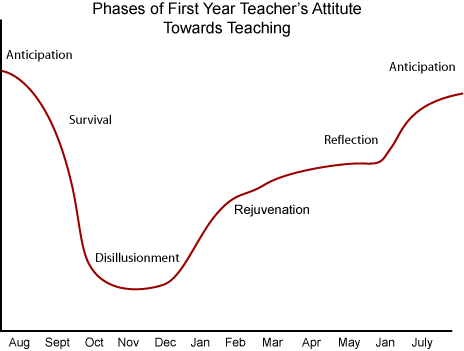
But I survived. And stayed marginally sane to boot. I kept in touch with friends who were also first-year-teaching, because the front of a classroom can be a starkly lonely place. It is good to feel as if you’re in the trenches alongside someone else (and now that I’ve briefly taught World War One, that’s an especially vivid metaphor). I watched all of Boy Meets World, and though I remain doubtful that it’s really very kosher to regularly assign essays on a whim at the end of class just because the topic pertains to an issue in your favorite students’ lives, I was reminded that even in the world of nineties sitcoms, it is still possible to be a truly fine teacher and that doing so doesn’t center around making your students happy. And then late one Sunday night in November, when I felt just awful, I found this:

fqjsm

I’m not typically a big charts and stages person, but this is absolute it-gets-better gospel truth. Believe it, cause it’s real. By December, according my notes at the time, I had “all warm fuzzy advent feelings after seeing them sing and getting gifts from them and having them treat me like a real human being and not just a grade machine.” Things were looking up. I was going to be okay and so were they.

In fact, there are a few students to whom I wish I could write individual thank you notes for encouragement they didn’t even know they gave. Highschoolers can cause more pain than they know–but their kindnesses, even unintentional and very small kindnesses, can bring so much joy. The times a student has gone out of his or her way to actually make my day better, I have usually cried (though not in front of them.) And it was a fairly normal but unexpected thing one single student did way back in early December that made me decide not to up and quit when I was feeling a bit desperate.

Really perhaps the thing I have learned most thoroughly this year is the thank you note thing: the value of appreciation and expressing gratitude. When I was a sophomore in college I wrote Dr. Brown a thank you note once and she made a huge deal out of it in front of the rest of the students, and said that sometimes she felt like Christ healing the ten lepers with only one coming back to say thank you. I thought this story was hilarious–I adored Dr. Brown, but she was comparing herself to Jesus, for goodness sake–and would tell it over and over to my English major friends. I no longer think it’s funny. I know exactly what she meant. When you teach and you care that you do it well, you are fighting on the front lines of humanity. You’re teaching the human mind to reach its potential, holding out the world in your hands, trying to get the faces in front of you to comprehend it, to feel their own smallness. There’s so much pressure to get it right, but when you do get it right, often nobody notices, and this is discouraging. To give more than you take, that is what every good teacher does, but no mere mortal can give out of a dry well. We all need water.

So, knowing that, and knowing what I know now especially, I want to shyly and belatedly be grateful to the people who taught me. I didn’t know what it took, and even if I had, I’m not sure I could have understood.  Thank you. Thank you for what you did for me: for crying with me, for laughing with and at me, for graciously thinking it was endearing when I told you bluntly that your class was “not my happy place,” for reading picture books aloud, for letting me run to your room in tears when I first discovered Billy Collins, for handing me that mysterious and wonderful envelope before the New York trip, for letting me sit on a desk during your planning period and just talk and talk and talk. And thank you for what you did for all of us: for heavy worry, for long patience, for giving us the best of what you loved, for volunteering to be Atlas with the world on his shoulders and believing it to be worth the trouble, for finally entrusting each of us to Jesus when it was all that you could do.

I see it a bit more clearly now. Second semester, when my responsibilities began to pick up pace, and when my heart learned to hold on anyway and smile in the wind, I started to care less about what my students thought of me and more about the students themselves. And I didn’t know that in a job in which I was supposed to be the helper, I would routinely feel so helpless to really love them well. So unable and weak. They need so much charity and compassion and help. I know this because I need this things too. I know this because, in our need and inability, we are the same.

Despite all of the doing and learning and trying, the appreciation and the lack thereof, I am discovering a secret which probably most teachers who’ve gone before me know. Education, when you really try to do it right, is debt. An extensive and painfully shining web of unpaid and often unacknowledged debt. We’re all bound and knotted together by it. We give and are given to over and over again, then march off triumphantly into the sunset, as if our spoils are our own, while the ropes of debt tug at our heels. Some days I can’t keep straight who is demanding restitution from whom. There is a colossal owing, and we, none of us, can possibly pay it back. And this, I think, is where education all goes bad or is hatched, where we begin to ceaselessly demand the pound of flesh from one another, or relinquish ourselves to the waist-high waters of grace.

This has been a long and meandering entry, but really there is one reason I have written it: I am preaching to myself. I am saying: “Alice, you feel as if you’ve worked hard and given much, but what you have given is that which was first given you. Your deficits are deep and wide, but they have been filled by a love that is deeper and wider. Your debts have been cancelled by the great Forgiver of debt, the Payment himself. Forgive your debtors as your debts have been forgiven. Look at the world and look at the hands that hold it and remember that you are small. See that your Lord is large and great. Love with liberty and with joy.”

Oh, to grace how great a debtor daily I’m constrained to be. Let that grace now, like a fetter, bind my wandering heart to Thee.

Lessons from Cinderella and Jake Barnes

I’ve watched a lot of movies since the beginning of college–most of them alone, on a computer screen. I like watching things this way. I feel free to criticize or adore whenever and however I want. I get to watch on my terms. Funnily enough though, when I give myself that choice I almost always choose criticism. I’ve gotten in the habit of quietly dissecting and improving and making-over most everything I watch. But last weekend I went and saw the new, live-action Cinderella with my family. I put my feet up on the empty theater seat in front of me, and let the whole thing carry me away.

It’s a beautiful movie shot in all the color you could wish for and told with complete openness. It looks at grief and joy and meanness and hope and tells each bit as straight as it can. I loved the end: when Cinderella is found because the sound of her voice carries out the open window and her unasked-for forgiveness makes her stepmother sink down and lean against the banister of the stairs with the weight of it. But I think the moment I loved the most was when Cinderella walks into the ball. She has arrived a bit too late for comfort, and she comes down the stairs by herself, with no one to announce her. Strangely, what was most evident to me was not that she is beautiful or hoping to find Kit, but that she is walking into a room alone. I have walked into a room alone, you have walked into a room alone–some days it is the bravest thing that we do. She descends with all eyes on her: nameless to all of them and probably already loathed by every woman in the room. Step by step she approaches the bottom of the stairs, and she has no idea what will happen when she gets there.

Then, late this past Monday night, I found myself on a little mental jag, when I should have been going to sleep. I lay in bed and thought about Jake Barnes in The Sun Also Rises: where he begins, and where he goes, and, most of all, where he ends up. He pines over Brett, letting his own physical inability to have her smash the side of his face down in the dirt and pummel him with punches again and again. He lets his wounds, real and imaginary, take him over and he throws away his self-respect and his aficion for bullfighting by letting Brett have, and ruin, the hopeful young Romero. But that’s not the way he ends: after everything that happens in Pamplona he literally goes into the sea alone, washes, and comes out clean.

And that’s when I thought of it: Jake’s like Cinderella. Perhaps this is silly and those of you who love Hemingway or fairy tales more fully than I do are looking askance, but let me try to explain.

When Brett sends for Jake, he signs the wire with love and loyally goes, but somehow he has unhooked her from his soul: he eats more than he drinks as they have lunch together, and the last image of the book–the raising of the policeman’s baton–means that Jake is willing to seek manhood and courage and meaning wherever he may have them, and lay the wounds of war and love to rest. This is him walking into the room alone, perilously free of the self-pity and self-sabotage he has had to protect him for so long.

All the good stories tell the same truths (this is why I love literature) and the principles which motivate Jake and Cinderella at their best are very near to one another. Though community and closeness and hands that hold onto yours are very important, there are things that can really only be learned alone. To walk into the room, to “have courage,” to “be kind,” to “get to know the values”: these are ultimately acts chosen by, and affecting, the individual soul.

As I have been thinking about this I keep remembering that this sort of independent bravery is  what I want for my students. The ones of whom I’m the most proud are the ones who are able to love their classmates without being swayed by them, who have found their own feet and are learning to stand on them: to walk down the steps, to raise whatever baton they’ve got.

But then I laugh, because really, who am I kidding? If I am telling the whole truth, I must admit that this freedom is what I want for myself–not to follow the scents and sights around me but instead, to be prepared to be separate, to be new and be different, to transform instead of conform. I want to be willing to find goodness and meaning outside of where the world has told me it must lie, and, though strange eyes may look on, to allow myself to be cut from a different cloth.