One Little Room an Everywhere

First, for fall break, Elspeth was going to come up and visit. Then she emailed and told me she wasn’t going to be able to make it, so I came up with plans to go down to the orthodox monastery in Ellwood City, and ran around telling everyone I was going to be a nun over break. But then their guesthouse was full, (“no room at the inn,” Jackie and I decided,) so now break has come and I am holed up in my little apartment with thick socks on and corn and bacon chowder in the crockpot. My own sort of monastic living.

Wednesday afternoon I got a package from Elspeth in lieu of her visit, which contained tea, biscuits, a despairingly sassy mug, and my favorite of all: gummy Flintstone vitamins. I can’t get sick now, can I? I mostly sat in for the evening and begun reading As I Lay Dying, took a brief walk in the rain with my friend Mary, and discovered that, glory of glories, there is whole season of What Not to Wear suddenly available on Netflix. I’m not prone to these sorts of statements, but I’m fairly certain I could actually be friends with Stacey and Clinton. More than one episode has gotten me perilously close to crying, and I have definitely squealed—they just look so marvelous and happy, even if Carmindy the glowy make-up lady does slather an obscene amount of foundation on every single one of them.

Yesterday morning I borrowed Ali’s van and went out and spent more than fifty whole dollars on groceries for soups and things, then felt like superwoman carrying almost my own weight in foodstuffs up the stairs in one trip. I played hymns on my cello, and went out to wander around in the neighborhoods even though it was just about to rain. (Though really, it was just about to rain for all of yesterday, except for when it actually was.) This may be sacrilege or something in this cloudy part of the world, but I like the way fall looks beneath a thick grey sky. The colors are deep and saturated and drowsy. In the evening I went over to Haley’s and we made dinner and talked about Shakespeare and cross-country road trips and Dr. Brown herself.

I came home to plan for the little class on devotional poetry which I am hopefully teaching in January, and found I wanted something from my old creative writing syllabus from last fall. So I called my dad and he dug through my huge box of papers, and cheerfully read off the titles of everything from Classical Ed on back through junior year, in an effort to make me regret I ever asked. He was positively intrigued to find a poem I had written which he thought was about my mother’s rouge. (It wasn’t.)

In any case, I went to bed early and lay there reading more Faulkner, which I’m pretty sure I’m enjoying. There is something about sitting down and trying to actually write a novel myself which causes me to drink in other’s good prose like I’m parched. And though Faulkner jerks and spits and just generally behaves in an ornery fashion, he knows the way beautiful language works, that any voice can speak poetry, that a great part of reading and writing is listening. I fell asleep to his words last night.

The title up above is from a John Donne poem about being in love, which I am not. But though it’s just me here, I have plans to fill this little space with good cooking smells for hours on end, to scrub out the bathtub, to vacuum the thick carpet, to sit down at my computer and courageously introduce a villain into my story for good and all. For now, this little two-room apartment with its finicky lamps and pile of dirty dishes and sunlight sliding through the blinds is plenty enough for me.

The Next Thing

You guys, blog entries don’t always solve my problems like they should. That’s why I write them, you know: I get upset and thinking about something and I start composing like mad in my head, then within a day or two I get it all out on the page in a big hunk of cathartic vomit, then everyone tells me how nice it is and I pat myself on the back and feel much better and go on my merry way. Unfortunately, a few weeks later I realize I’m still pretty screwy in the same old ways, and I already wrote about it, so there’s nothing else to do now. Drat.

One particular entry has continued to sit in my gut, though I wrote it months ago. It is the one about living up to my own expectations, making a dreadful little god of the woman I think I ought to be.

This tendency has all been especially apparent lately with my attempts to write fourteen novel pages every two weeks for my independent study. Somewhere along the line I’ve convinced myself that not only must everything I write turn out brilliantly, but it must be wonderful from the first draft, that the plot of an entire book must knit itself together seamlessly in the first attempt. So, with that in mind, I sit down to write every day and vacillate routinely between terror and despair.  I mean, if I can’t do a simple novel right on the first try, what am I worth?

I’ve been stumbling along anyway, sending weak kicks in the direction of the imaginary-Alice-who-can-do-all-things, and gratefully soaking up encouragement from Dr. Potter, and the book I’m reading on fiction writing, and the friends who say I’m over-thinking it.

And yesterday my mom sent me an essay in the mail called “The Judgment of Memory,” by a man named Joseph Bottum, who was, at the time, editor of First Things. It was mainly about memoir writing, about our tendency to write about our parents and childhoods (my parents are brave to encourage this habit of mine), about the way in which we dilute our own memories, about the way in which modern writers shy away from story and myth and substance, and instead give marvelous little detailed descriptions of things between which they are ultimately unable to draw a connection.

This conflict between focusing on details or plot is not just present in writing, in the way I squeeze words onto a page, but in my own life, in the way I spend my time, in the way I occupy my mind, in the way I rest. It is comfortable to look at small things like myself and my words and my to-do post it note for the week. It is uncomfortable to try to fit grand archetypes and ideals into my compact, inelastic life.

Details come easier because they can be added unto the all-powerful vision of ideal-Alice. The story comes hard because it is His. She does not exist in His story: there’s only Him and me. In fact it’s mostly Him. He was in all these places first. He “father’d-forth” all I see and all I know. Joseph Bottum writes that “In the end, every sentence with the word I in it is a lie: self-justifying, self-righteous, self-conscious, self-sick.”

So, what to do? How to follow along as He tells the story?

Way back freshman year, I wrote a frustrated little entry called “Weather and The Woman Question“ and Mrs. Liebmann commented and told me not to worry, just to “Do the next thing.” (That advice immediately skyrocketed right up there with “Don’t take yourself too seriously,” and “Say what you mean.”) It is not really as hard as I like to pretend to figure out the next thing. The next thing after this is to practice my cello, to write a page, to finish my laundry. I know how stories go. I’ve got lots of examples of lives well-lived.

For Christ, the next thing was usually something like eating dinner or going to bed or praying or talking to his mom or making a table. Sometimes, though, the next thing was healing a lame man, or casting out a whole horde of demons, or overturning a bunch of tables. One day the next thing was to be forsaken and to die. On Sunday, the next thing was to get up and walk out of a tomb.

Which means that the next thing for you and for me is really, simply this, from Luke 8: “Return to your own house, and tell what great things God has done for you.”

Letting Her Die

When I was a little girl I had all sorts of plans for the great lady I was going to be when I was grown up. I was going to be elegant and kind and sought-after and I was going to wear the best sort of clothes and have one of those bell-like laughs you read about in less-truthful books. I was going to be infinitely wise and glisteningly beautiful and able to leap tall buildings in a single bound.

Sometimes, when I am having a good day or week or month, I flatter myself that if eight-year-old Alice showed up on my doorstep she would suitably impressed. She would think that I was Her. I get all warm and fuzzy when I think that and then a little voice in the back of my head says, “Of course, she’d be wrong.”

Because little Alice is pretty easily satisfied, really. Give her mascara and some sparkly stuffs and she’s delighted. The goal self, the dream self has grown since then.

She now knows everything worth knowing and has read everything worth reading. Her clothes now are not only good, but are completely singular and they never wear out or need dry cleaning. She never runs out of gas or leaves awkward voicemails and she always knows what to make for dinner. She is impervious to fire, water, poor grades, rejection, and heartbreak. She has a group of friends who are just diverse enough that they all still get along, and just talented enough that their abilities complement Hers. She never has to be brave because she is never afraid.

Her legend in my mind continues to grow. Even comfortable self-deprecation is just another round-about way of reminding myself of who she is and who I am not. And every time someone gives me one of those extravagant compliments—the kind you get from people who don’t know you well enough yet—She absorbs it. A friend says I am well-spoken? Well, I know I’m not, words only occasionally come out of my mouth in the right order, but She will be, along with brilliant, and beautiful, and best-selling (just to dip into the B’s).

During those good times when I’d like to have little Alice round for tea, I almost think She’s real—but then my own feet will trip over themselves and I’m back where I begun. One of the reasons Sophomore year hurt is that I was so clearly not what I should be. I was not Her. It’s not that She never cries, but She doesn’t exactly bust open at the seams and ooze anxiety for months on end.

This panic has been coming back to me in smaller doses this summer. I’ve struggled to write, because nothing I write is good enough—all of my words limp and plod, already weary after five minutes on the page. They do not measure up and neither do I.

So  then I turn to my reading, which is currently very overwhelming (I’m backlogged with four summers’ booklists) with books that I don’t think I’m going to enjoy very much at all, but I know I can’t possibly be Her until I’ve learned to.

And as for the music she is supposed to like I am so intimidated by the thought of it that I avoid listening to anything at all, except alone in my car. Every way I turn right now, She seems to have laid out expectations for me. She’s getting pretty pushy.

It’s time I stopped feeding the tyrant. My dream-self is getting fat with my own expectations for Her, anyway. Bloated. I do not know how to stop except to simply get up and walk away from Her, to spend my summer re-reading favorite children’s books and plugging away at my story, chanting quietly, “I’ll revise later. I’ll revise later.” That will do for a while.

But really, if she is to die, for good and all, like Ozymandias, I’m going to have to come before my God and let her be torn away. And then I will need to be washed and then I will need to begin to learn freedom like the widow bringing her mite, and the fear of the Lord like Paul. It’s a long, arduous process. But He has promised me that it is finished, that He has done it, and that He loves me. So I, like little Alice, will be satisfied.

Summer Readings

Since it seems less and less likely that I will find much in the way of summer work (though I’m still certainly open to the option,) my main occupation for the summer has become that of reading and writing.

Since I’ve been home I’ve been forging my way through Thomas Wolfe’s Look Homeward, Angel. I do mean forging— my mom finally started to say encouragingly, “Alice, why don’t you read something for fun?” I finished it last night, but, man, Eugene Gant drags his feet getting from ages zero to eighteen—I swear he grows up slow and sticking as molasses. His father, Old Gant, spends a large part of the book wasting away from cancer and alcoholism, then right near the end, Ben, the only character Tom Wolfe has deigned to paint sympathetically, comes down with pneumonia and up and dies, bringing the whole dysfunctional family together and causing me to cry at a book I didn’t even like. On top of all that, Old Gant is still alive at the end, and Eugene has never had a love affair with a woman who isn’t at least five years older than himself or even achieved a decent haircut.

It’s all part of my summer reading, see, which is intended to spur on the writing of a story about a teenage boy and his little sister. Several of the other entries on the list are re-reads, including The Great Gatsby and Catcher in the Rye, which I’m very nervous about now that I’m no longer sixteen. I also want to re-read all of The Mennyms books, which are a British children’s series about a family of life-sized rag dolls. I’m sure they’ll help me incalculably. Right now, though, I’ve begun a collection of sweet and simple essays by E.B. White. Following on his heels will be some Henry James and Eudora Welty.

I want to love books again this summer. I want to love them the way I used to. My book-habits now involve stacking them in pretty towers and smelling their pages and touching their spines reflectively and taking pride in how quickly I can find my favorite bits with having to fumble through any unnecessary pages. I’d like to read them again.

When I was a kid I sometimes read three books in one summer day. I would block out my little brother’s kicking feet and my mother’s requests to set the table and my sister’s demands to not hog the bathroom for hours at a time, and I’d simply fall into pages which pulled me along at a pace I never questioned, to the homes of lifelong friends I’d made the hour before.

If, on occasion, I did have to leave a book, to eat dinner with my family, or go to bed, or some such, I would, an hour or so later, get a funny hunger in the pit of my stomach. The uneasiness would grow more and more acute until I realized: I missed my book. I’d been holding my breath since I put it aside and I needed back in so I could breathe again.

I remember being in awe that some light little packet of paper which I could hold in my hand could captivate me for hours. Even at the time, I think I was aware that in actuality there were much smaller pieces of technology with much larger memories, but they did not impress me in the same way. I could see and account for everything that made the book what it was: the paper, the ink, the words, the little punctuation marks, and yet I couldn’t understand it. I sat down to consume the story and it ended in consuming me. A good book was something beyond.

So in the next couple months, I will remember how to love in a book, not what I pretentiously claim are its finest features: its paper and stains and ink and splendor on my shelf, but its expansive pilgrim soul which, in this world, always remains just out of reach.


March

I slept for twelve hours last night and I’ve got an attractive bass cough. I’m not sick, it’s just been a full week.

I spent a huge amount of time with my classical ed classmates, trying to figure out what to do about our midterm and our class and our lives. By having us spend so much outside-class-time together, Dr. Edwards has kind of created a monster. I’m tempted to try to write you some hefty, ideological entry, because that has been my week. But yesterday, after our Hamlet discussion, when I told Dr. Dixon that I’ve just been in a really critical mood lately, he said, “Yes. You have.” So instead, I will be gentle.

Since I’ve seen you last, I’ve written an Easter poem, done my laundry, gotten a cuddle-wrap in the mail from my Grandma, walked Pinchalong, and cleaned and cluttered my desk several times over. I’ve had an interview for a summer job, planned for an independent study, cleaned up when a four-year-old didn’t make it to the toilet, gotten an apartment for next year, stayed up till three talking, and found rides to and from school for Easter break. Since I’ve seen you last, I’ve been blessed.

And now I am sitting here, not knowing what else to tell you, which is unusual. Usually I write my entries before I actually write them, if you know what I mean.

I guess the purpose of this is to tell you again (though I’ve told you before) that after twenty years, God’s goodness is still large and small, unexpected and regular. There’s no need to say anything more spectacular than that, and there never will be.

Writing: On Living Up and Going From There

It’s been longer than I meant it to. That happens in writing. In the interim I intended to write a Valentine’s Day entry from which you can thank God for sparing you, and an entry on my trip to Staunton to see Shakespeare, which would’ve mostly been gushing, so if you imagine “!!!” and “!!!!!!!” you’ll about have the jist. But I’m not writing about either of those things tonight. That, too, happens in writing.

I find it hard to explain myself, and what I do, and why, without talking about my family. I’ve noticed since being at college that people either are a product of their home, or strangely, simply, they are not. I am my parents’ daughter. I cry more than they do, I need more hugs, and I am lazier, but I am theirs.

There is no poet I love whom they did not love first. They are responsible for the dear and the unread portions of my bookshelf and for my ability to find a book fast on the library shelves. For my first few semesters here I sent them every paper I wrote. I do not remember who taught me my letters, but my mom and my dad taught me my words.

On school mornings my small-town-Midwest-raised mother told us, without pretense, to “make haste!” and now in her many emails she tells me to “persist” and to “strive.” My mama is a verb person. My daddy like adjectives, I think. The first time he called me “svelte,” he made me look it up in the dictionary. We read Shakespeare and Thackery and Dickens and Rosetti. We sang and we talked and we were silent.

Every birthday, a parent (usually my dad, who’s into that sort of thing) writes a poem in cramped black ink. One of my favorites, from my sixth birthday, is a chronicle of all the things they’d like to give me, most of them extravagant, all of them silly. I easily remember the last lines, I’ve read them so often.

“But I am a dad and I mainly have words

And they say that we love you and though it’s absurd

That little black marks could do something so hard,

They’ll always, yes, always, smile up from this card.”

And so, even three states away, they do.

And so, years and miles later, I write. I have been given words, and I try to use them.

I had a little crisis yesterday. It occurred me for the first time (I like being sure, so I’ve never given myself much a chance to change my mind) that I might not want to teach. I might want to write. Really write.

I will not sit here and tell you that I love learning. I hope I do, but I’m simply not sure. I will tell you that I love words, that I love stories, that I love a bound book for what it is, a blank piece of paper for what it can be, a pen for the smudge it makes on the side of my hand. I love going into the shower starry-eyed, and coming out a half hour later with a subplot. (I did that last night.)

So what I am doing, at the moment, is being a student (after some tears yesterday, I confirmed that with my mother.) What I will be doing in year and a half is unsure. (Oh, oh, oh, how I like being sure, though…) I may be teaching, but I will be writing.

I am not always sure that I know how to become a better teacher. But I know how to become a better writer. When I graduated from high school my parents gave me a volume of C.S. Lewis and my Dad wrote on the inside “Always say what you mean.” That is the best advice for writing that I know.

So here is what I mean: I do not know if I can teach. I do not know if I can live off my writing. I do not know if I can live up to my parents as my imaginings tell me I should. I do not know, in fact, if I can live up to any of my imaginings. But I am learning what grace means. I am learning all the adjectives that make it visible and present, and I am learning my place among them. And God willing, I will spend the rest of my life writing them out in cramped black ink, as my parents have taught me.

Again and Again

I’ve had things to write about. I just haven’t got round to it, see. So all these nice ideas were piling up in my head, threatening to form this big, old entry about things I like and things that are great and things I’m thankful for, and I thought, “Man! That’s so unoriginal. That’s been DONE.” And it has. Again and again. By me. Here and here and here and here and also here. (For example.) In fact, that’s most of this blog.

But funnily enough, in all that listing and enumerating I have yet to exhaust God’s blessings. Think of that. And I’m commanded to praise the Lord. Again and again and again. Isn’t it lovely when what you’re commanded to do and what you want to do is precisely the same thing?

So here we go, friend.

One thing:

Last week I went to a little meeting with the staff of The Quad and we had this discussion about why we read and what it means to be a good reader. And normally, that would have been just fabulous, but this time instead of participating properly, I quietly had myself a little existential crisis.

Why did I read? I knew all the right answers, about how it makes you more fully human and more fully alive and all that, but why did I, Alice, who had written multiple papers on this very topic, actually read? What were my real motivations? Was I only mimicking my parents? Did I really even like it? Was my whole life a façade?!?

So I sat in the corner and stewed and drank apple cider and did not contribute to the discussion. But then later, you know, I figured that if my life was a lie and all that, I probably would have had an inkling of it before age twenty. I’m fairly introspective (read: self-absorbed.) Also maybe, just maybe, I’m a normal person who reads for the normal reasons. Sometimes to escape, sometimes out of habit, sometimes because I have to, and sometimes that I may “know life and know it more abundantly.” So now I’m re-assured. And that’s a good thing.

Another thing:

We’ve had game night at the Edwards’ a couple times so far this semester. And it’s a little thing, but for me it’s also a big thing, (and after all this time I still don’t even really like games.) Sometime I’ll write another separate entry to tell you why, but no hurry. It’s going to be a part of my life for the next while here.

A third thing:

I have a smallish job this semester and it’s a gem. Every other week on Friday or Saturday morning I borrow my dear roommate’s car and drive to Mercer while everything is still dewy and chilly, with myself and the quiet and that one field of sunflowers by the side of the highway. And then I clean Dr. Brown’s house. This morning I did windows. Soap and rinse, time to dry and Windex. (Time to dry is my favorite part.) I’m tired at the end. I’m tired at the end because I did something. In the quiet morning, I did something.

And then I drive home, put on decent clothes, eat lunch, and go to class to read books. It feels marvelously like a double life. And I like both parts.

The next thing:

There’s something else that deserves a whole entry, which I’m hereby scheduling for late February. It’s the American Shakespeare Center at Blackfriars in Staunton, VA, or, as I like to call it, the happiest place on earth. I’m going over our break in February with Dr. Harvey and other delightful people for a one credit travel course to see four plays. There’re still spots open, so you should come too. Even if you think you don’t like Shakespeare, even if you think you don’t like anything, you will like this.

A particularly delightful thing:

One of my favorite things about this semester so far has been the friendships. Every day, I wake up shocked to discover how great it is to have friends. (God only knows why I’m surprised to find that this is blessing.) I’ve always had friends (really, I have—even in seventh grade when I specifically planned not to because I was only going to be at that school for a year and who really needs ‘em?) But this year, we’re upperclassmen, spread across campus, (or even states and countries) busy with non-intersecting things, and I seem to have entered into the wild, wonderful, and weirdly adult world of intentional friendship. The kind where you send notes and emails and say you and me tomorrow, kid.

It keeps surprising me what friendships grow and last, when I didn’t think they could. It even surprises me what friendships happen at all, and how once you get past the first layer of person there’s more of them underneath and more and more and more. C.S. Lewis wrote that “There are no ordinary people. You have never talked to a mere mortal.” It’s true, friend. And it’s kind of astounding.

The greatest thing:

Well, I suppose the best part is the again and again, the knowing of life more abundantly. Miss Jan, a dear friend from long ago used to sit at the fascinating piano in her living room that had keys and magical buttons, and sing the final verse of “Amazing Grace” this way:

“When we’ve been there ten MILLION years, bright shining as the sun, we’ve no less days to sing God’s praise than when we first begun!” (Again and again and on and on)

Things

It’s raining while I’m writing. And I’m thinking about things. Things I’m packing, things that are following me to Pennsylvania on Friday. Jewelry and clothes and books and paper clips and notes from friends and shampoo and paper and too many shoe boxes and bobby pins and boots and notebooks and two teddy bears of varying sizes and a couple very tiny ceramic pigs.

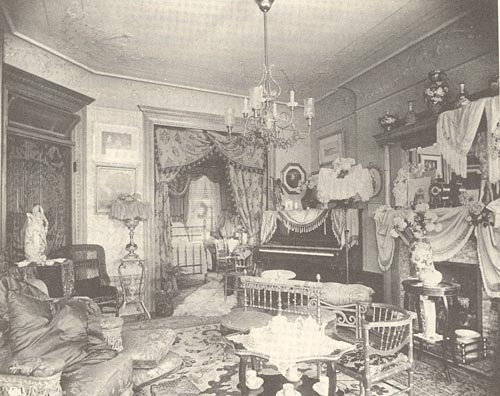
I’m working on a story right now, and the other day I had the distinct pleasure of listing the contents of a character’s room. The list was longer and less sensible than the one above. I really like it. I like imagining all those things piled together with no seeming order.

Though I don’t know many people rich (or silly) enough to have one, I have never liked the idea of a room that looks like this.

Image

It looks like the place Darth Vader would go to relax. Even the plants are dead. Give my little Victorian heart clutter any day.

Image

Beautiful, beautiful unmatching clutter.

Image

Touchable, holdable, lovable things.  Things that sit on your desk and wall, and say, “Remember?”(which leads to another “Remember?”…and another and another.)

Remember intercampus mail?

Remember the time Reb made you stop dressing your boy bear in girl clothes?

Remember when you wrapped food up in a napkin to look like a purse and sneak it out of the gala, but then you had to stop in the photo booth first?

Remember when Karen first fell in love with giraffes?

Remember that second day of seventh grade when you were so scared to go back that you threw up, but then you found a brand-new, sunshine yellow beanie baby in your backpack?

Remember your cousins when they were little and grinny?

Remember when George used to sign all correspondence “From a loving brother”?

Remember kindergarten when you were all set to marry Spencer Hill and be a rescue nurse in forsaken places like Nevada?

Remember when you got to fill a new (to you) room and year with these things, and smile at them? Oh, wait. No you don’t. That happens on Saturday. Excellent.

College’s Best-Kept Secret and How to Overcome It (I think)

Here are some reasons that I haven’t written in a while:

1) The next “favorite” on my list was favorite people, and when one really comes down to it, how does one write that entry? Could get a bit touchy, you know?

2) I’ve been working. Mopping floors and filing papers—quite enviable.

3) I’ve been writing. A little story for the new Mr. and Mrs. Upper along with the beginnings of something much longer.

4) I’ve been watching Good Mythical Morning.

5) I’ve been reading Suri’s Burn Book.

6) I’ve been slacklining. (Excuses are wearing thin at this point…)

7) Mainly, I just haven’t.

Before college the inhabitants of every corner of the earth converge to give you conflicting and vehement advice, but there’s one thing no one ever tells you. Unless you’re one of those mission driven people who gets an internship or works at a camp (and if you are, that’s fine, I still love you) then here’s college’s best kept secret: SUMMERS ARE WEIRD.

It goes like this. You come home and you think “Oh! I’m home! It’s summer!” and then you do nice home things and you go to work and you come home at the end of the day and you think “Oh! I’m home… Where is everyone? Oh. It’s summer.”

And that’s when it hits: you thought summer was going to be like partying inside of instagram, but it’s really more like sitting in your messy room looking at everyone else’s instagram, which you’re pretty sure (but not positive) that they’re all inside of partying without you.

So here’s some suggestions for my fellow weird-summer enthusiasts (or not so enthusiasts):

1) Read your summer books aloud: to your friend, to your cousin, to your teddy bear, to yourself.

2) Look up all those quotes whose origin you’ve never actually known, for that satisfying feeling of I-once-was-wrong-but-now-I’m-right.

3) Dry your laundry on the clothesline.

4) Go for a run in the heat, come home and say, “Welp, I did THAT.”

5) Turn halfway down the stairs into your regular hang-out spot.

6) Paint a room alone. Write secret messages in large letters then cover them up and giggle.

7) Try on old clothes and sit around in them for an embarrassingly long time.

8) Drive. Be loud in the car in whatever way you can think of.

9) Go to the farmers’ market on week days to make the venders feel loved.

10) Make lists. Surprisingly easy and surprisingly fun.

Do this and you will be left with a sore throat, extraneous knowledge, nice smelling clothes, a bunch of lists and no pictures or gas. Summer well spent.

Favorite Words

For years my favorite word has been quixotic. She’s a marvelous little heiress of a word. She didn’t have to make her own way in the world, work to build her own connotation. She’s named after Cervantes’ legendary windmill slayer, and the Oxford English Dictionary draws connections with the word vagabond. She sounds good too, like mint ice cream, and a loud, old-fashioned oath, and shuffly feet.

My other favorite words are stolen from others. In the play Wit the main character describes the first time she came across the word soporific in Beatrix Potter’s The Tale of the Flopsy Bunnies. (All the best words have stories, of course.) The little girl is fascinated to discover that “The bunnies in the picture are sleeping. They’re sleeping like you said, because of sop-or-fic. The illustration bore out the meaning of the word…just as he had explained it. At the time it seemed like magic.” And she moves from there onto John Donne.

There’s also the list from The Cozy Book. “Mumble, Scribble, Sandal, Muzzle, Alabama, Cuspidor and Orphan Annie, Pachysandra, Sarsparilla, Tusk and smug and fog, Galoshes, Ambidextrous, Henrietta, Amble, Dawdle, Wobble, Mosey, Listen, Cousin, (Close to cozy),Superstition, Baked Alaska, Dandelions, Hummingbirds, Busybody, Dillydally, Ali Baba—Cozy words.”

And just now flipping through the OED I found the word shriven. That’s one I haven’t known for long, but I love it. It sounds like it lives at the heart of everything truly good, and it does.

But I’ll tell you a secret. It easy to think of lovable words, but it is far easier to think of unlovable ones. Pull out your psychology textbook or your latest tax return or even your saved texts and you will find them: words which have had their livelihood confiscated. Words which are no longer permitted to mean anything to anybody, to be colored in some brave, bright or bilious way, but only to be a code, destined to be deciphered by the brain and summarily discarded. Most can be resurrected if one is willing to stop and eat them slowly, but some are quite dead and one must replace them with their first cousins. What follows is a post mortem.

UNNECESSARY (un-needful, not full of need, not desirous of action); FULL (abundant, fitting, “…it is fitting and right, its out constant duty at all times and in all places…”); TRANSCRIPT (across the written word, a ship skimming over ink to deliver the message, the meaning, the truth); LIKE (bearing a likeness to, as He bore our griefs and carried our sorrows, we are to bear likeness to Him); COMMON (as in the Book of Common Prayer, and Aaron Copland’s Fanfare for the Common Man, the commonalities which bind us); ORIGINALLY (beginning, birth, that from which we inevitably derive our meaning); DEMONSTRATION (manifest action, letting words live, living oneself); SECURE (do not think of safety, but why you desire safety, of what and for what?) GRADUALLY (gradient, sloping, speeding down a grassy hill not so gradually after all); CONFIRM (with assurance, understanding, a setting of records); PREVIOUS (before, progenitor, parent to the now); COMPLETE (“He said, ‘It is finished!’ And bowing His head He gave up His spirit.”)

It is the connotation which makes all the difference, you see. We need denotations to communicate, connotations to do everything else, to express.  A word without connotation has, as yet, no color. It has not lived. Bathroom for example, means simple body functions to most of us, but really it’s the sanctuary of the bathtub, the place of solitude and hour-long wonderings. (I planned this entry in the bath.) Also, my grandparents use the word costly instead of expensive, and I find it vaguely enchanting. What does expensive mean anyway? Out of thoughtfulness? I like taking words apart and putting them back together and seeing how much bigger they become. It’s filling, satisfying, right.

For real, thirst-quenching language here is a sonnet from my favorite word dismantler, stitcher, piler and occasional word-welder, Gerard Manley Hopkins:

As kingfishers catch fire, dragonflies draw flame;

As tumbled over rim in roundy wells

Stones ring; like each tucked string tells, each hung bell’s

Bow swung finds tongue to fling out broad its name;

Each mortal thing does one thing and the same:

Deals out that being indoors each one dwells;

Selves—goes itself; myself it speaks and spells,

Crying Whát I dó is me: for that I came.

I say móre: the just man justices;

Keeps gráce: thát keeps all his goings graces;

Acts in God’s eye what in God’s eye he is—

Chríst—for Christ plays in ten thousand places,

Lovely in limbs, and lovely in eyes not his

To the Father through the features of men’s faces.