Two Weeks

I am a first year teacher, and all year I’ve struggled with how to write on this blog–how to tell the truth, but tell it slant. There have been discarded entries (which I never had in the past) and few which did not really come out how I intended them to. There has also been a lot of staring at the blank page. I want so much to give a clear picture though, because writing helps me understand. The past two weeks have been strange and full and often strangely, fully good, and I want to tell you about them, but even these 336 hours have seemed to contain a lifetime.

I went to play practice for hours every afternoon and night and decorated the set with my favorite books stacked along the back wall.

As part of their prank, the seniors built a ball pit in the room I teach in. So I taught about Imperialism for a few minutes, but then I let my students sit in it and play with all the bright colors, while they wrote letters to someone they were thankful for. And I got to wear a princess crown all that day.

We prayed together during the junior girls’ Bible study and as a faculty at lunch one day–for those who are sick and those who are scared. (Those people are sometimes us.)

Lauren Robinson and I both graded all 44 senior thesis papers in a week and a half. I sat on the floor behind her desk on Wednesday afternoon madly calculating final grades, while the freshmen giggled their way through speech presentations. Late that night the two of us painted the rock, barefoot, with Paul Simon on full volume in her truck. They all passed.

My front tire got slashed by some unknown enemy.

I went down to the gym for a few minutes to watch the juniors and seniors have their last dance lesson. I was charmed by what a good time most of them seemed to be having, but was also deeply grateful that I was no longer out there on the floor.

I ate brunch with Sarah Moon, and we talked about things that were not students and teaching, and it all felt very surreal.

I averaged about four hours of sleep each night.

Students brought me food and Starbucks unbidden and I didn’t know what to do with myself.

It briefly seemed as if my social security number had been stolen by someone in Vermont, and I laughed very hard and happily at the prospect of someone wanting my identity. (It turned out to be a clerical error.)

I got tired of giving critical notes to the students at the end of rehearsal, and just decided they were all cute and could act however they wanted. (Thank God for multiple directors.) Instead, I wandered around Target and Walmart trying to find all the shades of foundation that our supply boxes were running out of and wished I knew something, anything about make-up.

While walking back in from letting my chaotic sixth period do their reading questions outside, I tripped and dropped my large stack of grading all down the stairs. I couldn’t think of anything to say, so I sat down and just looked pathetically back at my students, and they picked it all up in a stunned silence.

I watched our pride and joy, You Can’t Take It With You, from the audience each night and it was still funny every time, even when the fireworks didn’t go off. I laughed and I grinned and sometimes I felt very, very sleepy

And then I turned twenty-three, which is simultaneously much older and much younger than I feel.


Sometimes, in these past two weeks, I have felt blessed and unaccountably successful. At other times, I have wanted to find a small, cozy hole, crawl into it until we reach July, and then bring the calendar to a full stop, preferably for quite some time. But after oversleeping this morning and then cleaning the bathroom while listening to Andrew Peterson, I feel smaller, more on kilter, as if I can fit comfortably into my skin again–I think I had been leaking out of it for a while.

When I write I try to organize and find meaning between all the little things, but it is not always easy. Sometimes I must be content to believe that the truth is somewhere between “Life is pain, highness,” and “Love is all we have left in this world, Grandpa.” I must trust, trust, trust, that my God knows the substance of all this: the bungled works cited pages, the loudly laughing teenagers, the spray paint that took days to wear out of the creases of my fingernails, the chai tea lattes on my desk. He knows what all these little shadows mean.

For now we see in a mirror, dimly, but then face to face. Now I know in part, but then I shall know just as I also am known.

Martha, Mary, and Food

I’ve been thinking a lot recently about Mary and Martha. A couples weeks ago I had some discussions with my juniors about a woman’s place in society, and there are so many things I wish I had said. I wish I had reminded them that the woman’s primary calling (like the man’s) is to sit at Christ’s feet, and hear his words, and that any structure that hinders her from “choosing the good part” is wrong. I wish I had reminded them that regardless of what I tell them, this “nearness-to-Jesus,” this is the litmus test.

And then this week I left school and my students to go up to Grove City for a C.S. Lewis and Inklings Conference, with Martha and Mary still whispering in my head. Martha, the teacher, the keeper of the full agenda and the red and blue pens. Mary, the student, jubilant to let down her inky guard for a long weekend, jubilant to listen.

I drove up for the conference in my grandma’s Buick, which only plays cassette tapes, and listened to the same Mark Heard album over and over and over. It’s called Ashes to Light, and you should hear it: “He looks at their faces and loves them in spite of his grief.”

I had a lot of conversations this weekend, personal conversations with close friends, and heard some good talks, very good talks. Papers on catechisms and incarnation and pedagogy, and keynote addresses on images and humility and honesty. On Friday night at the banquet Diana Glyer spoke on artistic collaboration and creating alongside one another for balance, for accountability, for prayer. Afterwards I walked up to her to tell her how encouraging it had been, and to thank her, and immediately burst into tears. Oops. She took me by the hand, and said “Tell me about yourself.” “This is my first year of teaching,” I said, “And I haven’t gotten a chance to think about these things for a long time and–thank you.”

All weekend I tried to balance Mary and Martha and failed. I made the mistake of checking my email on Saturday and immediately spiraled into a foul mood, though it only contained run-of-the-mill announcements and student requests. Then I drove home today and listened to Mark Heard over and over and over again. I have come to the point in teaching where I have stopped worrying so much about what my students think of me and have started worrying about them–so the songs reminded me of my teenagers. “Feet of clay and an inner light, they were given everything.” I thought again about how I wanted them to “choose the good part,” to accept the good gifts. I thought about Mary and Martha, and then I thought about food.

The paper I gave on Friday morning was about food in Narnia, the way its goodness depends on the giver. And the difference between Martha and Mary is the difference between feeding and being fed. The hostess cannot go hungry. If we have not first eaten the bread which means his body, the we cannot possibly be his hands and feet. If I try to teach my students what tastes sweet and what will make them strong, without first sitting at my Lord’s table, I will fail.

There is even more to it than that, though. I am now able to hesitantly believe that I am meant to be a teacher, but before that I was, am, and will be his. I am his, and there is only “one thing needed”: I must sit and hear his word.

If you’re interested, below is said paper, devoid of parenthetical citations because they look weird on a blog. I promise they were there.

The Mysterious Workings of Food in Lewis’s Narnia Chronicles

George Sayer, with whom C.S. Lewis often stayed while on holiday, describes his taste in food as “plain, solid, and traditional…roast meat of any sort.” He had no appreciation for “subtle French recipes” or even “for puddings or for fruit.” Yet the food which Lewis did love he treated with whole-hearted devotion, and since children were the original audience the Narnia books, within the Chronicles he regularly approaches the subject of food and drink with the appropriate seriousness and urgency of a child of seven. In imagining Narnia, Alan Jacobs writes, “What [Lewis] has to do…is trust the images that come into his mind–or, more accurately, trust that he is being formed as a Christian in such a way that the images that come to his mind are authentic ones, ones that lie at, or at least near, the center of his soul.” So Lewis uses the food which his characters naturally eat: Puddleglum’s eels and the feasts at Cair Paravel, to tell the goodness and mystery of gifts. The food in Lewis’s Chronicles, whether of deep magical importance or a simple symbol of good fellowship, is nearly always given and ultimately reflects the character of its giver.

Jacobs tells a story about an American named Firor who sent Lewis multiple hams in the late 1940’s, while food was still scarce in Britain. “Lewis and friends started calling him ‘Firor-of-the-Hams,’ and on one occasion a dozen or so of the Inklings signed a collective letter of gratitude to him.” It turned out that this same Firor was a doctor and a great hero who had rescued a colleague’s wife from behind the Iron Curtain, so a real generosity and solidity was reflected in his gift. Lewis implicitly trusted those who relished food as much as he did. Around the same time Nathan Starr sent Lewis bacon, along with a passage of his own Chaucerian-style verse to recommend the meat, and almost immediately received an invitation to visit Lewis’s rooms at the college. Lewis considered the right sort of food an indication of good character

So, when an outsider first enters Narnia, if he is able to fall into the right company, he is immediately fed well, signifying the virtues of Narnian culture and fellowship as a whole. When a bewildered and delighted Prince Caspian enters into the heart of Old Narnia for the first time and is led around to meet all the creatures who live in hiding, Pattertwig the squirrel offers him a nut and the bears are eager to feed him their messy honey. Lewis tells the entire episode like a travel story, with scores of new introductions, and these gifts of food are each beast’s way of making his mark on both Caspian and the reader’s imaginations throughout the ongoing procession. Even before that, when Lucy herself first enters Narnia, she understands Tumnus’s core good-heartedness not merely by his welcoming words (which turn out to be false) but by his hospitality: “a nice brown egg, lightly boiled, for each of them and then sardines on toast, and then buttered toast, and then toast with honey, and then a sugar-topped cake.” Moreover, the Pevensie children know they have found good friends in the Beavers when they see cozy smoke rising from Mr. Beaver’s dam and realize they are being brought home as dinner guests. In fact, though the Beavers are virtuous in many ways, to Lewis their most important quality may be their abundant and generous hospitality, considering Mrs. Beaver’s response when the company realizes they must run for their lives: “Now, Mr. Beaver, just reach down that ham. And here’s a packet of tea, and there’s sugar…And if someone will get two or three loaves out of that crock…You didn’t think we’d set out on a journey with nothing to eat, did you?”

In fact, one of the ways in which Lewis expresses celebration, especially after his characters have passed through great trials, is in jubilant descriptions of good (and often very British) food. When Jill and company escape from the Underworld, they are treated to the most comfortable and fulsome fare by the good dwarves, just to prove that they are home: “Not wretched sausages half-full of bread and soya bean either, but real, meaty spicy ones, fat and piping hot and burst and just the tiniest bit burnt.  And great mugs of frothy chocolate, and roast potatoes and roast chestnuts, and baked apples with raisins stuck in where the cores had been.” Jill and the reader are both starved for warmth after all the grey time underground, and here at long last it comes to them by way of the dwarves’ cast iron breakfast skillets.

Narnian tradition itself centers around not just these individual exchanges of food, but a great and full tradition of feeding the multitudes. Eustace and Jill enter Narnia and within hours of being recognized as friends of the king are settled at his table for the “serious eating and drinking.”

…though Eustace had been in that world before, he had spent his whole visit at sea and knew nothing of the glory and courtesy of Narnians at home in their own land …each course came in with trumpeters and kettledrums. There were soups that would make your mouth water to think of, and the lovely fishes called pavenders, and venison and peacock and pies, and ices and jellies and fruit and nuts, and all manner of wines and fruit drinks.

Lewis’s lavish description of the banquet demonstrates not only his love for a full plate but his glowing vision for complex and purposeful fellowship between countrymen. The fanfares of the trumpets call forth the food of hard-won (rather medieval) merriment.

But beyond the solidity of Narnian fare itself, the souls of many individual characters are reflected in that which they offer their guests. As Christ himself says, “ye shall know them by their fruits.” The Scrubbs can be immediately discounted as people of worth in Lewis’s world because of their vegetarian diet, while vain, air-headed Lasaraleen serves Aravis a meal “chiefly of the whipped cream and jelly and fruit and ice sort.” However, something more unpleasant than mere empty-headedness is hinted at when Puddleglum and the children are taken captive by pale, still little Earthmen, and are given only “flat, flabby cakes of some sort which had hardly any taste.” Though Puddleglum and company do not know it, these creature are captives as well, empty and stale and sad. They are incapable of offering good sustenance in their current mind-numbed state.

On the other hand, Puddleglum himself serves Jill and Eustace eel stew, of which he himself is very disparaging, but which is ultimately “delicious…the children [have] two large helpings each. This uncomely but ultimately excellent first meal with their new friend establishes the marshwiggle and his golden, despondent soul immediately and irrevocably in the affections of children and readers alike. Likewise, when Father Christmas returns to Narnia after his long, involuntary absence, the tea he presents to the Pevensies and the Beavers wonderfully “sizzling and piping hot” imparts all the warmth and goodwill of the promise of his season. Of course, Father Christmas’s power is not really his own, but instead his good gifts of food are born from the same source which brings spring back to Narnia at long last.

This land of Narnia itself has its own mysterious reserves of good food to offer. Late in the first day of the new world’s existence, after Aslan has sent Polly and Diggory and Fledge halfway across Narnia on an important errand, and the children find the have nothing to eat, Polly finds an old bag of toffees in her pocket and Diggory cleverly buries the last one in the new Narnian earth by the side of the lake. The next morning when they wake, a toffee tree has grown up. “Loaded with little brown fruits that looked rather like dates…The fruit was delicious: not exactly like toffee–softer for one thing, and juicy–but like fruit which reminded one of toffee.” This reminding of something just out of the mind’s reach is a constant of Narnia’s character. For every true disciple, Narnia always carries the distinct flavor of home, and, ultimately, Aslan’s Country. The best and most truly homely places in Lewis’s world produce the most wonderful and mystical food for their people. The Earthmen, once free from the witch’s enchantments, are ecstatic to return to Bism, their homeland deep beneath the earth’s crust, because of the fresh precious stones it provides for them to eat like ripe fruit: “bunches of rubies…cupful[s] of diamond juice.” These worlds contain an unavoidably inherent magic.

Yet, as is clear from the reader’s first introduction to Narnia, not all the magic there is good magic, just as not all food which fills a belly fills it with good things. At first the turkish delight the witch feeds Edmund seems very good: “each piece was sweet and light to the very center…[he] had never tasted anything more delicious.” Yet  Wayne Martindale writes that “An authentic pleasure is one we love to recall and rejoice to share,” so though Edmund thinks he has relished the White Witch’s food, there is nothing he wants less than for his siblings to have a taste of it. His greed for it only grows until he will do nearly anything to have more of it, until he desires nothing else. As Lewis points out sharply, “there’s nothing that spoils the taste of good ordinary food half so much as the memory of bad magical food.” The false queen has literally but subtly let Edmund pick his own poison, demonstrating the sharp, fast-acting venom of her own evil motives. When the boy later obeys her summons and asks for more sweets, she gives him only bread and water, cruelly understanding that he now hungers only for turkish delight.

And food in Narnia can contain not just bad and deceitful magic but ultimate betrayal. Perhaps the most horrifying episode in all of Lewis’s Chronicles centers around preparations for the giants’ Autumn feast at Harfang. The children and Puddleglum are betrayed by the Green Lady’s sweet words and her promises of soft beds. From the beginning of their visit the refreshments and edibles given to the guests seem false and evil. The giants give Puddleglum a liquor so strong that it immediately intoxicates him and makes him unable to help and protect Jill and Eustace. Later the three discover with revulsion that they have been tricked into eating talking stag, and are consuming the flesh of a Narnian. Thus the stage is set for the final terrifying revelation as Jill comes upon the giants’ cookery book. The Green Lady has described to the hungry travellers the wonders of a place where “the roast and the baked and the sweet and the strong will be on the table four times a day.” As Jill reads the recipes for “Man: [an] elegant little biped” and “Marshwiggle:[of] stringy consistency and muddy flavor” she understands that they are to be the “roast and the baked and the sweet and the strong.” The witch has committed an act of deep treachery in giving them over into the hands of those who will devour them. At Harfang food signifies not a gift of grace and fullness but a taking of innocence and of life.

Yet the meaning of a meal depends upon the character of the host, the provider of the feast. Aslan often invites his people in with same welcoming words the Green Lady used to lure Puddleglum and the children to Harfang, yet he means them truly. Martindale states, “Feasting is a common motif in Narnia when Aslan has finished some great work…Feasting is associated both with life, as a necessity, and with joyful celebration in peace and plenty.” Therefore Aslan’s full table not only represents good fellowship as opposed to ill, but a kind of solemn mercy. Lewis well understands the sanctity of the Eucharist and is eager and willing to write some of that same significance into the bread and wine Aslan serves to his Narnians. As the Dawn Treader’s travelers near the end of the world they come upon an extravagant feast of just this import:

There were turkeys and geese and peacocks, there were boars’ heads and sides of venison, there were pies shaped like ships under full sail or like dragons and elephants, there were ice puddings and bright lobsters and gleaming salmon, there were nuts and grapes, pineapples and peaches, pomegranates and melons and tomatoes…the smell of the fruit and the wine blew toward them like a promise of all happiness.

The feast is gorgeous and hearty and good and yet the sailors claim there is “too much magic about here.” If they imbibe Aslan’s food, they will imbibe his great and terrible grace. At last, following the example of Reepicheep, (always the most courageous in his trust of Aslan,) they eat. Ramandu’s daughter tells them that the banquet is renewed each day, and they watch as what they have not consumed nourishes great flocks of birds. The great lion feeds even the “birds of the air.”

But of course, when faced with a mysterious banquet, not all are Reepicheep, willing and able to believe that good givers give good gifts. Aslan gives Diggory the simple instruction to “Pluck an apple from the tree, and bring it back to me.” Diggory obeys, but once there he encounters Jadis who, in sharp rebellion against the command on the gate, has taken the fruit for herself and stained her mouth nastily with it. She has made herself her own giver, her own god. She then tries to  convince Diggory to do likewise, to take for his own ends, to be savior to his dying mother: “We are here by ourselves and the Lion is far away. Use your magic and go back to your own world. A minute later, you can be at your Mother’s bedside, giving her the fruit.” The witch tempts Diggory to be the giver himself, not to trust and obey the ultimate and good giver of the food. Yet a refusal to trust the giver of a good meal will ultimately lead only to bondage. The stubborn dwarves in The Last Battle refuse to believe there is a world beyond the stable door though they sit in the midst of it. Aslan lays a great feast in front of them but they will not accept that they are eating anything but hay and refuse, and end by brawling over the imagined scraps. They do not trust the food because they do not trust Aslan. “Their only prison is in their own minds, yet they are in that prison; and so afraid of being taken in that they cannot be taken out.” Jadis is destined for the same fate: ultimately the good and healing fruit becomes a “horror” to her, because she would not trust and ate it “at the wrong time and in the wrong way.”

However, Diggory does not follow the witch’s example, but instead brings the apple back to Aslan, trusting the giver for the way through to life. The Lion then makes good on that trust, in glorious fashion. He offers the boy an apple off of the new tree, grown to protect Narnia. “What I give you now will bring joy. It will not, in your world, give endless life, but it will heal. Go. Pluck her an apple.” So Diggory brings the apple of healing and youth home to his mother, not as the giver, but as merely the agent of her recovery. As his mother at last falls into a “real, natural and gentle” sleep it is the peace and rest of Aslan, the giver of the fruit, reflected in her eyes, which Diggory dares to hope will bring her new life.

Years before Narnia really came to be, Lewis wrote in Mere Christianity, “A man can eat his dinner without understanding exactly how food nourishes him. A man can accept what Christ has done without knowing how it works: indeed, he certainly would not know how it works until he has accepted it.” Lewis has crafted characters who, in consuming the food laid before them, the bread or the wine or the meat, accept also the inherent virtues and evils of the hands that have provided it, and are often changed by them. Edmund and Lucy and Eustace perhaps see this best, as they approach the end of the world, hand-in-hand, and come upon the clearest and brightest giver of all: a white Lamb, who has prepared a meal before them. “They sat down and ate the fish, hungry now for the first time for many days. And it was the most delicious food they had ever tasted.”

A Couple Things I Miss

I am home sick from work because my head feels like an over-inflated balloon, so clearly now is the time to write. There are many good things about teaching, (and I hereby pledge to write to you about them in a couple weeks, just in time for Thanksgiving,) but oh, how I miss writing.

The problem is not that I don’t have the time to write. I’ve never believed that as an excuse, anyway. I always managed to write when I was a student, both in high school and college. If there is time to breathe, there is time to write.

The problem, I think, is that I haven’t yet learned how to let teaching act as a catalyst for writing. Writing is never really born out of itself, you know. You see something or read something or hear something, E.B. Browning writes of the “gold and purple” of her husband’s heart or Don Draper takes his kids back to see his childhood home, and suddenly a wonderfully itchy little ball begins to form in your midsection, and you’re off. It’s that little outside idea which ignites the whole wonderful Rube Goldberg process of getting words onto paper. Unfortunately, I have yet to learn how, as a teacher, to pick up on those little hints to kick-start the machine, and right now my life has time for precious few other sources of inspiration.

I come home, want to write, and review my options: I could begin work on a fourth draft of novel #1, but really I should wait for an agent to help me do that. Right? Right. That’s what they tell me. Well, to attract that agent I should get a few stories published in reputable magazines. This means I should I actually write a few stories. But the only idea I currently have is for a little Flannery O’Connor knock-off, which would probably turn out to be pretty useless. I could work on organizing chapters and scenes for novel #2…But does my room really need that clutter of scribbly index cards when novel #1 still requires so much ripping apart and pasting back together? So I come sidling back to my blog for the first time in almost a month. Hello. I’m rusty with my words, but I’m making an effort.

There is something else I miss. Besides the writing. Something more basic and more valuable. A couple weeks ago I was talking to one of my best friends from college and she mentioned that she might have a family wedding down in my area next fall, and would come and see me. “Jacks, really? Please come.” I said, “I would cry.” I meant it as a joke, I really did, but then there were tears on my cheeks. I miss my friends. I have good ones.

I don’t just mean the girls I went through college with. I mean my sister in Tennessee and my Karen in Madrid. I mean so many of you. Friendship is a wonderfully incomprehensible thing. One can pick up friends in the strangest and most sudden ways, lose them states away, and then find them again years later like the missing right half of your favorite pair of socks. How did this happen? I wonder sometimes. How do you and I find so much to say to one another? And why is it that we would rather be silent together than apart?

Lewis, who I rather think knew a lot about friendship, wrote this:

“In friendship…we think we have chosen our peers. In reality a few years’ difference in the dates of our births, a few more miles between certain houses, the choice of one university instead of another…the accident of a topic being raised or not raised at a first meeting–any of these chances might have kept us apart. But, for a Christian, there are, strictly speaking no chances. A secret master of ceremonies has been at work. Christ, who said to the disciples, “Ye have not chosen me, but I have chosen you,” can truly say to every group of Christian friends, “Ye have not chosen one another but I have chosen you for one another.” The friendship is not a reward for our discriminating and good taste in finding one another out. It is the instrument by which God reveals to each of us the beauties of others.”

This idea that God meant us for one anothers’ lives, to stretch and grow and comfort each other in our own certain ways brings me a particular quiet delight. He knew our friendships would extend over miles and months, that our worries and prayers for one another would form fine threads connecting us from here to there to the next place, elongating till their length could wrap round the whole world. Those continuing threads of affection are what He intended. I am so thankful.

Oh, look… Somehow my God has given me a small, but perceptible, path from discontent to gratitude. How good it is to miss things. How near to nostalgia lies joy.

Sixteen Women Worth Your Hero-Worship

This list came about in two ways: first, I was re-reading Jane Eyre. She mused on the inequity between the sexes, and I thought, Go, Jane, go… Then, a few chapters later, she calmly observed that beautiful, soulless Blanche was simply “too inferior to incite jealousy,” and she had me. I watched her forgive her terrible aunt, love and leave Rochester, survive on barren moors, find a family, become independent, resist (sort of) the manipulative advances of St. John, and, at long last, return to care for and marry her former master. I wanted to meet her, to befriend her, to be her. I thought she was the coolest, most self-possessed person I had ever met and she only existed in a book.
The other thing that happened was that I found this list. And I was very, very disappointed. I know, I know, it’s Buzzfeed, what did I expect? But really: about two-thirds of these women I don’t even like at all, and, as for the rest of them, well, I like their movies? But that in no way makes them worthy of large chunks of my admiration and emulation. Which, after my experience with Jane, was what I was searching for.
I believe that it is important to have heroes. (I’m twenty-two and about due for that revelation.)
Not just literary heroes, like Jane, but tangible examples of what it means to live a good life, to do what you can with the time that’s been given you. People to remember, to revere, to consciously try to live up to.
And if you ask most people from the Christian circles I grew up in to name their heroes, they’ll usually give you a splendid list. And that list is going to be almost entirely comprised of men. Great men, good men, wise men, and very few women whatsoever. It is true that well-behaved women rarely make history. For centuries, a woman could expend all her mental, physical, and emotional efforts to serve God and love those around her, and still her name would be forgotten just a generation or two after her death. Wallace was right to say that the hand that rocks the cradle rules the world, but history has done an extraordinarily poor job at remembering the names and deeds of those to whom those hands belonged.
So what follows is my little attempt to begin to fix that inequity in my own mind, at the very least. If asked specifically for female heroes we’re likely to name our mothers and grandmothers, aunts and teachers. It is a good thing to recognize the virtues of those around you, particularly those who raised you, and I don’t want to discourage that in the least. But there’s something to be said for the larger-than-life quality inherent in someone who has had national or international impact. To adore and emulate the same virtues in the same person is to build kinship, affection, and understanding with people you have not met yet and may never meet a tall. Literary heroes will serve this office in a sense, but not with the same solidity as people who have actually lived. We need this combination of the actual and the mythic in our heroes. (Those were, after all, the qualities of the Man who died for us and then rose again.)

1) Deborah 1200-1144 BC

Judge of Israel. Dispenses advice under a palm tree. Admonishes the commander of the army for his cowardice. Drags him out of bed so he will go and fight. Rejoices in victory, and writes a song.
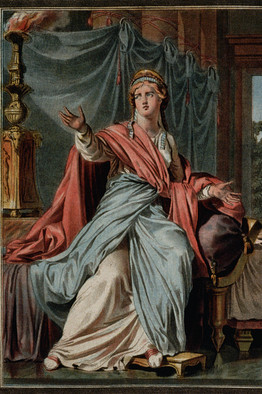
“Let those who love Him be like the sun when it comes out in full strength.”

Read: Judges 4-5

2) Esther 400’s BC

Orphaned and then adopted by her cousin. Grows up in lower echelons of society. Becomes queen through her charming personality and God’s providence. Risks death to save her people. Prepares a banquet in the presence of her enemies. Obtains justice for all concerned. Establishes Purim.

“And so I will go to the king, which is against the law; and if I perish, I perish!”

Read: Esther

3) Eleanor of Aquitaine 1122-1204

Wife of two kings, mother of three (along with five other children.) Queen of both France and England, at different times. Fills her courts with troubadours. Imprisoned for supporting her sons over her husband. Rules England while her son Richard crusades. Generally rides all over Europe on horseback to retrieve wayward offspring. Most influential woman of the 12th century.

“Let the word of the Lord not be bound up in your mouth, nor human fear destroy the spirit of liberty in you. It is more acceptable to fall into the hands of men than to abandon the law of God.”

Read: A Proud Taste for Scarlet and Miniver E.L. Konigsburg

4) Queen Elizabeth I 1533-1603

Outlives her enemies to become queen. Establishes the Church of England. Sends Sir Francis Drake to the new world. Fends off the Spanish Armada. Claims to have the heart and stomach of a king. While imprisoned early in life uses her diamond to write poetry on the window.

“Life is for living and working at. If you find anything or anybody a bore, the fault is in yourself.”
“Fear not, we are of the nature of the lion, and cannot descend to the destruction of mice and such small beasts.”

Read: Elizabeth I: Collected Works

5) Mary Sidney Herbert 1561-1621

Sister of Sir Philip Sidney and related by marriage to George Herbert. Has the queen over for dinner. Raises two sons. Finishes Philip’s translations of the Psalms after his death and completes her own translations of Petrarch. Manages the Pembroke estates. Watches Shakespeare with King James. John Bunyan models the “House Beautiful” on her home.

“Unlock my lips, shut up with sinful shame,
Then shall my mouth, O Lord, thy honour sing;
For bleeding fuel for thy altars flame,
To gain thy grace what boots it me to bring?
Burnt offerings are to thee no pleasant thing;
The sacrifice that God will holde respected
Is the heart-broken soul, the spirit dejected.”

Read: The Collected Works of Mary Sidney Herbert, Countess of Pembroke.

6) Anne Bradstreet 1612-1672

Leaves England for America with her husband at the age of eighteen. Suffers from joint problems and later tuberculosis. Moves all over the New World. Raises eight children. Becomes America’s first published poet and the first woman published anywhere.

“If we had no winter, the spring would not be so pleasant: if we did not sometimes taste of adversity, prosperity would not be so welcome.”
“There is no object that we see, no action that we do, no good that we enjoy, no evil that we feel of fear, but we may make some spiritual advantage of all.”

Read: The Tenth Muse Lately Sprung Up in America, Several Poems Compiled with Great Variety of Wit and Learning

7) Susanna Wesley 1669-1742

The twenty-fifth of twenty-five children and gives birth to nineteen herself. Has a sometimes absent and incarcerated husband. Raises and educates her ten surviving children, most notably John and Charles Wesley. Survives two severe house fires. Writes meditations and scriptural commentaries. Begins her own Sunday afternoon services in the absence of proper teaching from the church.

“Whatever weakens your reason, impairs the tenderness of your conscience, obscures your sense of God, takes off your relish for spiritual things…that thing is sin to you, however innocent it may seem in itself.”

Read: Susanna Wesley, Her Collected Writings

8) Abigail Adams 1744-1818

Wife of the second U.S. president, mother of the sixth. Gives birth to six children. Restores the family home into what is now a National Park. Tells her husband to ‘remember the ladies.’ Has to chop the wood herself while living in the White House.

“If we do not lay out ourselves in the service of mankind whom should we serve?”
“Great necessities call out great virtues.”
“If we mean to have heroes, statesmen and philosophers, we should have learned women.”

Read: The Letters of John and Abigail Adams

9) Julia Ward Howe 1819-1910

Marries Samuel Gridley Howe at the age of twenty-four. Raises her six children while studying foreign languages and writing essays, poetry, and plays on the side. Writes the “Battle Hymn of the Republic.” Publishes multiple works without her husband’s knowledge. Works to establish Mother’s Day. Travels around Europe and the Caribbean.

“I am confirmed in my division of human energies. Ambitious people climb, but faithful people build.”
“I want to take the word Christianity back to Christ himself, back to that mighty heart whose pulse seems to throb through the world to-day, that endless fountain of charity out of which I believe has come all true progress and all civilization that deserves the name. As a woman I do not wish to dwell upon any trait of exclusiveness in the letter which belongs to a time when such exclusiveness perhaps could not be helped, and which may have been put in where it was not expressed. I go back to that great Spirit which contemplated a sacrifice for the whole of humanity. That sacrifice is not one of exclusion, but of an infinite and endless and joyous inclusion. And I thank God for it.”

Read: Words for the Hour, Modern Society, Sex and Education

10) Fanny Crosby 1820-1915

Blind from infancy. First woman to speak in the U.S. Senate. Joins the Faculty at her alma mater, the New York Institution for the Blind. Marries Alexander Van Alstyne and gives birth to a baby girl who does not survive. Writes almost 9000 hymns using almost 200 pseudonyms. Works devotedly in city rescue missions.

“Thou the Spring of all my comfort,
More than life to me,
Whom have I on earth beside Thee?
Whom in Heav’n but Thee?”
“Blessed assurance, Jesus is mine!
O what a foretaste of glory divine!
Heir of salvation, purchase of God,
Born of His Spirit, washed in His blood.
This is my story, this is my song,
praising my Savior all the day long;”

Read: Fanny Crosby’s Life Story, The Blind Girl

11) Christina Rossetti 1830-1894

Youngest of four children, all of whom are very creative. Deals with bouts of depression. Becomes deeply interested in the church. Begins to publish her poetry and eventually hailed as the natural successor to E.B. Browning. Suffers from Graves Disease and breast cancer. Volunteers in a fallen women’s home. Never marries.

“Choose love not in the shallows but in the deep.”
“Shall I find comfort, travel-sore and weak?
Of labour you shall find the sum.
Will there be beds for me and all who seek?
Yea, beds for all who come.”

Read: Goblin Market and Other Poems

12) Laura Ingalls Wilder 1867-1957

Moves with her family from Wisconsin to Kansas to Minnesota to Iowa to Dakota Territory by the time she is ten. Survives one of the most bitter Dakota winters on record. Begins teaching school at the age of fifteen. Marries Almanzo Wilder and has one daughter, Rose. Eventually settles in Missouri. With encouragement from Rose, writes about her growing up years.

“Laura felt a warmth inside her. It was very small, but it was strong. It was steady, like a tiny light in the dark, and it burned very low but no winds could make it flicker because it would not give up.”
“Then he drew a long breath, and he ate pie. When he began to eat pie, he wished he had eaten nothing else.”

Read: the Little House series

13) Corrie ten Boom 1892-1983

First licensed female watchmaker in the Netherlands. Joins the Dutch resistance. Has a secret room built in her bedroom to hide Jews from the Gestapo. Is arrested and placed in various Nazi prisons and camps for ten months. Is released through a clerical error. After the war founds a rehabilitation center in a former work camp.

“And so I discovered that it is not on our forgiveness anymore than on our goodness that the world’s healing hinges, but on His. When He tells us to love our enemies, He gives along with the command, the love itself.”
“Mama’s love had always been the kind that acted itself out with soup pot and sewing basket. But now that these things were taken away, the love seemed as whole as before. She sat in her chair at the window and loved us. She loved the people she saw in the street– and beyond: her love took in the city, the land of Holland, the world. And so I learned that love is larger than the walls which shut it in.”
“To forgive is to set a prisoner free and discover the prisoner was you.”

Read: The Hiding Place (Read, re-read, and re-read this)

14) Dorothy Sayers 1893-1957

Wins a scholarship to Oxford and is one of the first women to receive a degree there. Writes detective novels about Lord Peter Wimsey and Harriet Vane. Gives birth to an illegitimate son and oversees his upbringing from afar. Also writes plays, literary criticism, and, somewhat reluctantly, apologetics. Translates Dante’s entire Divine Comedy. Known for wearing men’s clothing because it is more convenient and generally speaking her mind.

“God did not abolish the fact of evil; He transformed it. He did not stop the Crucifixion; He rose from the dead.”
“And what do all the great words come to in the end, but that? I love you- I am at rest with you- I have come home.”

Read: Whose Body?, Gaudy Night, Are Women Human?, Christ of the Creeds, “Why Work?”

15) Flannery O’Connor 1925-1964

Raised and remains a devoted Roman Catholic. Participates in the prestigious Iowa Writers’ Workshop. While working on her first novel is diagnosed with lupus and moves home to her mother’s house in Georgia where she lives for the rest of her life. Writes many stories and two novels which most readers either misunderstand and hate or misunderstand and love. Obsessively raises poultry, particularly peafowl.

“‘Jesus was the only One that ever raised the dead,’ The Misfit continued, ‘and He shouldn’t have done it. He thrown everything off balance. If He did what He said, then it’s nothing for you to do but throw away everything and follow Him, and if He didn’t, then it’s nothing for you to do but enjoy the few minutes you got left the best way you can by killing somebody or burning down his house or doing some other meanness to him. No pleasure but meanness,’ he said and his voice had become almost a snarl.”

“All human nature vigorously resists grace because grace changes us and the change is painful.”

Read: Wise Blood, The Complete Stories, Mystery and Manners, The Habit of Being

16) Elisabeth Elliot 1926-

Moves to Ecuador. Marries Jim Elliot. After her husband is killed by the Auca, moves with her small daughter to live with them and share the gospel for two years. Moves back to the U.S. Marries twice more. Has her own daily radio program for thirteen years. Writes extensively on her experiences and on Christian living.

“One does not surrender a life in an instant. That which is lifelong can only be surrendered in a lifetime.”
“It is God to whom and with whom we travel, and while He is the end of our journey, He is also at every stopping place.”
“We want to avoid suffering, death, sin, ashes. But we live in a world crushed and broken and torn, a world God Himself visited to redeem. We receive his poured-out life, and being allowed the high privilege of suffering with Him, may then pour ourselves out for others.”

Read: Through the Gates of Splendor, These Strange Ashes, Let Me Be a Woman

This is not an exhaustive list, and tends to show my own biases, but I figured it was best to start with what I knew: most of these women are westerners and tend toward the more modern. Many of them are published authors and almost all are prolific letter writers. This list is not meant as a compendium of those you absolutely must love and admire. It’s just encouragement and ideas towards starting a list of your own.
And if you want some male heroes, I’m happy to oblige. I just figured that an inventory like that was, well, a little easier to find…

Time

Time has become my ultimate enemy. Not the great hooded figure whom Shakespeare fears, standing and cradling his massive scythe, but instead his nasty, pockmarked little cousin who crouches on the floor and counts out the hours like currency. He carries a scythe too: it’s small and sharp and with it he kills sleep and he kills joy.

Okay. Well then. Now that that ponderous metaphor is out of my system, we can move along.

Really, though, I am staging a rebellion against minutes and deadlines and ticking second hands. Or trying to, at least. This semester has been too much for me in some ways. I was secretly triumphant last week when my alarm clock gave up the ghost and I blissfully slept an extra hour and a half.

I’ve just had a nice long car ride full of no obligations (i.e. a little computer that will no longer hold a charge) and friendly company, so in the spirit of my revolution against the pressure of the hours, I’d like to propose the following amendments to my own manifesto.

-Don’t antagonize sleep. When you go to bed in the wee hours and are still not able to rest, don’t pull out your computer again to do a little more. Be patient. Wait.

-When the number and scale of responsibilities frighten you, pray over your hours.

-Eat meals at the table. Try not to bring your work with you.

-Remember it’s only little old you and your little old worries. And God is very great.

-Take long baths.

-Place diligence over deadlines. Think of whatever your mother would say.

-Remember that you love to write and read and talk. Don’t let yourself twist God’s blessings into burdens.

-Wage war on the passive voice with courage. Go forth and do. Do the next thing.

The notes above are obviously intended for time immemorial, but it’s also worth pointing out that this is Holy Week. The hours of this week have great import for life and death and death-in-life and life-in-death. So I will pause, and worship, and remember Him who is eternal, who created time and came down to enter it Himself, who knows that it too may be redeemed.


Community

I am home for a whole week of break. Yesterday afternoon I took a walk with my dad and it was sunny and balmy. This afternoon I took a walk with my mom and it was bitter and rainy. (No reflection on respective parents, I’m sure.) My plans for this week include seeing people I love, doing a very small amount of homework, applying for a couple more jobs, writing things which are not my novel, and reading about Christianity and fiction. Also a lot of sleep.

This is a funny place to be, in my last semester. I feel like I’m teetering on the edge of the world, and that in May I’ll fall into it head-long for the first time, but of course that is silly. I’ve been in the world all along. I was born into it.

I am frightened about next year’s changes, though. I am not worried about a job or a home or a car (though I’m sure I ought to be sometimes.) Instead, I am rather predictably worried about being lonely. I am terrified to step out of the tight knit little college atmosphere, well-insulated with people who love me deep and well, into a looser sort of place where, though I will have support, there will not always be a hand to hold within arm’s length, or a smiling face directly when I look over my shoulder.

In college, I have gratefully stumbled into friendships with interesting, valuable, layered people. I’ve become an aficionado of the one-on-one friendship, of the tea date, of laughter and the well-placed, comfortable bit of sass. I have collected friends who don’t mind my camping out on their couches when they’re not home, who remember my aunts and cousins though they’ve never met them, who dutifully read this little blog.

I love these people dearly and I intend to absolutely hold onto them for quite a long time, but I am realizing more and more that what I will need when I graduate (and what I have perhaps missed, sometimes rather keenly, throughout college) is community. A common group with common loves.

Dr. Messer asked me the other day if I had any friends or peers who were as invested in writing as I was—people I could really get into it with. I don’t and I never really have. It is also true that, though it takes more courage than I would like to admit to say so, I still find it much easier to write about my God than to talk about Him with friends. It is not that they don’t love Him too, but that we’ve been shy to build our friendships on Him, shy to say His name.

I am indeed shy to write this because I am not ready to step away from the people I consider to be my best friends. I do not intend to ever be ready. I will always love them as I do now, except someday hopefully a little better. I am, however, longing for this community of which I still maintain only the vaguest idea.

I sent out the second draft of my novel to quite a few people last week, and that has, unexpectedly, (though why I wouldn’t expect it, I have no idea) been quite a start. For the first time all these people have the opportunity to read the pages onto which I’ve strained my pale little soul for the last two semesters. It makes me wonder how it would be to sit down and wholesale read the draft of someone else’s novel, someone else’s carefully strung words. How it would be to sit down and say, what do you think a Christian novel might be in the twenty-first century? Do you think it can exist? Do you think you or I might write one? Perhaps we ought to pray and then begin.

One Hundred

This is my hundredth entry.

I remember when I first started college and my mom told me I should start a blog. I knew about mommy blogs and food blogs and fashion blogs and celebrity blogs and look-I’m-adventurous-and-studying-abroad blogs. But I was only going to college, and most people I know do that. Sure, I liked to write, but I did not think I would have anything very out-of-the-way to say. I told her ‘No.’

Then one day that first fall semester, I was bored, and I made a wordpress account. A few days later I nervously posted this. And it stuck. The feeling of writing and having others read it stuck to my ribs.

Within months it became indispensable to me. I got used to the feeling of an idea growing in the back of my mind, of catching the little bugger and slapping it down on paper, poking and prodding and stretching its edges till it was just as I wanted.

I have written about my small travels, about sitting home, about my friends, about my classes, about my writings and my readings, and a great deal about my family. I have learned to write about my God in a way of which I never used to be capable. I am beginning to know him. This blog has caught much of the excess that often overflows my edges.

I often like to pretend that writing here is more than that, though. I like to pretend that writing an entry about a fear or a frustration will simply quench it. That just bringing it out of the darkness and showing it to the internet will kill it swiftly and thoroughly, and I can march forward in triumph without ever looking back. But it never does work like that. It usually takes much more prayer and patience than 600 words can carry until my fears are driven out into the swine.

But while writing will not heal me, it has taught me that I am not alone. My ugly ingrown fears and sins are wonderfully unoriginal and shared by many of the people who surround me. I know because they have told me so. Many of you have told me so, have reminded me that I am one saved wretch among many others.

I may very well have been right freshman year in thinking that I don’t have anything very out-of-the-way to say, but I’ve had the joy of saying it anyway, of being listened to, of crying and laughing at myself, of coming back again and again to pour myself out in convoluted words. I am tremendously grateful. Hooray, little one hundred.

How to Write a Novel (Part I)

-Be frightened underclassman.

-Decide to write novel so that will be person worth speaking to at parties and also to change world and self.

-Excitedly produce short prologue out of thin air.

-Realize have, as usual, given main characters awful names.

-Keep names out of cussedness.

-Hope am good enough writer to become famous anyway.

-Settle in gleefully for months of planning.

-Begin with one outline-ish word document.

-Assign pretentious title from Hopkins.

-Spend summer filling awkward orange notebook with disconnected paragraphs, most written by Tolkien, not self.

-Use special pen.

-Never mention to anyone.

-Make lists of books for character (not self) to read.

-Allow word document to spawn eighteen runty chapter babies.

-Eat M&M’s.

-Eventually mention to one friend, then two, then three.

-Refer to as “my story.”

-Become overwhelmed when friends speak confidently of future B&N author cardboard cutouts.

-Feel weird.

-Search internet for pictures which look like characters.

-Discover no one looks like characters.

-Wonder if characters are too ugly or too pretty or just too fictional.

-Encouraged by crazies of NaNoWriMo, write twenty actual pages in one year.

-Hide away in princess lounge to do so, usually wearing pajama pants and fuzzy blanket as cape.

-Pretend am doing something respectable and normal like biology.

-Feel covert and important.

-Watch Mad Men to inspire self.

-Realize have given self five seventeen year old boys to write about.

-Question own decision making skills.

-Tell more people.

-Continue to shyly use word “story.”

-Have brilliant idea to do independent study!

-Realize will have to begin saying word “novel” for clarity.

-Use “novel” in conversation, usually whispering and doing awkward side-eye to gage reaction.

-Promise to put new friends in as characters “just crossing the street or something.”

-Regret decision.

-Write syllabus for following semester, brazenly assigning self one hundred whole pages.

-Become horrified by others’ unconditional confidence in abilities.

-Decide everyone is possibly mentally deficient (including self, for trying.)

-While home for summer, read Thomas Wolfe for inspiration.

-Hate Thomas Wolfe.

-Continue to read Thomas Wolfe.

-Write another actual chapter.

-Regret hundred-page decision.

-Consider sending pathetic email to independent study professor.

-Give chapters to mother.

-Wait.

-Re-read Mennyms books and weep.

-Receive chapters back from mother, covered in red and “don’t be discouraged.”

-Take twelve deep breaths.

-Revise some.

-In first independent study meeting, when professor cheerfully asks about current progress, begin crying.

-Realize am safe from professor ever asking same question again.

-Continue to be terrified.

-Discover deadlines excellent for forcing courage.

-Create whole bookmarks folder of encouragement websites for writing.

-Become surprised by usefulness of internet.

-Put one word after another.

-Become suspicious when professor unequivocally likes new chapters.

-Wonder nervously if professor actually knows about novels.

-Begin to adjust to own use of word “novel.”

-Struggle, however, to adjust to friends’ use of word “book.”

-Become surprised by continual question, “What’s it about, or can I know?”

-Wonder if world, including own English professor’s wife, believe am hording magical personal secrets.

-Become embarrassed by own inability to summarize plot.

-Wish plot was full of magical personal secrets.

-Tell sassy close friend entire plot in detail.

-Allow friend to give character fatal illness.

-Refuse to allow friend to change first name of main protagonist.

-Become less afraid.

-Turn in self-assigned pages approximately 30 hours late on regular basis.

-Decide sleep is good reward for writing.

-Discover if keep self up writing too long, head will refuse to stop writing, even in bed.

-Decide writing will have to be its own reward.

-Send uncomfortable chapter to friend to avoid asking questions of delightfully awkward professor.

-Become pleased with own cleverness.

-Begin writing acknowledgements page.

-Go, go, go.

-Insert unplanned chapter in act of great daring.

-Decide to use as senior honor’s project so will never have to let go of baby.

-Become sloppy.

-Consolidate chapters into document called “A Draft for Word Count and Ego.”

-Long for revision.

-Dream about revision.

-Wish could time travel to next semester when am revising.

-Become alarmed by professor’s comments about narrative point of view.

-Wonder if POV is even important.

-Wonder what POV even is.

-Become reckless.

-Send apologetic late night emails to professor for incoherence of narrative.

-Drink Earl Grey.

-Cry nonsensically loud tears of joy.

-Nearly finish draft before bed.

-Wake up in elation.

-Actually finish draft!

-Post well-planned facebook status.

-Perform deeply private happy dance.

-Raise ire of entire TLC by printing 144 pages immediately before classtime.

-Use massive stapler.

-Carry around printed draft like newborn child.

-Become terrified by others’ eagerness to hold it.

-Email draft to family. (Change “Ego” to “Encouragement.”)

-Sit in bath planning eradication and merging of certain minor characters.

-Refuse to type or write single word in interest of “letting story breathe.”

-Read portions of draft aloud to self while roommate is away.

-Stab maliciously at embarrassing portions with finger.

-Send impossibly patient independent study professor messy thank you note.

-Consider studying for finals.

-Consider beginning new project.

-Continue instead to mentally smother current project with affection and abuse.

(TO BE CONTINUED)

Why This Matters

Yesterday I had my last CivArts and Dr. Munson talked about modernism and postmodernism, all crushed into one little class period. I love modernism, and I am not entirely sure why. I think it is because of the earnestness of self-critique and the push for excellence and the wholehearted love of a worthwhile thing. Nowadays we are rarely interested and earnest and willing, or, if we are, we try not to admit to it too much. No one would want to be our friend.

Of course what happens to modernism is that it is determined to find art only in introspective progress and is sometimes rather obsessed with obscurity. It digs and digs in the darkest recesses looking for new beauties, usually while hiding its eyes from revealed truth. It crouches and shrivels away from the light, until it collapses into a little dung-heap of postmodernism and self-referential irony.

To watch this happen over the course of an hour and half has made me so sad. It’s the terrible history of a people governed by fear.

I know fear. I am afraid. Throughout college I have become a much slower writer because of fear. I am afraid that I will say the wrong thing, that I will not say it well enough, and most of all, I am afraid that the things I write have no real meaning, that my words are just cheap, hollow ornaments which will shatter when dropped, to then be swept up, thrown away, and forgotten.

So, in my small grey puddle of fear, I sympathize with the modernists in their avant-garde tunnel vision. If it’s new, there’s a better chance of something worthwhile being accidentally dredged up in there somewhere, right? At my worst, I must even acknowledge a kinship with the deconstructionists. Some mornings, before I get up, I lie there, deeply afraid that there is nothing worth saying at all.

But I keep writing. I wrote papers this semester, kept up with my blog, edited two magazines, and drafted a novel. Why do I do that? Why do I spend hours of my life crouched on my desk chair, staring at a blinking cursor, hugging my knees, accidentally holding my breath while waiting for a word?

I do it because fear is mortal. I do it because fear pronounces my efforts dead and futile, but John Donne told me that death shall die. I do it because there are bloody hands stretched upon a cross, mighty and willing to save Prufrock from drowning. I do it because death has burst out of the grave and invited me to put my hand in his open side. I do it because a very long time ago, men followed a star in the eastern sky, where the sun rises, and found God incarnate. I do it because the Child who lies in the manger in Bethlehem is eternally stronger than the marked monstrosity which slouches towards it.

“For unto us a Child is born, / Unto us a Son is given.”

Things to Do, Things Did, and All Saints

I’ve been keeping a journal for a while now—two years on Saturday, actually. It’s a bound notebook that my friend Heidi decorated for me sophomore year and every day I write two lines in it about what I did, what I saw, what happened. I do it, I suppose, so that I can read and remember. For example, the entry for October 27, 2011 reads, “Am Lit midterm – sweater over flannel – Bible Study – felt better about tenure.” I don’t usually write about what I wear, but apparently it felt important to me that day, and not that this will clear things up much, but one of the entries the day before had been “cried about tenure.” Whatever that means. The next October 27th was a bit more even-keeled: “cleaned at JB’s – lazy afternoon – Lunch w/ Lu – did no homework whatsoever.” That was a Saturday and this year the 27th was a Sunday: “Quiet morning – coding w/ John in early aft. – early church – All Saints Vespers – just a Sunday : ).”

I’ve never been successful at keeping a journal before, but this seems to be sticking. I like lists, and keeping track, and knowing what happened when and how, and reading over and watching old worries grow and then fade back into oblivion. I’m a record-keeper.

I’m not alone. Here’s a favorite to-do list by Johnny Cash himself:

Image

I’m willing to bet he did real good on all those things, except that last one. I think we keep these lists because we figure if we know all these little things, if we have it all stored up, when the time comes we’ll be able to see the big important things better somehow.

I’d been thinking about that and then Sunday night I went to the All Saints Vespers and thought about it some more. I thought about keeping track for not just two years of college, but through long centuries, through so many lives and deaths and prayers and graces. Christina Rossetti promises her hesitant audience, “Yea, beds for all who come,” and that’s a lot of beds. Really, though, beds for Christina herself, Jonathan Edwards, Eric Liddell, my Grandpa, Flannery O’Conner, Joan of Arc, Aunt Jean from camp, Paul, Corrie Ten Boom, Tolkien, Rahab, Dietrich Bonhoeffer, Gerard Manley Hopkins…“all saints” is a lot of saints. Why do we keep track?

Well, because on Sunday evening I kneel with brothers and sisters of mine and pray aloud to Him “whose nature is always to have mercy.” We’re all members of the marvelously sprawling society of the previously lost and we must stick together, so as to remember what it means to be found. We know the taste of grace, and when we forget it those around us and before us will remember. “But the mercy of the Lord is from everlasting to everlasting on those who fear him, and His righteousness to children’s children…” (Psalm 103:17) The work of the cross stretches farther than you or I can see.

So all the scribbles and notes and records of practicing and cleaning and lunches had and walks taken are an anchor till the “yet more glorious day.” I will keep marking things down in homage to those who did so before me. Around the turn of the fifteenth century a woman named Julian of Norwich wrote in the midst of illness, “All shall be well, and all shall be well, and all manner of thing shall be well.” Everyone from T.S. Eliot to my own mother has read and believed her words. I don’t know if they’ll get nearly as much from me, but I’m trying. I’m making lists, keeping track.