Permission to Fear

I am home for a snow day today and absurdly grateful for it.

I have been thinking quite a lot about fear lately, and but I am having a very difficult time marshaling my thoughts. I don’t know why fear is so hard to talk about, because everybody is afraid. Fear is probably the most universal emotion–even those who’ve hardened themselves to love and to hate still know fear. Almost every bad and sinful choice any of us ever make is a result of letting fear rule us.

Maybe the reason I don’t like to talk about fear is that I know that I shouldn’t live in it, and I am ashamed that I do. I am ashamed that I am frightened to say certain things or to talk to certain people. I am ashamed that I let others’ opinions matter so much, even when I know they are wrong. I am ashamed that sometimes today and its small, assorted burdens terrify me like nothing else. “You are too intelligent and privileged to be afraid.” I tell myself. “If TSwift and Florence can shake it off, then so can you.”

But sometimes I can’t. More often than not it seems the walls of my heart are eggshell thin and the weighty little fears of the day crush in through them and paralyze and panic me. And then there I am, along with Paul, not doing what I will to do, but instead doing what I hate.

So I’ve decided that I’m just going to be scared. I’m giving myself permission to be afraid, for my face to blanch and my mouth to get dry. When fear shows up I will not try to push him out. Instead, I will send him to sit in the back corner, and speak to him often. I’ll say to him, “I will let you stay, but you must know that while you have the power to make my knees shake and my voice stutter, you have no power over my will. Do your worst. Smash my heart all the way down into my stomach. Force me to taste my own bitterness all night long. You are mortal and weak. And when I hold you up to the light of the Gospel I can see right through you.”

And then, with fear sitting on a straight-backed chair in the corner of my chest, I will go on doing. To be frightened is to have the opportunity to be exhilaratingly brave, so with a fist-sized lump in my throat I will go on speaking. When I become too scared, I will laugh. We are told that perfect love casts out fear, so while I wait for perfect Love to do just that, I will serve Him who gives me “that grace to begin.”

Three Memories for the Mid-Way Point

My junior year of high school we took U.S. History. One day at lunch, part-way through the year, I found a classmate crying in the hallway. She told me she had failed the last few history tests and she was too intimidated to ask the teacher and she was just so, so lost. We were not particularly friends, but I politely offered to help and I remember being surprised when she was eager to take me up on it. So she came over a couple nights later and we sat at my dining room table and ate brownies and talked about tariffs. After we got our next test back, she wrote me a profusely sweet little note, “ALICE! Thank you so, so much for helping me! I got an 84!” An 84, I thought, That’s good? I would hate an 84. And every time I remember that I thought that, I am ashamed. I want to go back and grab my sixteen-year-old self by the lapels of her worn-out uniform sweater and shake her. I want to tell her that in six years’ time she will not remember a single one of her own silly test grades but she will remember that beautiful, hard-won B-. She will remember the smiley-faces that were drawn all over that note, and she will be humbled by them.

This Christmas my family flew up to Minnesota, and en route we had what became an eight-hour layover in the Atlanta airport. We sat and we sat and I watched the people. There were a lot of servicemen and women–lots of Marines especially–some hurrying to catch a flight and some just waiting. As one after another went by and I hoped for each one that he was going home, I realized that though the women in uniform looked like women, the men mostly looked like boys. I did the math in my head, and realized that most of them were probably closer in age to my students than they were to me. Then they looked very young indeed. In the midst of all of that sitting and watching, I wrote this in my prayer journal, about my students: “I must keep repeating my mantra from earlier in the year, before I cared about them so much: You love them far more than I ever will and You do it better. There is nothing I can break down that You cannot build back up and stronger. I will trust in Your love for them.”

My sophomore year of college was my hardest. Everything looked very grey to me and I felt grainy and sad. If you have been reading this blog long enough you may remember. That March, at the tail end of my spring break, my mom and George came up to visit me. I remember running out into the ice and snow to meet them when the car pulled up. My mom got out to hug me, and then she said, “Oh, I brought you something.” She leaned into the car and turned back around holding a mason jar full of bright yellow daffodils from home. Just last night I remembered all this rather suddenly and for reasons I still cannot articulate, I cried while remembering. The snow, and the slate-colored sky, and the weary brick of my dorm building, and then my mother’s familiar hands, holding daffodils which she had carried over nearly five hundred miles of highway.

On Listening

Recently I have been remembering that January can be hard. For a month that supposed is about beginnings, it feels awfully in between.

For the past several New Year’s Eves I have stayed in with my family, (by past several, of course, I mean every single one of my life,) but this year I went to the Avett Brothers’ concert in Raleigh. We sat way up in the nosebleeds in the PNC arena, about level with the balloons hoisted up in nets, ready to be dropped at the stroke of 2015. Karen and I propped our feet up and watched. I was delighted to remember what it is to be an observer, someone with the luxury of seeing and hearing and thinking to oneself. I rediscovered the occasional joy I find in listening.

Sometimes I am a good listener and sometimes I am not. Sometimes I am listened to and sometimes I am not. Listening, of course is more than just waiting politely while somebody talks, trying to digest what they say so that the next thing out of your mouth sounds relevant. Truly good listening involves care not just for our own words, but for the speaker’s: what did they mean by what they said, and what did they mean us to hear? Is there truth in this, or if there are lies, where are they coming from, and why?

I decided the other day that there are times in our lives (say through our twenties or so) when we should not be allowed to speak quite as much: we girls especially. When a friend is glad or sad we have such a tendency to try to paste over our obligations of affection to them by saying that we love them or that we’re so very, very happy, and then doing nothing more. When we do not know how to care for people, we claim that our care is floating around in the feelings in the air, and then we move along. We try to convince them of our love instead of actually loving.

Listening can teach us out of that, I think. If we listen well and constantly, we might learn so much: pain, patience, loyalty, sorrow, joy, the mutability of the human heart, and its simultaneous mysterious eternity. At long last, listening might teach how to manifest that love we only feel or the love we outright lack. I suspect that, at times, listening is the manifestation of love.

So the beginning of the new year for me was an exercise in attentiveness and remembering how to do it. I came to a new place in my old boots with old friends, and at midnight the balloons and confetti rained down on those below and for the rest of the concert I could hear latex popping in the quiet between songs. The little pear-shaped old man on the next row down bobbed his head to the music, as he had all night, and I only sang along when I knew the words. My best friend informed me that “auld lang syne” meant “times long past,” and I decided I’d rather not forget them.

The Christmas in Minnesota

I have a week before I go back to teaching and there is so, so much to do (most of it having nothing to do with school.) But before I do all of the so, so much I need to keep up a tradition. Every year on this blog I have written about Christmas, with the exception of last year, when I must have been too busy with my novel to do anything here except whine about how tired I was. Oops. But anyway, this year there is no frantic writing independent study, only a surprisingly well-rested Alice, too distracted to take on her real to-do list.

This Christmas was quietly different from all the others (related here, here, and here.) It was both more joyful and more painful. As I get older such feelings are more keen, but more often than I used to, I know what they mean and I know what to do with them. I do not, however, always know how to express them.

I thought that I would tell you about the week in the old way, beginning to end, like a story, but it does not have enough narrative thread for that. It has a setting, of course: a Bible camp up in the Iron Range of Minnesota, where the camp director has raised his seven children, and has recently moved his quickly aging parents. Because it is Christmastime children, grandchildren, husbands, wives, and two little boys named after the same great-grandfather have converged upon the camp, where the ground is slushy, but still a bit slick. With them, they bring chocolate and the old family Christmas songbooks. They plan to stay for four or five days.

So that is the stage set, but beyond that, there is no plot, one event does not lead to another, so if I told it like that, it would make no sense. That is was not what it was. The week was not a story in itself, but merely an infinitesimal part of a great and large story, a moment about the length of a heartbeat.

My grandparents are near the end of that story. My grandma is confused and sad and only partly herself. She tries to introduce her grandchildren to one another, but remembers the taste of the orange balls she used to make. My frail grandpa is contemplative and eager for coherent company. While the girls organized a game of cousin knockout on Christmas Eve he stood bent over in the corner of the gym and enthusiastically dribbled a basketball till it bounced out of reach. He stands up in Sunday meeting and says that we are greatly blessed by Christ’s coming. And he asks, again and again, that we all sing “Come Let Us Adore Him.” (That’s his preferred title for the carol, I think, because he does not consider himself particularly “faithful,” but he does know Jesus to be worthy of adoration.)

My mother and her siblings are at another part of the story. A part which is harder and less certain than they anticipated, I think. They take charge and they clean and they cook and they delegate and they worry. They find perhaps that, more than before, they have no one older and wiser to pass their worries along to, save passing them around in a circle to one another. They must go straight back to the Source with it all, give every bit of it up in prayer. Then when next their hands are free on Christmas Eve some one of us bestows upon them a child to hold: a quiet, solemn little gift-baby, theirs for a few minutes, who will nestle his head into their shoulder and rest.

Then there are the grandchildren. (That’s us.) We are at the part of the story in which we have come into our own, some of us without noticing. I can only speak for myself, but the old excitement for Christmas has been replaced by a certain sober joy. My cousins sat on the couch and helped grade the fill-in-the-blanks on the last test I gave, and I remembered sprawling on the end-room bed with them, summers before, reading To Kill a Mockingbird. On the 23rd we dragged down the tree from the attic, set it up with great care, and literally festooned the rafters with lights. On Christmas Eve night, we had a dance party (inspired by Sally’s cautious hip-hop moves.) When we are together now, we want to be together. We don’t care if we dance like Peanuts characters. We are not forgetting ourselves, but deliberately setting ourselves aside. We are slowly, at our own paces and in our own ways, learning the value of what has been given to us: the old summers in the above-ground pool, Proverbs read at breakfast-time, full couches and long legs, parents who name their daughters Hope.

Earliest in the story are Billy and Liam. Small lap-sitters, futures unseen, no worries beyond whether they too are allowed to have some of that candy they see everyone else has got. It is for them that Christmas is intended first and foremost. Jesus’s beginning as infant was his loud, clear announcement of his intentions: that since he was coming as the least of these, he meant to love and save the least of these.

And so, if we follow the story, beginning to end (or end to beginning, as it were,) we find the Son of God at its core: the adored gift-child, bearing in his tiny frame all the fearful hope and promise of his death for our redemption.

Come, thou long expected Jesus, born to set thy people free; from our fears and sins release us, let us find our rest in thee. Israel’s strength and consolation, hope of all the earth thou art; dear desire of every nation, joy of every longing heart.

Christmas and Awe of a Small Kind

Last night, I was having trouble sleeping because my head was so stuffy and my room was chilly, so I wrapped myself in a warm blanket and curled up on the chair in the upstairs hallway. All the lights were out and I watched the gas heater flickering in front of me. Inside the blacked windows on the front of the heater, there is a cracked and crusted latticework, and behind that burns a tall, orange flame. Last night I turned it up so I could hear the gas softly roaring and ticking, and all around the foot of the lone tongue of fire, dozens of tiny blue flames sprung up. I stared at the impressive shadows the fire cast through the latticework into the darkness, and pitifully wished that I could still breathe through my nose.

When I was a little girl, I used to turn up those flames just to watch them burn. I would crouch on the floor, pressed against the little factory-printed placard which read, “Keep children, clothing, and furniture away,” and I would imagine that the inside of that heater was a small cathedral. The shapes of the lattice pointed heavenward like church windows, and the tall flame was a preacher, praising his God. All the little blue fires were his congregation, or sometimes even the choir, if I turned it up very high so that I could hear them singing hallelujah in a quick, clicking rhythm as gas was released. I thought it was the most beautiful little world in there. Sometimes, even at the wise old age of seven or eight, I had to restrain myself from prying the hot glass off the front to see if I could get inside, enter the cathedral, burn like a singing flame beneath the majesty of those arches.

Last night as I sat in the darkness and watched the tall flame rise and rise and rise I remembered all that. I wondered why I didn’t feel awe like that anymore, especially at Christmastime, the time of the lighted fir tree and the swelling choral arrangement. A couple months ago I told my students very certainly that if they ever found themselves in a place in life in which there were not awed, then they were in the wrong place. I burrowed deeper into my blanket and doubted my own words.

I do believe that awe is the response for which the Advent season begs. This is why we set children in the midst of it, hand them presents, watch their faces glow, and sentimentally compare them to the baby in the manger. Awe comes naturally when you are small and everything looks big, and it is for this reason that Christ bids us to “come as little children.”

But there are other sorts of Christmases, lest we forget. New life always arrives with the silent promise of eventual death. Two years ago I wrote this entry about the shootings at Sandy Hook Elementary, and last night I could not stop thinking about T.S. Eliot’s poem, “The Journey of the Magi.” “A cold coming we had of it,” the kingly speaker says “…A hard time we had of it…Sleeping in snatches, / With the voices singing in our ears, saying / That this was all folly.” The wise men reach the appointed place (there is no mention of a bright, guiding star, no room for awe,) and the wine is all drunk up, three trees grow close together in a meadow, and a white horse mysteriously gallops away as they approach. The speaker pronounces the wonder they have come to see to be “satisfactory.” Then, hesitantly, he continues,

I had seen birth and death,  

But had thought they were different; this Birth was 

Hard and bitter agony for us, like Death, our death.

We returned to our places, these Kingdoms, 

But no longer at ease here, in the old dispensation,

With an alien people clutching their gods.

I should be glad of another death.

I actually got up out of my warm chair last night and turned on the light so I could re-read that poem. And even now, a day later, I am still struggling to explain the solace it offered me. It seemed to say that the way birth pains mirror death pains is not coincidental, that sleeping only in snatches is better than not waking at all, that at times it is well to be unsatisfied with the “old dispensation.”

So, if the remembrance of Christ’s birth does not provide me with the feeling of awe which I’ve been demanding, at least it brings me a measure of certainty. Certainty that God made his promises with the purpose of fulfilling them, that that there is order in his plan, that Someone much greater than myself is at work far beyond my sight. (Someone greater than myself? Beyond my sight? Perhaps this is awe after all. Awe of a small kind.)

After I read the poem I turned off the light again and returned to my chair by the flickering heater. I pulled the blanket tight, tight around me and I prayed. I prayed for those magi, and their hard, cold journey towards the Savior. (Sometimes I figure that if eternity is eternity and God really is outside of time, I can pray for anyone anywhere in history, and my Lord will hear.) I prayed that my own heart would soften and rest. I prayed for my students to whom, I think, awe still comes naturally. I prayed and I watched the tall flame glimmer in the cathedral, and listened to the tick of the gas valve in the dark, warm room.

“The people who walked in darkness have seen a great light; those who dwelt in the land of the shadow of death, upon them a light has shined.” Isaiah 9:2

Thankfuls about Teaching

I have just spent all afternoon grading a test on American Democracy and the West, and I am tired.

But on Friday, after my last class, during the peace of a seventh period planning hour, I was sorting through paper and books and I thought to myself, “Oh, I like my job.” Please note: that is the first time that thought has ever “risen unbidden,” in my mind, as they say. That is the first time this year that I have been able to be thankful for my circumstances without prompting.

Not that prompting is a bad thing. A prompting to be grateful is the conscience. A prompting to be grateful is the Holy Spirit. But when, every once in a while, thankfulness arises easily (as it should) then that is grace and I will celebrate.

So here I am, a few days later, trying with all my little might to catch the tail-end of that spontaneous gratitude. I am going to tell you what I love about teaching.

I am thankful for my students. I am thankful for the students who ask questions, especially those questions that begin with something other than “What do we need to know about…” or “Did we go over…” I am thankful for the students who take responsibility for their actions and attitudes. I am thankful for the students whose hands shoot up like air-propelled rockets during class discussion. I am thankful most of all, perhaps, for the students who work so hard that, no matter the final grade, I can feel the sheer effort and earnestness radiating off each page they write for me. I hope they know that I love them, and sometimes even admire them.

I am thankful for the people I teach with. I am thankful for their advice and trust and constant, present support. I am thankful for the pumpkin-shaped basket full of candy in the workroom. I am thankful to sit on roll-y chairs around a big table and eat lunch with them each day. Last week, when there was an open mic hour in forum to for students to thank the teachers, I wanted so badly to get in line with the rest of the kids who were waiting to speak. I am grateful for the sanity these men and women bring. But most of all I am grateful for—more than grateful for, awed by—their steadfast compassion and prayers both for my students and myself. I ceased to be their pupil years ago, but they are still teaching me so much.

And I am thankful for teaching itself. At its best, teaching is a little bit like writing in real-time. (I guess, at its worst, it’s like that too. Like a really poorly organized essay that doesn’t have a thesis statement or even a prompt…) I am thankful for test-writing, which I have quickly discovered is the secret glory of teaching. I am thankful to be pushed to study and then communicate history which I know is shaping me as I watch it shape my students. Stories, especially those that really happened, have the powerful effect of washing over in waves and re-shaping the clay of my soul.

At the core, I suppose I am most thankful to be part of something which is so much bigger than I. In the grand scheme of the educations of these forty-five people, I am the least important facet. Certainly for now, they rely on me, and because of that, as the apostle James says, I’ll be held to a higher standard, so I must give my utmost and beyond. But the responsibility for their minds and the “weight of their glory,” as Lewis would call it does not end with me. I am thankful that though the calling before me may sometimes feel like a burden laid upon my back, we are never asked to carry a burden any farther than Golgotha. At the foot of the Savior, we may drop our weights and duties, for they were His to begin with, and we may worship with empty hands.

Easter in the Fall

A few weeks ago I followed my dad out into my mom’s garden when he went to pick the remaining vegetables. Most of the plants were dark and bent and dead. The okra was half the height it had been, and the beans’ home-built trellis was tilting with mad exhaustion. The tomato vines curled blackly around their stakes and a few last over-ripe tomatoes, glowing orange-red, hung almost oozing off of them. Ever since then I have wanted to write this entry.

The changing of seasons always puts me in an Easter mood.  Each time the earth shifts humors in its cycle of yearly sinking down into somber sleep and rising up again, new and singing, I think of Gerard Manley Hopkins’ line: “There lives the dearest freshness deep down things.” This is both one of my God’s favorite party tricks and the grandest foundation of his character: he continually brings life out of death. Brown leaves rot and carpet the earth, so that fresh green life will leap out, nourished by death in its last decay. The withered hand is stretched out, whole again. Four-days-entombed Lazarus comes forth, trailing his grave clothes behind him.

And so for me, it is Easter weekend.  It is always Easter weekend. Christ died and rose to life, and so, in miniature, must we, along with the rest of his creation.  I am not saying something new. I’m saying something very old. Not only do we walk through the valley of the shadow of death, but we, with Christ, are baptized into death (Romans 6). But then, on the other side, (hear this,) then we come up out of those strange pathways and that dreadful river and look down to find our feet new-shod with the gospel of peace, fit to face the day.

The old self must crumble and rot, so that the new self can rise and grow. Death is the only way through to life.

Eventually, when we rise up out of death, clinging to our Savior’s hand, we will turn and see that the old dark valley and those rushing waters are gone and dissolved for good and all: that Donne spoke true and death has died. Our feet will no longer be new-shod, but new feet entire, whole and well, fit to face eternity.

The Here and Now

All through college I heard so much about the importance of place, of the dirt beneath your feet, of opening your eyes as wide as they’ll go and looking watchfully at the walls and horizons which surround you. And now I’m back in Greensboro, probably for good. Back in the muggy air that hugs me, sleeping in my childhood bedroom, getting up each morning and driving to the place I could drive to in my sleep. I love security, so in my eyes, all of this is very good.

But time is place too, in a sense. A place I can’t return to. I lie in bed at night, and remember that there is no big sister on the other side of the room to keep me awake talking endlessly about her day. I now meet friends for drinks on the same corner to which I used to walk to pick up ginger ale when my mom had the flu.

During teacher workweek at Caldwell, I sat in almost the exact same spot in the lunchroom where I used to pour chocolate milk all over my pizza to impress the other second graders. My new desk is in the back corner of a classroom which I routinely bathed with tears over Geometry and Precalc. And I remember standing up near the whiteboard there during play practice one day and teaching ourselves how to use chopsticks, with whiteboard markers. I can look out the doorway into the hall and see the locker I stood next to hyperventilating when my friend was rushed to the hospital at the end of one school day.

The room I teach in is the same one in which, during my freshman year, I used to sit in the back corner during class, with a messy spiral notebook, the smudged pencil which was the beginning of my first novella. When I stand to face my students I stand in almost the exact spot where, on the night of my senior prank we put a little tub of baby chicks. I remember curling up on the hard floor with my sweater a few yards away and trying to sleep, while they cheeped softly for hours.

Sometimes I feel a little like Ebenezer Scrooge standing and watching the jumbled ghosts of my past. Don’t take the metaphor too hard, though. Because while those shadows play there are very real people in front of me with their own, quite solid pencils and spiral notebooks in their hands. And behind me there are completely tangible whiteboard markers that I really ought to be using.

And so I teach and I think about the shadows and the reality and the way this reality will soon fade into shadows. And then I think about the great reality, which is this: God is faithful. God is faithful to have brought me back to place in which I cannot ignore His perpetual goodness to me. I grew up in here and every corner is marked and scuffed by my fears and aches. I look at them and I see Him. In the memories of my hardheadedness, I see His patience, of my cruelty, His sacrifice, of my pains, no matter how small, His abundant and overflowing grace. I see His faithfulness in each place and each time, in each here and each now.

And so tomorrow, I continue to teach history. Not my history, thank God, but His. Always His.


Sixteen Women Worth Your Hero-Worship

This list came about in two ways: first, I was re-reading Jane Eyre. She mused on the inequity between the sexes, and I thought, Go, Jane, go… Then, a few chapters later, she calmly observed that beautiful, soulless Blanche was simply “too inferior to incite jealousy,” and she had me. I watched her forgive her terrible aunt, love and leave Rochester, survive on barren moors, find a family, become independent, resist (sort of) the manipulative advances of St. John, and, at long last, return to care for and marry her former master. I wanted to meet her, to befriend her, to be her. I thought she was the coolest, most self-possessed person I had ever met and she only existed in a book.
The other thing that happened was that I found this list. And I was very, very disappointed. I know, I know, it’s Buzzfeed, what did I expect? But really: about two-thirds of these women I don’t even like at all, and, as for the rest of them, well, I like their movies? But that in no way makes them worthy of large chunks of my admiration and emulation. Which, after my experience with Jane, was what I was searching for.
I believe that it is important to have heroes. (I’m twenty-two and about due for that revelation.)
Not just literary heroes, like Jane, but tangible examples of what it means to live a good life, to do what you can with the time that’s been given you. People to remember, to revere, to consciously try to live up to.
And if you ask most people from the Christian circles I grew up in to name their heroes, they’ll usually give you a splendid list. And that list is going to be almost entirely comprised of men. Great men, good men, wise men, and very few women whatsoever. It is true that well-behaved women rarely make history. For centuries, a woman could expend all her mental, physical, and emotional efforts to serve God and love those around her, and still her name would be forgotten just a generation or two after her death. Wallace was right to say that the hand that rocks the cradle rules the world, but history has done an extraordinarily poor job at remembering the names and deeds of those to whom those hands belonged.
So what follows is my little attempt to begin to fix that inequity in my own mind, at the very least. If asked specifically for female heroes we’re likely to name our mothers and grandmothers, aunts and teachers. It is a good thing to recognize the virtues of those around you, particularly those who raised you, and I don’t want to discourage that in the least. But there’s something to be said for the larger-than-life quality inherent in someone who has had national or international impact. To adore and emulate the same virtues in the same person is to build kinship, affection, and understanding with people you have not met yet and may never meet a tall. Literary heroes will serve this office in a sense, but not with the same solidity as people who have actually lived. We need this combination of the actual and the mythic in our heroes. (Those were, after all, the qualities of the Man who died for us and then rose again.)

1) Deborah 1200-1144 BC

Judge of Israel. Dispenses advice under a palm tree. Admonishes the commander of the army for his cowardice. Drags him out of bed so he will go and fight. Rejoices in victory, and writes a song.
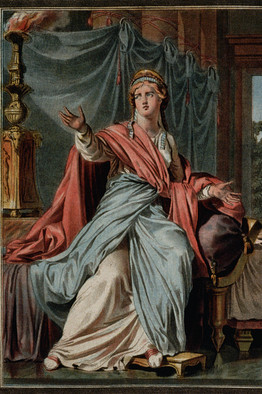
“Let those who love Him be like the sun when it comes out in full strength.”

Read: Judges 4-5

2) Esther 400’s BC

Orphaned and then adopted by her cousin. Grows up in lower echelons of society. Becomes queen through her charming personality and God’s providence. Risks death to save her people. Prepares a banquet in the presence of her enemies. Obtains justice for all concerned. Establishes Purim.

“And so I will go to the king, which is against the law; and if I perish, I perish!”

Read: Esther

3) Eleanor of Aquitaine 1122-1204

Wife of two kings, mother of three (along with five other children.) Queen of both France and England, at different times. Fills her courts with troubadours. Imprisoned for supporting her sons over her husband. Rules England while her son Richard crusades. Generally rides all over Europe on horseback to retrieve wayward offspring. Most influential woman of the 12th century.

“Let the word of the Lord not be bound up in your mouth, nor human fear destroy the spirit of liberty in you. It is more acceptable to fall into the hands of men than to abandon the law of God.”

Read: A Proud Taste for Scarlet and Miniver E.L. Konigsburg

4) Queen Elizabeth I 1533-1603

Outlives her enemies to become queen. Establishes the Church of England. Sends Sir Francis Drake to the new world. Fends off the Spanish Armada. Claims to have the heart and stomach of a king. While imprisoned early in life uses her diamond to write poetry on the window.

“Life is for living and working at. If you find anything or anybody a bore, the fault is in yourself.”
“Fear not, we are of the nature of the lion, and cannot descend to the destruction of mice and such small beasts.”

Read: Elizabeth I: Collected Works

5) Mary Sidney Herbert 1561-1621

Sister of Sir Philip Sidney and related by marriage to George Herbert. Has the queen over for dinner. Raises two sons. Finishes Philip’s translations of the Psalms after his death and completes her own translations of Petrarch. Manages the Pembroke estates. Watches Shakespeare with King James. John Bunyan models the “House Beautiful” on her home.

“Unlock my lips, shut up with sinful shame,
Then shall my mouth, O Lord, thy honour sing;
For bleeding fuel for thy altars flame,
To gain thy grace what boots it me to bring?
Burnt offerings are to thee no pleasant thing;
The sacrifice that God will holde respected
Is the heart-broken soul, the spirit dejected.”

Read: The Collected Works of Mary Sidney Herbert, Countess of Pembroke.

6) Anne Bradstreet 1612-1672

Leaves England for America with her husband at the age of eighteen. Suffers from joint problems and later tuberculosis. Moves all over the New World. Raises eight children. Becomes America’s first published poet and the first woman published anywhere.

“If we had no winter, the spring would not be so pleasant: if we did not sometimes taste of adversity, prosperity would not be so welcome.”
“There is no object that we see, no action that we do, no good that we enjoy, no evil that we feel of fear, but we may make some spiritual advantage of all.”

Read: The Tenth Muse Lately Sprung Up in America, Several Poems Compiled with Great Variety of Wit and Learning

7) Susanna Wesley 1669-1742

The twenty-fifth of twenty-five children and gives birth to nineteen herself. Has a sometimes absent and incarcerated husband. Raises and educates her ten surviving children, most notably John and Charles Wesley. Survives two severe house fires. Writes meditations and scriptural commentaries. Begins her own Sunday afternoon services in the absence of proper teaching from the church.

“Whatever weakens your reason, impairs the tenderness of your conscience, obscures your sense of God, takes off your relish for spiritual things…that thing is sin to you, however innocent it may seem in itself.”

Read: Susanna Wesley, Her Collected Writings

8) Abigail Adams 1744-1818

Wife of the second U.S. president, mother of the sixth. Gives birth to six children. Restores the family home into what is now a National Park. Tells her husband to ‘remember the ladies.’ Has to chop the wood herself while living in the White House.

“If we do not lay out ourselves in the service of mankind whom should we serve?”
“Great necessities call out great virtues.”
“If we mean to have heroes, statesmen and philosophers, we should have learned women.”

Read: The Letters of John and Abigail Adams

9) Julia Ward Howe 1819-1910

Marries Samuel Gridley Howe at the age of twenty-four. Raises her six children while studying foreign languages and writing essays, poetry, and plays on the side. Writes the “Battle Hymn of the Republic.” Publishes multiple works without her husband’s knowledge. Works to establish Mother’s Day. Travels around Europe and the Caribbean.

“I am confirmed in my division of human energies. Ambitious people climb, but faithful people build.”
“I want to take the word Christianity back to Christ himself, back to that mighty heart whose pulse seems to throb through the world to-day, that endless fountain of charity out of which I believe has come all true progress and all civilization that deserves the name. As a woman I do not wish to dwell upon any trait of exclusiveness in the letter which belongs to a time when such exclusiveness perhaps could not be helped, and which may have been put in where it was not expressed. I go back to that great Spirit which contemplated a sacrifice for the whole of humanity. That sacrifice is not one of exclusion, but of an infinite and endless and joyous inclusion. And I thank God for it.”

Read: Words for the Hour, Modern Society, Sex and Education

10) Fanny Crosby 1820-1915

Blind from infancy. First woman to speak in the U.S. Senate. Joins the Faculty at her alma mater, the New York Institution for the Blind. Marries Alexander Van Alstyne and gives birth to a baby girl who does not survive. Writes almost 9000 hymns using almost 200 pseudonyms. Works devotedly in city rescue missions.

“Thou the Spring of all my comfort,
More than life to me,
Whom have I on earth beside Thee?
Whom in Heav’n but Thee?”
“Blessed assurance, Jesus is mine!
O what a foretaste of glory divine!
Heir of salvation, purchase of God,
Born of His Spirit, washed in His blood.
This is my story, this is my song,
praising my Savior all the day long;”

Read: Fanny Crosby’s Life Story, The Blind Girl

11) Christina Rossetti 1830-1894

Youngest of four children, all of whom are very creative. Deals with bouts of depression. Becomes deeply interested in the church. Begins to publish her poetry and eventually hailed as the natural successor to E.B. Browning. Suffers from Graves Disease and breast cancer. Volunteers in a fallen women’s home. Never marries.

“Choose love not in the shallows but in the deep.”
“Shall I find comfort, travel-sore and weak?
Of labour you shall find the sum.
Will there be beds for me and all who seek?
Yea, beds for all who come.”

Read: Goblin Market and Other Poems

12) Laura Ingalls Wilder 1867-1957

Moves with her family from Wisconsin to Kansas to Minnesota to Iowa to Dakota Territory by the time she is ten. Survives one of the most bitter Dakota winters on record. Begins teaching school at the age of fifteen. Marries Almanzo Wilder and has one daughter, Rose. Eventually settles in Missouri. With encouragement from Rose, writes about her growing up years.

“Laura felt a warmth inside her. It was very small, but it was strong. It was steady, like a tiny light in the dark, and it burned very low but no winds could make it flicker because it would not give up.”
“Then he drew a long breath, and he ate pie. When he began to eat pie, he wished he had eaten nothing else.”

Read: the Little House series

13) Corrie ten Boom 1892-1983

First licensed female watchmaker in the Netherlands. Joins the Dutch resistance. Has a secret room built in her bedroom to hide Jews from the Gestapo. Is arrested and placed in various Nazi prisons and camps for ten months. Is released through a clerical error. After the war founds a rehabilitation center in a former work camp.

“And so I discovered that it is not on our forgiveness anymore than on our goodness that the world’s healing hinges, but on His. When He tells us to love our enemies, He gives along with the command, the love itself.”
“Mama’s love had always been the kind that acted itself out with soup pot and sewing basket. But now that these things were taken away, the love seemed as whole as before. She sat in her chair at the window and loved us. She loved the people she saw in the street– and beyond: her love took in the city, the land of Holland, the world. And so I learned that love is larger than the walls which shut it in.”
“To forgive is to set a prisoner free and discover the prisoner was you.”

Read: The Hiding Place (Read, re-read, and re-read this)

14) Dorothy Sayers 1893-1957

Wins a scholarship to Oxford and is one of the first women to receive a degree there. Writes detective novels about Lord Peter Wimsey and Harriet Vane. Gives birth to an illegitimate son and oversees his upbringing from afar. Also writes plays, literary criticism, and, somewhat reluctantly, apologetics. Translates Dante’s entire Divine Comedy. Known for wearing men’s clothing because it is more convenient and generally speaking her mind.

“God did not abolish the fact of evil; He transformed it. He did not stop the Crucifixion; He rose from the dead.”
“And what do all the great words come to in the end, but that? I love you- I am at rest with you- I have come home.”

Read: Whose Body?, Gaudy Night, Are Women Human?, Christ of the Creeds, “Why Work?”

15) Flannery O’Connor 1925-1964

Raised and remains a devoted Roman Catholic. Participates in the prestigious Iowa Writers’ Workshop. While working on her first novel is diagnosed with lupus and moves home to her mother’s house in Georgia where she lives for the rest of her life. Writes many stories and two novels which most readers either misunderstand and hate or misunderstand and love. Obsessively raises poultry, particularly peafowl.

“‘Jesus was the only One that ever raised the dead,’ The Misfit continued, ‘and He shouldn’t have done it. He thrown everything off balance. If He did what He said, then it’s nothing for you to do but throw away everything and follow Him, and if He didn’t, then it’s nothing for you to do but enjoy the few minutes you got left the best way you can by killing somebody or burning down his house or doing some other meanness to him. No pleasure but meanness,’ he said and his voice had become almost a snarl.”

“All human nature vigorously resists grace because grace changes us and the change is painful.”

Read: Wise Blood, The Complete Stories, Mystery and Manners, The Habit of Being

16) Elisabeth Elliot 1926-

Moves to Ecuador. Marries Jim Elliot. After her husband is killed by the Auca, moves with her small daughter to live with them and share the gospel for two years. Moves back to the U.S. Marries twice more. Has her own daily radio program for thirteen years. Writes extensively on her experiences and on Christian living.

“One does not surrender a life in an instant. That which is lifelong can only be surrendered in a lifetime.”
“It is God to whom and with whom we travel, and while He is the end of our journey, He is also at every stopping place.”
“We want to avoid suffering, death, sin, ashes. But we live in a world crushed and broken and torn, a world God Himself visited to redeem. We receive his poured-out life, and being allowed the high privilege of suffering with Him, may then pour ourselves out for others.”

Read: Through the Gates of Splendor, These Strange Ashes, Let Me Be a Woman

This is not an exhaustive list, and tends to show my own biases, but I figured it was best to start with what I knew: most of these women are westerners and tend toward the more modern. Many of them are published authors and almost all are prolific letter writers. This list is not meant as a compendium of those you absolutely must love and admire. It’s just encouragement and ideas towards starting a list of your own.
And if you want some male heroes, I’m happy to oblige. I just figured that an inventory like that was, well, a little easier to find…

Culture and the Gospel

I want to write about something I know I’ve already addressed in different ways in this entry from last Christmas and especially this one, from a couple years ago, but I’ve had a lot of time to myself to think recently, so what follows is going to be particularly long. Beware.

For most of us it is so easy to see the sharp disparities between Christianity and the culture in which we live. The situation in Iraq is suddenly turning awful and we’re all looking on in horror. And in our own backyard, we see so much bitterness and rebellion and mockery. There is greed and cruelty and an all-consuming cult of self, often espoused by people who claim to care a very great deal about “making the world better.”

We have learned enough about our Lord, who overturned tables in the temple, to understand that this is not what he wishes. We are able to see how what is around us is rotten. But I think the sight of so much that is dreadful often tempts us, as a church, to a subtle wringing of the hands, and to a sometimes not-so-subtle and rather despairing call to “reinforce the battlements of Christian morality once more,” to “save our God’s dying and unheeded biblical principles in the face of a perverse and evil world.” “Oh!” we say, “The culture has gone down the drain, and we must defend truth.”

First of all, God’s principles are not dying. They are quite as well and strong as He is, was, and always will be. (Whether anyone is listening to them is an entirely separate matter.) And the culture has not “gone down the drain.” I’m sorry if you are only just now noticing and it comes as a shock, but it has always been down the drain, ever since Adam and Eve ate the fruit. If you want to understand what is wrong with the world, the root of its rottenness, bitterness, and cruelty, we must always look at our own hearts.

Cultures of all kinds and ages, after all, are changing, ephemeral, and really rather insignificant in the scheme of things. I have been watching Ken Burns’ Civil War series in preparation for my debut as a history teacher in the fall, and I keep thinking of what Dr. Edwards used to say: that the great sin of our country in the nineteenth century was slavery, and that now it is abortion. I believe there is quite a lot of truth to that, both specifically and generally. Most cultures are born with their own virtues (usually rather scant) and their own sins (usually quite profuse,) and are eventually, and often violently, overtaken by the next human concoction for governance, approximately opposite in its schemes of morality, but just as self-sick.

The problem is humanity. We are the common denominator. I have been rereading Mere Christianity (if you couldn’t tell already) and Lewis is quite clear about the ultimate unimportance to the Creator of these revolving human civilizations and their timely deaths. “God has no history. He is too completely and utterly real to have one.” The marvelous mystery is that, though cultures will eventually fade away like bad dreams, mankind can be real, as our Father is. In fact, in the great spiritual war, we, the men and women made in His image, are the battlefield, the ground to be gained, of much more significance than “kingdoms and principalities.”

Yes, Christ came to save, but He did not come to save our crumbling, sello-taped culture. That will pass away. He came to save you and He came to save me—he came on a quest for our sinful, maggot-ridden hearts: to take them, and if we will let Him, to remake them out of entirely fresh stuff, to remake them out of Himself. He came to teach us, by example, to how to die and then how to live anew.

But I know that the question remains. How do we live anew in a world filled with machinations which are so clearly built for the purpose of degrading what is holy? I remember the Ten Booms, living out the gospel in Nazi-occupied Holland. (I have picked an extreme example on purpose, because perspective is a healthy thing, and also because you ought to read The Hiding Place.) I remember that they prayed, and took pity upon their oppressors. They prayed, and opened their doors to every man, woman, and child who needed them. They prayed, and even in prison sent messages to one another pronouncing the goodness of God. They prayed, and, at long last, transformed concentration camps into places of healing and new life. This, I believe, is what it means to live faithfully.

We are to be the people in whose homes and minds “mercy and truth are met together.” We are told to seek the kingdom, to take heart, to trust the Lord, to love our enemies, to fear no more, to forgive as we have been forgiven, to be patient and joyful, to store up sound wisdom, to pray without ceasing, the bless those who curse us, to forsake foolishness, to walk humbly, to be kind and tenderhearted, to freely give, to serve the Lord all the days of our lives, “and, having done all, to stand.” We are told to speak, to do, to go, to give, to pray, to love, to die, but never, to my knowledge, does God tell us to be concerned citizens. He wants quite a lot more than that. He does not want His people to make the world fit for Him, but to make His people fit for their true home.

I‘m still struggling to express what I mean, (probably because I’m still learning all this myself,) so I’ll borrow an old puritan prayer from the Valley of Vision:

Thou Great I Am,

Fill my mind with elevation and grandeur at the thought of a Being with whom one day is as a thousand years, and a thousand years as one day, a  mighty God, who, amidst the lapse of worlds, and the revolutions of empires, feels no variableness, but is glorious in immortality.           

May I rejoice that while men die, the Lord lives; that, while all creatures are broken reeds, empty cisterns, fading flowers, withering grass, He is the Rock of Ages, the Fountain of living waters.

Turn my heart from vanity, from dissatisfactions, from uncertainties of the present state, to an eternal interest in Christ.

Let me remember that life is short and unforeseen, and is only an opportunity for usefulness;

Give me a holy avarice to redeem the time, to awake at every call to charity and piety, so that I may feed the hungry, clothe the naked, instruct the ignorant, reclaim the vicious, forgive the offender, diffuse the gospel, show neighbourly love to all.

Let me live a life of self-distrust, dependence on Thyself, mortification, crucifixion, prayer.

Of course, I have been holding back. I have been holding back the greatest, grandest thing: “In the world you will have tribulation: but be of good cheer,” Christ says, “I have overcome the world.” Everything I have been saying is just talk, really, for He has already done it. It is in the Divine character to act as savior and conqueror. It is in our Lord’s character to be more powerful and holy and loving than we can even conceive. Even when we are so often faithless, He promises to remain faithful. I’ve been reading Psalm 46 a lot lately:

God is our refuge and strength,

A very present help in trouble.

Therefore we will not fear,

Even though the earth be removed,

And though the mountains be carried into the midst of the sea;

Though its waters roar and be troubled,

Though the mountains shake with its swelling.

There is a river whose streams shall make glad the city of God,

The holy place of the tabernacle of the Most High.

God is in the midst of her, she shall not be moved;

God shall help her, just at the break of dawn.

The nations raged, the kingdoms were moved;

He uttered His voice, the earth melted.

The Lord of hosts is with us;

The God of Jacob is our refuge.

Come, behold the works of the Lord,

Who has made desolations in the earth.

He makes wars cease to the end of the earth;

He breaks the bow and cuts the spear in two;

He burns the chariot in the fire.

Be still and know that I am God;

I will be exalted among the nations,

I will be exalted in the earth!

The Lord of hosts is with us;

The God of Jacob is our refuge.

And He always says what He means and does what He says. When he hung on the cross, he said, “It is finished.” And so it must be. As Julian of Norwich repeats so definitely, because it is the surest truth she knows: “All manner of things shall be well.”

I have been playing hymns on my cello lately, and my grandpa will come in and sit down and close his eyes. By the second or third note he is always singing along. The other day I found myself watching him and wondering what it took to be the sort of person who, at nearly ninety, loves his God so well. And then I realized. My grandfather is the best man I know, but his devotion to his Lord has nothing to do with his virtue. He loves so deeply because the gospel is so rich and so true. Everything and everyone he meets compels him to hold onto Jesus so much tighter.

And I have been listening to my grandpa’s prayers better recently too. He has trouble with many words now, but there is one word he always speaks clearly: blessed. He never asks God for blessing, but seems always to be thanking Him for it. “You have blessed us,” he says, “We are so greatly blessed.” He knows the abundance of mercy that is promised, and that what our Lord promises he will accomplish. “Behold, I make all things new.” My grandfather comprehends the gospel so much more fully than I do, but still, he is only standing at the edge of God’s goodness, and even there he is overwhelmed.

“Turn your eyes upon Jesus, look full in His wonderful face and the things of earth will grow strangely dim in the light of His glory and grace.”

Do not listen to any nonsense about culture wars. The battle is spiritual, it is for the hearts of the children of God, and victory is already certain. We’re going home.